
Translated material
Smoke of the Fatherland
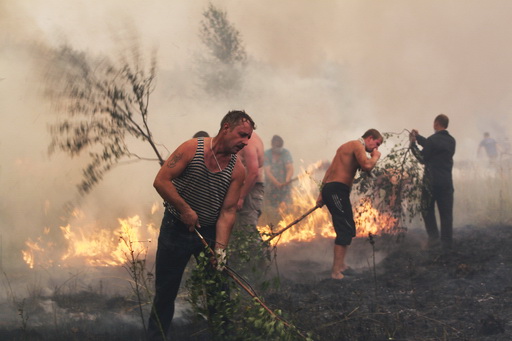
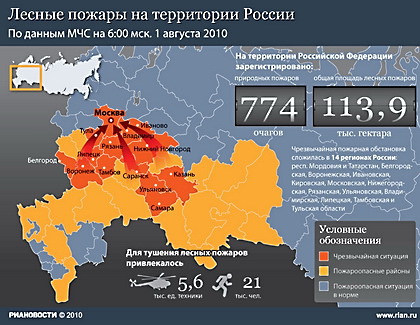
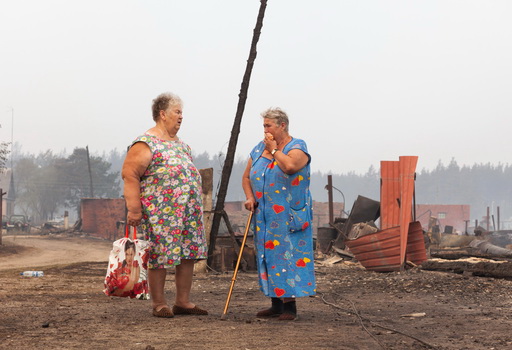
120 thousand hectares of forest are on in Russia in 17 regions. 29 people died. Basically, civilians who burned down with their houses in the villages.
Compare the victims of forest fires in Russia and in Western countries. Germany, August 1975. Due to large-scale forest fires, 5 firefighters died. In 2000, fires were blazing in Europe everywhere: in Southern France, behind the Pyrenees in Spain, on Corsica, in Italy. There are no victims. In Spain, in July 2005, 11 firefighters died. California, October 2007. 11 dead, 85 injured, of which 61 people are firefighters.
In other words: in developed countries in fire, mainly firefighters die. The losses of insurers can be calculated in billions, but the death of the civilian population because they did not manage to take it out - this is almost never there.
The statistics of American fires are even more interesting.
1825, New Bransvik-160 people died. 1871 Wisconsin, over 1700 people died. 1881, Michigan, more than 200 people died. 1894, Minnesota, 418 people died. 1910, a fire in Aidaho, Montana and Washington killed 86 people.
But statistics at the end of the 20th century:
1949, Montana - 19 firefighters died. 1951, California - 15 firefighters died. 1994, Colorado - there were 14 firefighters. 2001, Washington - 4 firefighters died. 2002, Colorado - 9 firefighters died. 2003, California is the statistics of fires in the United States, a poorly populated country with many arid zones, in the 19th and early 20th centuries., The largest fire in the history of the state, 3,640 houses, 120 thousand people were destroyed. Evacuated, 24 dead, 2 billion dollars. losses. 2006, California - 5 firefighters died.
That is, what do we see? The days passed when large fires in London or Edo took thousands of lives. Now in civilized countries, civilian people almost do not die in fires. Firefighters die. We have a reverse trend: when analyzing the rubble of burned houses in the Nizhny Novgorod region, two corpses were found in Semilovo, two in Barkovka, five in the upper Verese. In the village of Mokhovoy, the Lukhovitsky district, during the analysis of the rubble, the bodies of the six dead were discovered, in the same place, when trying to cope with the fire, a fireman died. “Total 28”, they inform us, a day later clarify that two more corpses were found in Vernier Vernier, and one person from Mokhovoy died in the hospital. Thus, the Ministry of Emergencies triumphantly reports, the number of corpses was 30 people, although 28 plus three will be 31.
How many corpses are actually unknown.
So do not die in Europe. So they die somewhere in Zair.
Prime Minister Putin, having arrived at the place of conflagration in a white ironed shirt, promised to severely punish the officials who allowed fires. Who is this official who made fires in 17 regions?
His name is V.V. Putin. It was under him that in 2007 the Forest Code was adopted, which eliminated the system of early struggle against fire in the forests and generally any state responsibility for the state of the forest.
Seliger and the Kremlin believe that the state is strengthened in Russia. Indeed, for billionaires in uniform you will have to soon start a separate Forbes list. But at the same time in Russia there is a total dying of all functions that the state performs in developed countries. From the daily function of providing justice to not so daily function of preventing forest fires.
Well, what is the liberal forest legislation in Canada, but there it is also provided for how and what the state should do with the forest. In the USSR, the state performed such a function: the leshozes monitored the state of the forest and first met focal fires, the foresters could write out a fine for agriculturalproof, the Federal Agency forces had an impressive number of aircraft to extinguish fires and really used them, and did not drop one tank under the television coat, like Shoigu.
In 2007, the leshozes were eliminated, the Federal Agency forces was completely destroyed, 200 thousand people were left without work-sometimes they were the whole dynasties of foresters devoted to the forest and the forest country of Russia, and the function of the protection and protection of the forest was entrusted to the forest code for commercial users.
That is, roughly speaking, the care of the protection of the Khimki forest is now entrusted to the cutters of this forest and the murderers of Mikhail Beketov. This is how to adopt the Criminal Code, which will lay the function of protecting and protecting citizens on criminals.
The Forest Code was pushed by two groups of lobbyists: the owners of the Central Bank (I remind you that one of them is Oleg Deripaska) and the developers of the Rublevo forests. Experts shouted in chorus “blessed”, there were even the most loyal “United Russia” from the forest regions, but the code not only shoved - they drove into the throat of the Duma in three readings with the strongest pressure of the presidential administration. Sobyanin was supervised then. Two years were wet, carried. On the third - pecked.
The matter, of course, is not only in the forest code. Rosleskhoz (which is now subordinate to the Ministry of Agriculture) is headed by a certain Savinov, and for a good reason - he is from St. Petersburg and seems to be familiar to Zubkov. For all these days, Savinov was not visible and heard.
In the village of Verkhnyaya Vereya, where houses burned, there were not even fire engines. Who is responsible for the fire department? The head of the Ministry of Emergencies Shoigu. When Putin baked the Nizhny Novgorod governor for the destroyed village, Shoigu stood nearby and smiled.
When 17 regions flashed, and fires covered 120 thousand hectares, Prime Minister Putin ordered the army to connect to business. From a purely technical point of view, this means that instead of a city fire engine, which is helpless against a forest fire (blue and left for water for three hours), from the nearest rivers, such as the Volga, water conduits will be quickly extended to the glowing forests. But what prevented him from managing this two to three weeks ago?
Answer: Lack of a country management system. (Not to be confused with the country's robbery system.) There was simply no one to make decisions until the premiere made the decision. And the prime minister had more important things: he went on a three-wheeled motorcycle to meet bikers, throwing his hand in a leather glove in a greeting, and sang with ten grief spys expelled from the USA, "where the homeland begins."
There are no natural disasters in the modern world. All disasters are social. The earthquake of magnitude 7.1 in January 2010 in Haiti takes 230 thousand victims, and 500 times a more powerful earthquake in Chile in February 2010 takes away their lives of 700 people. Moreover, this applies to fires - disaster, which instantly does not spread, and, unlike earthquakes, with the drought of the predictable.
In 2008, 200 386 fires occurred in Russia, in which 15,165 people died. During this time, 1,451,000 fires occurred in the United States, in which 3,320 people died. What follows from this statistics? The first is that in Russia 99% of fires are not registered. And the second - which in Russia dies ten times more people per thousand fires than in the United States.
And the social composition of the victims of fires in Russia under Putin became, as in Zimbabwe.