
Translated material
From the cathedral to the cathedral
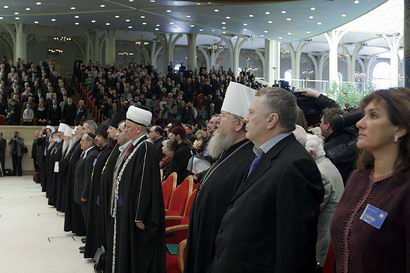
If anyone does not remember, the decision to create a religious and public concept of human rights was made at the last, ninth, World Russian People's Cathedral (VRNS) in March last year. Then, however, the task was formulated in a rather strange way: the document was to “answer the question of whether there are values that are above human rights and freedoms”. The explanations that representatives of the patriarchy gave were usually accompanied by sharp criticism of Russian secular human rights organizations, “upon closer examination” supposedly not at all fighting evil, and either striving to achieve their corporate goals, or fulfilling some “orders”. If you recall those conversations, then one cannot but admit that the Orthodox community has since since then.
The theme of the current
anniversary, cathedralwho finishes his work today, “Vera. Human. Earth. The mission of Russia in the 21st century ”(Supervisor). At the final meeting, the cathedral must adopt a declaration of human rights, but so far no one has seen its text. On the forum, as always, there are representatives of all branches of the authorities of the Russian Federation, political parties and public organizations, the Commissioner for Human Rights in the Russian Federation Vladimir Lukin, military, educational figures, education and culture, the Orthodox clergy and leaders of other religious communities of Russia. Prince Dmitry Shakhovskaya, Count Peter Sheremetyev and several clergy of the ROCZ arrived from the Russian abroad. Claims to the "classical" international concept of human rights remained the same.
Modern “rights” implies that the moral autonomy of a person can be limited only by the autonomy of another person. There is no higher authority that helps to recognize good and evil. It is clear that believers cannot share this point of view. This is partly manifested in their relationship with homosexuality, to the question of the legalization of euthanasia. Meanwhile, the European Parliament
One by oneAccepts
Documentswho call on to fight the norms of traditional morality as "religious prejudices." That is, in fact believers are deprived of the right to freedom of conscience. The Orthodox are not ready to put up with such a state of things: even if for Russia integration with the EU is a matter of a distant future, our country today is part of the pan -European space, at least in the field of law.
“The society becomes anti -human,” said in his
reportMetropolitan of Smolensky and Kaliningrad Cyril, under whose leadership, work is being carried out on a legal document, in which human rights become an instrument of emancipation of instinct, and the concepts of good and evil are mixed and replaced by the idea of moral autonomy and pluralism. Such a society loses the levers of moral impact on the personality. ” It does not push people to good, but, on the contrary, concesses what is revered by believers of direct evil. Of particular fear among the Orthodox is the fact that "in a complex of human rights and freedoms, ideas are gradually integrated that contradict not only Christian, but also traditional moral ideas about a person." In the limit, “the absolutization of the sovereignty of an individual and its rights outside of moral responsibility” can lead to the death of modern civilization.
The second disputed, from the point of view of the Orthodox, the moment of the European model - human rights prevail over the interests of society. “Obviously,” said Metropolitan Cyril, “that this thesis has a positive meaning. But this approach is dangerous when a person begins to build his behavior based on personal egoism. In our opinion, it would be right if these rights were balanced by public solidarity. ” Social-state relations, "on the one hand, would ensure the freedom of the individual, and on the other, they helped her follow moral standards."
Agree, a big difference in comparison with the initial emphasis on values, "which is higher than human rights and freedoms." “We respect human rights and freedoms,” said the head of the cathedral Patriarch Alexy II. And critics of secular human rights defenders this time was not heard. Moreover, at a sectional meeting on the second day of the cathedral, many speakers spoke about the need for close cooperation with them. “The Bureau of the Council will be in constant contact with human rights organizations,” Metropolitan Cyril assured (although in the report he did not fail to notice that sometimes “a concept of human rights is hidden, untruth, insulting religious and national values,” and confirmed the readiness of VRNS to interact only with human rights organizations sharing the views of the church on human rights). At the meetings, the words that the cathedral should raise the question of responsibility to the people of higher federal officials sounded more than once. The church is ready to support human rights activists in the fight against the cult of violence, with the disappearance of people, to monitor the observance of social and labor rights of citizens. So far, however, only in words, but it is already good that we are talking about real rights of real people, and not just about the “rights of the Orthodox majority”, as was often happened before.
It is impossible not to note another important, in my opinion, changes: when representatives of the Russian Orthodox Church only started talking about human rights problems, their statements were reduced to the categorical “Russia is not suitable for the liberal concept of human rights”. Now the formulations have become much more accurate: European standards are disputed by “believers”, “Orthodox”, and by no means “Russia”. Perhaps this is just a diplomatic trick, but another thing is not excluded: the understanding is gradually coming to the Orthodox that the manner of talking from the whole society, mainly secular, is unproductive and much more honestly and wiserly clearly identifying their own views - leaving behind other civil groups the same right to say.
However, it is with the Orthodox concept of human rights that the Moscow Patriarchate connects the hopes of the “mission of Russia in the 21st century”. And not only the patriarchy. "If we manage to use the potential of the traditional religions of Russia, its ethnic and cultural diversity and develop a generally accurate concept on human rights and personality dignity, this will reveal new prospects for us, will help change and improve the appearance of human civilization," says Patriarch Alexy. “We decided to take the subject of human rights to be discussed at the cathedral in order to correct the flaws of a modern world order and avoid the conflict of civilizations,” the deputy chairman of the department of external church relations of prototype will manage to him. Vsevolod Chaplin. "Russia should again play a decisive role in building an architecture of international relations. This, including the role and spiritual, consisting in building a balance of forces and interests and ideas of tolerance in the international arena" is already Minister of Foreign Affairs Sergey Lavrov. After all, the modern world order is cracking at the seams: an attempt to plant democracy of the Western model in Iraq and Afghanistan actually failed.
According to the deputy head of the Department of Interethnic Relations of the Ministry of Regional Development of Alexander Zhuravsky, in September in Nizhny Novgorod, a conference should be held with the participation of representatives of the Council of Europe, which will be announced a document that declares the value of a religious tradition. The outcome of the discussion will be decisive for the whole world, according to the Russian Orthodox Church. “Religious people should realize their responsibility and enter into a dialogue with the secular world, and if he is not ready for dialogue, to defend their position,” said the representative of the Russian Orthodox Church under European international organizations, the Bishop of the Vienna and Austrian Ilarion.
What are the chances of Russia to teach the world of "multi -culturalness"? So far, alas, nothing indicates that they are great. The cathedral said a lot about the centuries-old Russian traditions of peaceful coexistence with Muslims, however, representatives of the Council of Muftis of Russia were not present at the forum (there were only their rivals “Tajuddinists” from Tsuchu)-which is unlikely to indicate cloudless relations with the Orthodox, gathered to bear the knowledge of the laws of “good neighborly”.
Among the “threats”, abortions, homosexuality and euthanasia were most often called our society. And if abortions can still be perceived as a real threat, at least for demographic growth, then the last two “illnesses” are not perceived in any way as priority, which should be placed. In our hospitals, without any euthanasia, people are sealed with dozens - from only a disregard. But the problems of xenophobia and nationalism at the cathedral were extremely reluctant, and every time they emphasized that they are nothing more than a flip side of attempts to discredit our spiritual values, a reaction to ugly exhibitions such as “Caution, Religion!” and a neglect of national shrines. (Skinheads, probably, all free time from stabbing spend time at exhibitions.)
There was a bewilderment: why does the produced “responsibility of religious people” rush primarily outside, to ennoble world civilization, and within the country their moral feeling clearly stalls and prefers to look for substitutions? Perhaps again the whole thing is in the eternal non -independence of the Russian Church? If in the international arena its confidence feeds on the support of the state, then in his Fatherland, and even with such a dangerous business as human rights, and look, you will incorporate the dissatisfaction of the authorities. The Patriarchate, even from the Institute of Regimental Priests, seems to be ready to refuse. In any case, on the briefing of the briefing on the first day of the Council, the Patriarch stated that, firstly, “the question was not initiated by us”, and secondly, there are not enough priests, and “we just got out of this crisis”. Anyway: "We cannot take on the functions of army police officers, we will not grab the hand of those who are engaged in hazing." Of course, the priest cannot be in the army and “not to see” hazing, and if he sees it, he cannot remain indifferent, and if he does not remain indifferent, he will certainly enter into conflict with the army authorities. The precious symphony cried then.
This is not to say that the patriarchy authorities did not understand this weakness. “What will be the message of Russia in the 21st century will largely depend on what life will be in Russia itself,” said Metropolitan Cyril. “You need to expose your future way to a deep understanding, and most importantly, spiritually updated,” Patriarch Alexy II emphasized. Oh, this is not easy, spiritual update, for believers, for unbelievers.