
Translated material
Duma of power
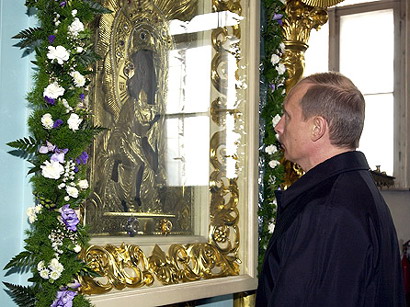
There is no doubt that the main event of the past week was to be the fifth anniversary of the stay of Vladimir Vladimirovich Putin on the captain’s bridge of the Russian state. The schedule of the presidential week was made in such a way as to brighter the role of the head of state. First, a visit to Kostroma to the Ipatiev Monastery - to demonstrate the continuity of the current Russian government, its connection with the historical tradition. Then a strict, but fair head of state accepts pacified, crushed oligarchs and explains the conditions under what conditions they will be able to continue their business. Finally, a visit to Armenia, to the only country of Transcaucasia, which gratitude accepts the Russian military presence. A visit that was supposed to show that, despite the evil machinations of Washington and NATO, Moscow managed to preserve some of its allies. And there the revival of the Great Empire is not far off.
Everything ruined the rebellion (or revolution) in Kyrgyzstan.
The fleeting revolution
After the events in Tbilisi and Kyiv, what happened in Bishkek should not be surprised. First, elections, the results of which are more than doubtful. Then mass protests, followed by formidable statements by the authorities that they will not allow violations of the law. However, when it comes to a power confrontation, the authorities recede, forgetting about all its threats. And then he simply falls apart, freeing up the opposition.
If you leave aside, then the regrettable circumstance that the political opposition failed to keep their supporters from the pogroms in Bishkek (which can be explained by the terrible poverty reigning in the country), then the main thing in the Kyrgyz events is their fleeting. It took several hours that there was no trace of the regime that seemed so strong. But just two days ago, the newly -appointed head of the Ministry of Internal Affairs threatened to use weapons against the demonstrators, and President Akayev contemptuously abandoned the mediation proposed by the head of Georgia Mikhail Saakashvili.
The speed with which the regimes are decaying, wearing all signs of stability, is very annoying Vladimir Vladimirovich. It is not for nothing that he stubbornly repeats that "strength funds are unacceptable for solving power issues." However, until recently, Putin seemed to be able to create a completely invulnerable social system. The court political scientists call it “controlled democracy”, and honest researchers - “imitation democracy”. Its essence is that the appearance of a democratic structure remains, its main attributes are elections, an independent judicial system that do not belong to the state of the media. At the same time, “simulation democracy” is arranged so that these institutions do not play their role: the elections do not ensure the participation of the people in the formation of the country's political course and the formation of authorities, the judicial system does not provide justice. At the same time, to preserve the regime, there is no need to resort to serious repression. Sufficiently tough control over television, falsification of elections and “point” judicial persecution of large opposition to fabricated accusations.
Putin as one of the creators of this system was something to be proud of. It has many obvious advantages. The authorities can reproduce the most arbitrarily long time, the malicious guardians of democratic values do not find sufficient reasons to prove the violation of these values, and the West is ready to be satisfied with the fact that it deals with a specific, but still democracy. The system revealed only one minus - it turned out to be extremely weak and unstable.
Many see the reason for the change of power in Georgia, Ukraine and Kyrgyzstan in the humanity and civilization of Shevardnadze, Kuchma and Akayev. Those, they say, were not capable of cruelty, could not give an order to use force. This is only partly true. It is impossible to go to mass repressions right away. At least you need to have police forces, ready to shoot at fellow citizens. This skill does not appear by itself, it should be brought up. It is necessary to beat the heads of special services, gradually give them more and more vile instructions, selecting the most retreating and unscrupulous. What are the Belarusian Old Man and Turkmenbashi consistently. But the consequence of such a reign is complete international isolation. It excludes visits abroad, the ability to have accounts in foreign banks. Children of dictators cannot study at Harvard, and wife can make purchases at Herrods.
New public contract
Of course, Putin has the opportunity to try to wrap the nuts, to deal with any opposition. But he is too cherished by communication with Bush, Schreder, Berlusconi. In addition, mediocre and selfish security forces, thank God, are unlikely to ensure the real tightening of the regime. And the president begins to maneuver, look for allies. Gathering with business representatives are more than indicative. The harsh tone of past meetings is forgotten. Not only is the president, as they say, he himself raised the topic of Yukos, previously considered forbidden, and assured those who were present that we were talking about a single case, which would not become a system. Putin suggested that the period when privatization transactions may be challenged from ten to three years. In fact, he promised to finally fix the huge wealth behind these people. But until recently, he considered the oligarchs as thieving managers, to whom the authorities entrusted wealth for a while. There is an attempt to conclude a kind of new public contract. True, the contract is a specific, more resembling a feudal agreement, when industrial barons promise loyalty to the overlord in exchange for the consolidation of land and estates for them. All would be nothing, only such agreements based on the will of the king and the honor of vassals were not strong in the Middle Ages. What can we say about the times of the current. The oligarchs will never forget and will not forgive the fear that they experienced after the arrest of Khodorkovsky. And knowing the ease with which Russia is treated by laws, they will never be sure that no one else is flattered to their property. At least until the authorities have the one who gave this property in power.
Goodbye, CIS
A visit to Armenia became anything, but not an evidence of the victories of Putin's politics. The Russian president did not hide his disappointment with how the situation is developing in the post -Soviet space. As if forgetting that all the last years of the CIS was proclaimed the most important foreign policy priority, Putin said that the Commonwealth was nothing more than a civilized form of divorce of the former republics of the USSR.
Thus, on the fifth anniversary of the Putin’s reign, it becomes obvious how the shaking of the system he built. And it is impossible to create a new one - the baggage of the past is too heavy.