
Translated material
Sorting molecules
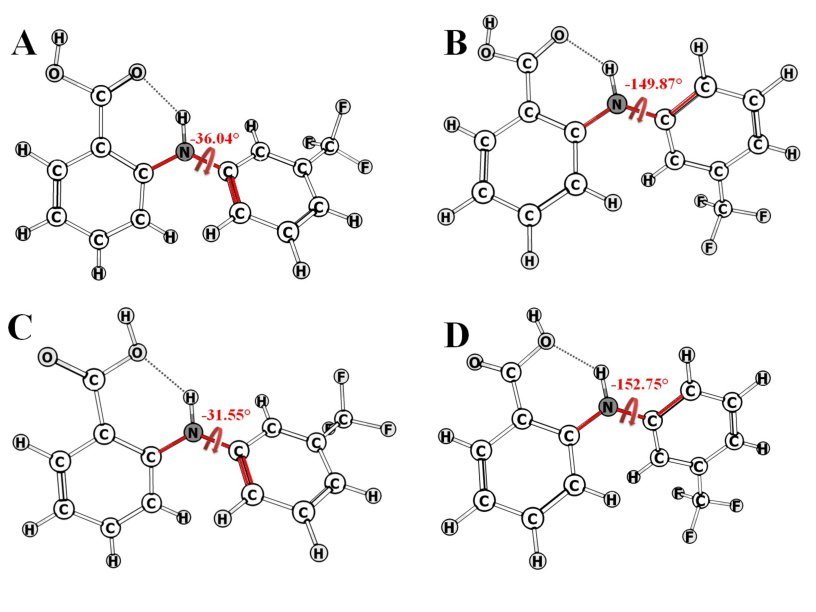
A method is proposed that allows you to quantify the shares of the conformers - the forms of molecules that differ geometrically - in poorly soluble drugs. With its help, scientists determined the prevailing types of packaging of anti -inflammatory flufenamic acid molecules in the solution that underlies the corresponding drugs. To avoid side effects, when creating the drug, its additional chemical treatment is carried out. The approach used by researchers will help control this process, which will allow you to get safe and highly effective drugs. The press service of the Russian Scientific Fund spoke about the work.
Flufenamic acid is a drug that has an anti -inflammatory and antipyretic effect. It is effective for the treatment of arthritis and other diseases accompanied by inflammatory processes. However, in Russia, the use of flufenamic acid is limited, since it has a number of side effects, such as gastrointestinal disorders and impaired renal function. Side effects are associated, including with a low solubility of the drug in water, which leads to an increase in the necessary therapeutic dose. You can increase the solubility and thereby reduce side effects by grinding the drug on micron -size particles (which is about 50 times less than the thickness of the human hair).
As an environment for grinding, supercritical fluids are often used - substances that are a cross between liquid and gas. In such a state, you can bring, for example, ordinary carbon dioxide, for certain temperature and pressure values. It is preferable for grinding drugs, as it is environmentally friendly - natural for the environment - and in the form of a fluid it solves many organic compounds well. Today, such a technology for improving solubility is widely used in pharmaceuticals. For example, it is used in the production of the anti -inflammatory drug Ibuprofen. However, when grinding drugs, it is necessary to carefully monitor the structure of the compounds that make up the formed crystals, since different conformations of molecules can affect the biological activity of the compound.
Scientists from the Institute of Chemistry of Solutions by G. A. Krestov RAS (I., Ivanovo) proposed a new approach for determining the packaging of flufenamic acid molecules in a solution of supercritical fluid. It is known that the connection has at least eight different types of crystalline forms, only part of which has improved properties, and therefore is most effective as drugs.
First, the researchers dissolved flufenamic acid in supercritical carbon dioxide at a pressure ninety times higher than atmospheric. Then the resulting solution was analyzed using a unique approach based on spectroscopy of nuclear magnetic resonance. This method allows you to effectively determine the chemical and spatial structure of the studied substance by its behavior in a high -frequency magnetic field. In addition, in order to understand how the fluid environment and the physical parameters of the system affect the structure of the molecules, the authors conducted a similar experiment with a solution of flufenamic acid in organic solvent at atmospheric pressure and room temperature.
This approach allowed the authors to determine that in the environment of supercritical fluid there are mainly only one of the two probable groups of flufenamic acider, whose share was 83 %. At the same time, in the organic solvent, both groups of the fire were almost equally equivalent (51 % and 49 %). Thus, this approach helped to register and quantitatively determine how the prevailing packaging of flufenamic acid molecules changes when carbon dioxide is placed in a solution.
“Our approach will help determine the conformation of various molecules in solutions and fluids, which will allow the likely packaging of molecules in the crystal and, as a result, chemical properties and a possible effect on the human body, even before grinding the drug. In the future, we plan to continue the research of other biologically active formations in order to find effective ways to modernize them, ”says the project manager, supported by Grant RNF, Ilya Hodov, Doctor of Physical and Mathematical Sciences, senior researcher at the Ni RAS.
The results of the study supported by the grant of the Russian Scientific Fund are published in the magazine Materials.