
Translated material
House of Culture
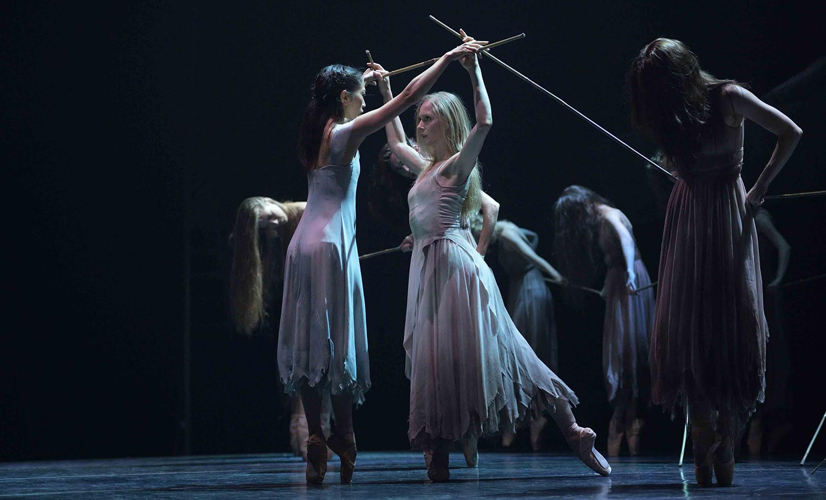
The choreographer Akram Khan announced the completion of a dance career and performed in Moscow at the Territory festival with the play “Xenos” . Two weeks earlier, at the Chekhov festival, the Giselle ballet was shown in the new production of the khan, which caused a unanimous delight of the metropolitan public - in the near future it can be seen online and on the film screen . About the play and his receptions in Russia - Sofya Dymova.
Giselle, staged in 2016 for English National Ballet and six times performed in Moscow, caused an abnormal agitation of the public. The pathos of the audience responses: finally, we have a real ballet of the 21st century, “not on a pet”; The classic ballet has long turned into a school obligation, where the libretto (it is also the content) is required only to demonstrate virtuosity; From the original, all the superfluous is removed, and even the music of Adan became unusually rich. And in general - unlike “ordinary” ballets, the khan has every number injures directly into the soul.
The simple mechanism worked: the performance is called “Giselle”, that is, refers to the myth of the great classic ballet-that is, to something obscure, lagging behind from the present, occupied by virtuosity only (only the lazy did not slip into his review on Giselle the notorious thirty-two fuets) and telling stupid fairy tales.
By reading the reviews on the Moscow Gazeli, the Khan, the Khan remains that there was no great ballerin from Semenova to Gill, nor the performances of Balanchin, Bezhara and Forsyte, nor the absurd pet with the imperial ballet-there were only an abstract petition, which was engaged in some kind of virtuoso stupidity, and even fuete in "Blue light on Shabolovka." That is, Giselle Khan began to be compared not with a real classic ballet, but with the most common myths about it.
The great ballet classic was taken by the choreographer Contemporary Dance . From this moment, the presumption of a miracle began to work for Akram Khan for Akram Khan. The apologists of the performance , following the choreographer, are warmly discussing horizontal, about the long -awaited abolition of ballet hierarchies and subordination of genres. But the opposition of the “modern” and “ballet” speaks of the hierarchy of the audience consciousness, thinking about art in the categories of subordination and progress.
Is it to be a progress that the libretto of 1841 rewrites the route Little on the covenants of the vulgar sociologism: a stopped weaving factory, an immigrant ghetto, outcasts against the nobility ( SIC ) , Giselle is pregnant, weavers after starvation turn into Amazons with bamboo rods in the teeth?
Is Remix Vincenzo Lamani to consider progress, who took only the initial fragments of the top and cadances from the original score of Giseli Adolf Adan? Patterns of three or four notes are endlessly repeated, moisture is connected, clusters of copper and rhythm-section chatter; The form is built as an endless bapto and at the time of climax is certainly breaking off. In this mode of new sentimentality, the flirty condensation of the “high” and “publicly accessible”, all the most popular postmusimal composers-the heirs of Max Richter and his “The Seasons” according to Vivaldi. In this form, only a few people in the hall can identify the initial music, and instead of Adan’s “Giselle”, it was quite possible to use, say, the Symphony of Ovsyaniko-Kulikovsky.
We are fascinated again with melodrama.
This is the main problem of the new “Giselle”: the authors cannot choose a clear method of working with a great myth, determine the degree of removal from the original source - which was brilliantly done in the famous play “Giselle - Mats EK” . The fundamental antitheses of the romantic ballet (the real - legendary, Christian - pagan, daytime - night, polychrome - monochrome - monochromia, PAS Classique - PAS CARACTè RE ) are eliminated, and the new clear structure is not built - although Akram Khan can structure its performances with almost classical clarity, as evidenced by at least shown in Perm in 2015 "Kaash."
The ensembles of the first act “Giselle” remarkable in terms of dynamics and energy endure an abstract-ascerative field, but in parallel there is a detailed game of views and gestures. Illarion (Jeffrey Sirio) sticks out his chest with a wheel and looks a wolf - which means a jealous and an evil genius. Albrecht (James Strister) looks at Giselle with voluptuousness - Lovelas and Macho. Giselle (Tamara Rojo) “learned life, but retained the purity of the soul,” as the annotation reports.
Ultimately, the intelligible Story , even in the spirit of naive romanticism of the 1840s, does not tell-he only hints at her. The migrant question and the naive desire of the khan “Make Giselle by a modern woman” are not scened in the libretto - this is only flirting with the current agenda. The long respiration of the cordeal ensembles, their fascinating ornamental CressCendi find themselves in the "Giselle" most meaningful.
The appearance of a cartoon nobility in fantasy crinolines and camisoles finally blurred the genre frames. Social drama? No. Theater capricchio in the spirit of Castelculi or Papaioanna? To become the Capricio "Giselle" interferes with its bad literature and lethargy of the stage gesture. "Choreographic masterpiece", how did the audience certify the scene with Willis? To do this, there must be a choreography in Villis.
There is a reason to carefully review the Grand Pas Classique , which Willis dance in the second act of the old Giselle.
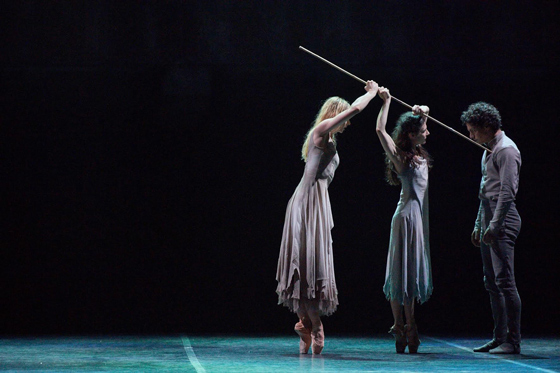
In the scene with ghosts on the legs of the dancers, Poins appeared for the first time, and the audience gullibly took it for the brilliant find of Akram Khan: they say, the pointeas are designed to raise a stage situation over everyday life and reality. Enthusiastic viewers forgot that for this purpose the pointer dance was introduced into choreographic everyday life 190 years ago. The Khan himself, of all the possibilities of pointe shoes, was interested, it seems, only her ability to make a tuk-tuk-stroke on the tablet.
 © Laurent Liotardo
Perhaps, in the romantic legend of Willis, who dance men to death, the legend underlying the old “Giselle” is much more artistic imagination than in a zombie-twy, scoring a victim with bamboo sticks.
We are fascinated again with melodrama. They are touched by how devotedly looked Giselle in the eyes of Albrecht, and was wounded by how cruelly he pushed her away: finally, living feelings appeared in the ballet.
Still, a real ballet-not a counterfeit petip performed by nameless troupes, which were flooded with Moscow on the same days, not surrogates like a close-up and shown on the big screen of the Khan performance-does not operate with categories of living feelings and household sentimentality. Its tools of exposure is rude, but more sophisticated.
In the “obligation” and “school curriculum”, classic ballets turn poor performance or problems with the audience culture.
Probably, the point is not that we forgot about the dance of Gill or the performances of Balanchin. It would be nice to compare the London “Giselle” with the performances of the papaioanna and Castelpucci mentioned by King Saltan Chernyakov and “Lady Macbeth of the Mtsensk district” of Varlikovsky, with “three sisters” or “Medea” Simon Stone (since we are talking about the remarkable films), with which it suits, with which more. Talk about the form and composition, cultural stereoscopy and stage polyphony, irony and pathetics, time and artistic language, thanks to which such compliance is achieved. To compare everything named with Giselle on the grounds that everything named is parts of the general and shiusekund movement of culture.
But the “Giselle” of the khan was compared only with the “Giselle” - on the grounds that this is a ballet.
The classic ballet in Russia reigns the attitude as mentally retarded. He has a tiny cultural ghetto, and we rejoice at his slightest movements, continuing to reason in the inheritance from the Soviet era of the opposition: classic - innovation, decline - progress, plot - plot. With a sense of culture as an integral space in Russia, things are still bad. Or, perhaps, the case of “Giselle” - a case of difficult times and our cultural undemanding comes from the instinctive savings of emotional and moral resources?
Two weeks later, Akram Khan entered the Moscow scene himself. The performance “ Xenos ” , like “Giselle”, is imprisoned for cash success, it also sins with longs and pathos on the verge of good taste. This time, the literary lining, associated with the First World War and the mass death of Sipaev warriors on its fronts, outgrown and destroyed the plastic of the khan-a naive-in -izer pantomime, high expression of endless circles and sudden falls. The Xenos had purely plastic logic and artistic freedom- the dancer choreographer did not need to drag the myth of the great classics on his shoulders, tell Love Story and try to be modern.
They say that Akram Khan undertook to compose a ballet about Votzeck, Frankenstein and Prometheus.
Subscribe to the COLTA.RU channel in Yandex.Zen to miss nothing