
Translated material
Eternal medalist
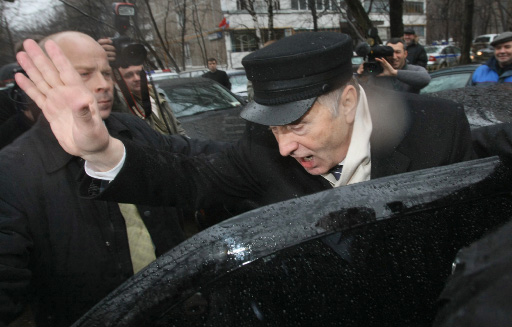 The LDPR party informally has existed since December 1989. But as the Zhirinovsky party, it has become known since March 1990, when, on the eve of the abolition of the 6th article of the Constitution (on the leading role of the CPSU, if anyone does not remember), on March 14, 1990, information appeared in the media about the formation of a new party. Her leader, perhaps for the first time, showed his talent to feel a political conjuncture.
In 1990, I still worked at school, and since the restructuring had already raised the foundations of the Soviet system with might and main, I was allowed to conduct a special course in modern history.
About once a month, I invited to an open dispute to high school students (teachers, sometimes some of the parents came) one of the famous politicians, writers, public figures representing different political views. We were visited by representatives of the Communists, the “Democratic Union” of Valeria Novodvorskaya, anarcho-syndicalists from the then popular “community”, one of the leaders of which was the current State Duma deputy Andrei Isaev, and others.
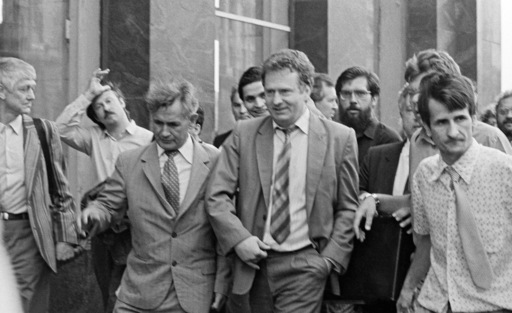
And in March I read in the recently created, but already very popular newspaper Kommersant-Daily, a small note that a new political party was formed in the USSR-liberal democratic (LDPR). Below, the contact phone and the no -saying name of the leader is Vladimir Zhirinovsky.
I'm calling. In my opinion, it turned out to be the home phone of Vladimir Volfovich. So, they say, and so, I explain, I am a teacher, we have a special course, and it would be nice to get acquainted with the ideology of the new party, come. Immediately agreed on a meeting in the next lesson.
Soon, at the Pervomaiskaya metro station, I meet the arrived, as I agreed, “in the first car in the course of the train movement” Zhirinovsky. He was, of course, then alone, dressed in an elegant light with an ebb with a tint of a dacron suit and a white shirt with an ordinary tie. Neatly and tastefully.
While we walked about ten minutes from the metro to school, I introduced him to some rules of the meeting, he asked about the children.
Vladimir Volfovich spoke at the meeting a lot, folding and with humor. At the same time - without any exaltation, without “foam in the corners of the mouth”: balanced and respectable. True, even then a certain pan -Slavism attracted attention. And our guest started a little when he talked about his long-standing trip to still anti-communist Turkey, where he had troubles: the local authorities seemed to take the Pushkin icon on his jacket for Karl Marx. It was like a bike, and many liked it.
When asked how he relates to the Memory Society, Zhirinovsky answered an angry Philippic against anti -Semitism. When asked which of the parties formed after October 1905 in Russia, he would have unexpectedly identified the LDPR with the “Oktyabrists” (who does not remember, by the party of a large trade and industrial bourgeoisie created not without the help of power after the tsarist manifesto of October 17 on the creation of the State Duma).
At the end of the meeting, as usual all invited, Vladimir Volfovich signed in the “Guest Book”. Wide, sweeping, large handwriting wrote: “Greetings modern youth. I am sure that in the future you will make the right choice. Chairman of the Liberal Democratic Party of the Soviet Union Vladimir Zhirinovsky. ”
Young people had to make a choice in the present: following the results of our meetings with guests, I conducted a kind of survey during the year - who liked it more. In the first place was the writer Alexander Kabakov, who had just gained fame after the story “Star,” the second uncle, a member of the “Memorial” Valentin Bulgakov, in the third - Vladimir Zhirinovsky.
He occupied, as I understood, only later, familiar to himself, an honorable prize.
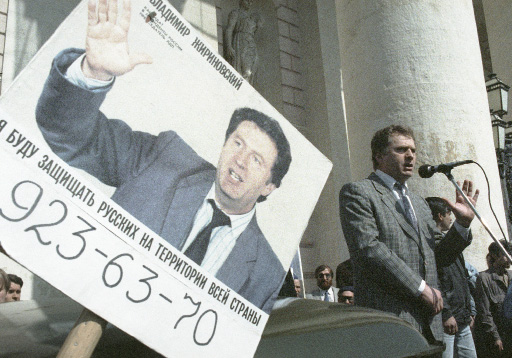
And for twenty years it has been entering all the short lists of modern Russian politics. And this despite the fact that before each election of Zhirinovsky and his party, this “theater of one actor”, predict a crushing failure. And every time she gains millions of votes. And this is already reciprocity.
Some believe that the love of the people for buffoon affects. Others perceive Zhirinovsky's voices as a protest vote, by the type of "spite everyone." The third - that moderate nationalists and socially unprotected layers of society vote for him.
One way or another, he is still afloat, the name of his party, which, by and large, has no relation to liberalism or democracy, has long been a brand. And he still knows how to like it. Because it is easy, with a sense of humor, stands out with its atypical expression and a special style, protrudes without a piece of paper and on any topic.
The phenomenon of Zhirinovsky is the phenomenon of any talented, cynical populist that always has its own audience - naive, dense and cheerful. Until then, at least while such a clowning is in demand by power.