
Translated material
The proximity of fire
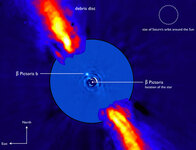
Photo of exoplanets at Beta painter (light speck to the left and above the center). Photo by ESO/A.-M. Lagrange et al. From the site ESO
The French astronomers, led by Ann -Marie Lagrange from the Grenoble Observatory ( Observatoire de Grenoble ), managed to get an image of exoplanets located closer to their parental star than any other planet in other similar images. We are talking about an already well -studied star - Beta painter (the second most bright in the constellation of the painter), which is from us at a distance of about 63 light years. It should be noted, however, that there are so few real pictures of the exoplanets (about five) and, moreover, the newly discounted object is more correct to call the candidate in the planets, since it remains to confirm that this is not a brown dwarf (a star-star) and not a background star. The latter, however, is almost excluded, since the probability that an extraneous object will be so close (projected to orbit corresponding to the orbit of our Saturn, 8 A.E.), extremely small.
The fact that this young star (its age is approximately 12 million years) has a massive planet, astronomers have been suspected for a long time. Since then, they managed to register the presence of an extensive protoplanetary disk consisting of dust and fragments that appear as a result of clashes of planetary "embryos".
New evidence of the presence of such a planet appeared in 2006, when it became known about the existence of a painter of a painter of a smaller dug disk, the plane of which has a small slope in relation to the plane of the main disk. The appearance of such a disk is easiest to explain with cosmic cataclysm. The once formed planet weighing from one to twenty Jupiter masses could be thrown out of the main disk during gravitational interactions with other celestial bodies.
The French astronomers may now find the desired planet. The discovery was made during a re -analysis of infrared pictures of the surroundings of a star made back in 2003 by a very large telescope (Very Large Telescope) of the Southern European Observatory ( ESO ) in Chile. To obtain them, an adaptive optics system was involved, which includes a mirror of a variable form, which compensates for the distortions arising due to the turbulence of the earth's atmosphere. According to estimates, the mass of the newly open planet should be about 8 Jupiterian masses.
On the illustration at the top:
Photo of exoplanets at Beta painter (light speck to the left and above the center). Photo by ESO/A.-M. Lagrange et al. From the site ESO
Links:
Beta Pictoris Planet Finally Imged? - ESO - Science Release
Planet Imged Closer to Star than Ever Before? - Newscientist
A PROBABLE GIANT PLANET IMAGED in the β Pictoris Disk VLT/NACO Deep L -Band Imaging - PDF
For the first time, scientists from the surface of the Earth saw an exoplanet - infox.ru