
Translated material
Ukraine after Yanukovych through the eyes of a historian
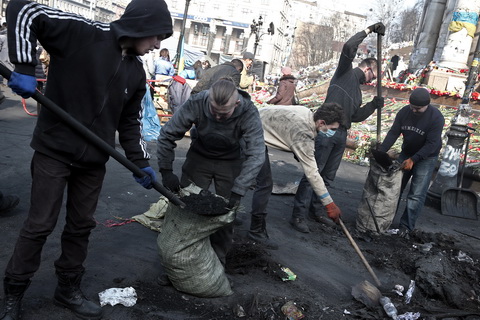
It is more difficult for a professional historian to determine what is happening today in Ukraine, since its categorical apparatus is different than that of political scientists or sociologists. On the other hand, without history, one cannot understand the modern Ukrainian phenomenon, which was spoke about with anxiety and hope in the world. At least, the interest of the world community in Ukraine today is the same as in 1991 and 2004, if not more. Of course, the dynamics of events is currently such that any assessments and even more forecasts are obsolete for several hours, not to mention the days. Perhaps these lines are obsolete in the process of writing them. Nevertheless, it is worth at least trying to connect the current with the past, to determine the guidelines for the near future in order to understand where we are and what is happening to us.
What we see today in Ukraine is the continuing dismantling of the Soviet system that has developed back in the time of Brezhnev. It was then that the main part of the current Ukrainian political, bureaucratic and business elite came from there. The former now and, fortunately, the whole and unharmed head of the Verkhovna Rada of Ukraine; Head of the Party of Regions faction; “Strong business executives” are the leaders of large industrial monopolists in the East, whose products, as it turned out, does not meet European standards; Komsomol business cords and communist agitators ... Their political rhetoric contains a traditional set of Soviet symbols-from “care for people” and “friendship of fraternal peoples” to “combating fascism” and “decaying West” ... Their political culture is based on demagogy, populism, double law and double morality. What is new here, what is modern?
The decomposition of Soviet institutions and collective values, which became obvious already in the time of Brezhnev, which for many Soviet people today remain a symbol of the "Golden Age", dragged on in time and acquired various modifications in the space of the former USSR. In Belarus, the decomposition of the Soviet system of values was suspended and temporarily mothballed by authoritarian methods; For this, a charismatic leader was needed. In Russia, development went in the direction of synthesis of traditional, Orthodox-imperial nationalism and technical modernization; For this, a charismatic, authoritarian leader was also found. In some Asian republics we observe regression and de-modernization. In the Baltic states - on the contrary ...
In Ukraine, the provincial, Soviet-party and economic elite began to rapidly merge with crime, the culmination of which was the election of people with a frankly criminal past. In this case, apparently, authoritarianism turned out to be without any charisma: each subsequent Ukrainian president looks worse than his predecessor from the point of view of professional political, and personal culture and ethics. The fact that Yanukovych's regime was based on criminalized elements and corrupt structures in a rotten state apparatus is logical. Lumpen, under the name “Titus”, making a living with dirty work against political opponents and competitors in business, has long become an element of maintaining the decomposed Soviet system. Is it necessary to remind that he always remained “socially close” in the Soviet system of values? Another cornerstone is based on the regime that has developed over the past 20 years, we can safely consider the remains of the “unified historical community of people - the Soviet people”, primarily the so -called “state employees”. Among them are all kinds of secular and churching officials, full -time and voluntary propagandists from among teachers and journalists. Today, the authorities are chasing all kinds of rallies and the meetings holds in eternal fear to lose a miserable salary or pension. Their awkward proximity with crime sometimes leads to tragicomic episodes: “Topaz, give a team, top-a-a-z ...!”,-this ended the dialogue of a pro-government propagandist with the leader of the “title” in the Mariinsky Park of Kyiv. As a result, the journalist received the head, but the topaz did not give the team ...
Advisor -CADEMIA, formed by immigrants “from the people”, has not yet received such a lesson. She continues to degrade morally and professionally along with the rest of the segments of the decaying system. Intellectuals, educated people in Ukraine voluntarily choose lumpen from the criminal environment. Service letter of the Kharkov rectors in support of the Yanukovych regime and his representatives in Kharkov in 2010. - Typically Soviet. The endowment of corrupt officials and nouveau riche with scientific degrees and titles, corruption in universities, imitation of scientific activity and corporate culture - there is nothing new in all this.
The political and sociocultural phenomenon of the Ukrainian Maidan has yet to be studied, but its reasons can now be expressed in one word: "Got it!" Human nature basically still contains a conscience that sometimes attends even frank villains and inveterate cynics and makes them weaker from the inside. From time to time, it makes itself felt at the sight of frank injustice or causing impunity, pushing people on desperate acts. The ethnication of current events in Ukraine, which has yet to find its definition, was not Vilnius, but Genevka, the district center in the Nikolaev region, in which ordinary people spontaneously rose against the "lawlessness" - the atrocities of bandits in mileyan uniforms - in July 2013. Nevertheless, the question arises: what next?
The fact that Yanukovych remains in Ukraine, his associates and the values that they embody is deeply symbolic. None of them arrived here in sealed wagons. The former president composed of himself and despised by all is just a product of the corresponding sociocultural environment. What to do with her? Send it from the country? Declare alien? Amputate, one after another, eastern and southern regions? Why, then it will be necessary to do the same with the northern and western ... What will remain in the end - the agrarian and provincial Bavaria within the historical region? And most importantly - who to entrust today the delicate mission of wrestlers with evil? Who else without sin?
The Soviet system of values continues to mutate in the direction of Russian Orthodox-imperial nationalism. It's time to call a spade a spade. The ideological doctrine of modern Russian statehood is the Orthodox-immersic nationalism of the time of Alexandrai, his program of limited modernization, the revival of the Moscow autocracy, xenophobia, anti-Semitism and hatred of intellectualism. Under the leadership of President Putin, Russia returns to its ideological origins - official Orthodoxy and autocracy, plus the technical modernization of the country. In search of itself, Russia turned to history and became its hostage. This is not the first time ...
Russia in the near future will remain an overall political opponent of Ukraine as an independent state. First of all, because she still needs Ukraine more than anyone else. And we are talking not only and not so much about the economy, but also about Russian identity. Already too deeply the Ukrainian component in his Little Russian guise has been mounted-since Gogol-into the foundation of Russian Orthodox-Slavic nationalism. Zbignnev Brzezinsky is right - without Ukraine, Russia cannot remain the same. The Ukrainian idea is a deep crack in the foundation of Russian Orthodox nationalism. It is unlikely that a new building will be able to build a new building on this foundation.
The idea of Ukrainian identity, separate from the Russian, will not be perceived by Russia until the idea of the Russian identity formed in the second half of the 19th century and survived under the cover of Marxist-Leninist rhetorics changes. Theoretically, this is possible, since in Russia, despite the dope of nationalism, a different cultural tradition, based on European values: liberalism, tolerance, and the culture of dialogue and modernization, continues. Unfortunately, the votes of its representatives have almost been heard in recent years.
Ukraine will be able to use this intellectual potential in the interests of the struggle "for our and your freedom." There is only one condition for this: reorientation of Ukrainian state policy of identity from the past to the future. As a historian, I urge: enough story! Enough illusions about our “millennial statehood” and “original belonging to Europe”. Today's Ukraine, like Russia, is still a hostage of its past. It is enough to look at the line of political faults that coincide with the conditional boundaries of historically established regions. It is enough to look at the next campaign of the fight against monuments. Is there a war with those windmills? After all, his political followers have long been changing the monuments to Lenin to Stalin’s monuments, simultaneously consecrating them with Kadil and incense. Isn't it time to “leave the dead to bury their dead”?
The idea and politics of Ukrainian identity need “rebooting”. The ethnocultural Ukrainian nation led to state independence. The creation of a monolithic national state on this foundation is hardly possible. Ukraine needs a new idea, to reorient from ethno-cultural symbols to political. It is not about inventing new symbols, proclaiming a second state language and turning a unitary state into a federal, although theoretically this is possible. It is about creating conditions for the formation of the Ukrainian political nation. This requires a “daily referendum” and the search for consensus. This requires a dialogue. I do not see another way in globalization and crisis of the doctrine of traditional national statehood.
The Ukrainian political nation will have to absorb the left social and Russian language-cultural components. Now the dialogue is more important than the result. From this point of view, the hasty abolition of the new government of the law on regional languages is fraught with serious political consequences. Now it doesn’t matter whether this is stupidity or a provocation. Now we need a visible and transparent dialogue for society with the parties of regions and communists, and not a culouur ban on their activities. Unfortunately, to this day, the Ukrainian elite has not developed a culture of dialogue and compromise. Apparently, she was busy with other things ...
The update and gradual de-adveisions of the Party of Regions will help her gain a more modern character, to find new, more adequate leaders who can speak in another language. Or at least just say ... This party can become a party of modern pragmatists-professionals, and not the Soviet partkhoz of the asset. In turn, the dialogue with the Communists should be aimed at the ideological reent of this party towards Ukrainian national communism. The historical heritage of Soviet Ukrainianization of the 20s and 60s of the 20th century is created by an ideological counterweight to the doctrine of Russian Orthodox nationalism. Orientation to social, not national categories can make the current communists political allies of left -wing programs and parties for the counterweight to corrupt and cynical oligarchs who plundered the country.
The Russian language as a symbol of identity is usurped today by Russian nationalists, Orthodox-Slavic fanatics and odious politicians. Ukraine needs a special program for the identity policy in Russian. In the end, how many native speakers of English, French or Chinese in the world with various national identities? How many ethnic Russians in the world who are political members - American, Canadian, French - nations? Russian -speaking Ukrainians living in industrial megacities oriented on the European path of development and European values are not weakness, but the power of Ukraine. They need to give a clear signal that they are “ours”.
The fatal geography of Ukraine will not disappear. At least until Russia again embarks on the path of westernization, as it was periodically happening during the time of Boris, Peter, Catherine and Alexander. Ukraine remains extremely vulnerable from all sides and its further geopolitical fate largely depends on Russia and Europe. It is possible that a closer acquaintance with Europe will lead to new disappointments. For Ukraine, the Association with the European Union is a symbolic choice of identity and related hopes and illusions. For the West, this is just one of the trade agreements. Regardless of geopolitical choice, Ukraine for a long time will be the periphery. The only question is, whose exactly: Western or Eastern? ...
Ukraine remains for many a little predictable country. This, in turn, indicates the lack of expert knowledge about Ukraine and the need for it - both in Ukraine and in the West. It is quite obvious that the level and nature of academic Ukrainian studios do not meet new intellectual challenges. The traditional arsenal of categories and concepts for determining national identity, its borders, the phenomenon of regionalism, the civilizational approach, the system of collective values and identities - all this, moving to Ukrainian soil, needs to be updated. Ukrainian studios should become more open to interpretations and more influential in the space of modern border, geopolitical, national, European ETS. Studios. But in order for expert knowledge to be in demand by politicians, a new system of mutual relations of the academic environment with the political.
Author - D -Ictor of the Canadian Institute of Ukrainian Studies, Professor of the Department of History and Classics of Albert University, Edmonton
Photo by ITAR-TASS/ Denis Vyshinsky