
Translated material
Three years in the dark
It is said that the leader of the Polish “solidarity” of Lech Valens somehow brought out a wonderful formula for the attitude of authoritarian regimes to the independent press: “Break the thermometer, and you will not have a fever.” Indeed, only two types of behavior are possible in the relations of the authorities and society: the authorities can either listen to the voice of society for effective management of the country, or “break” ...
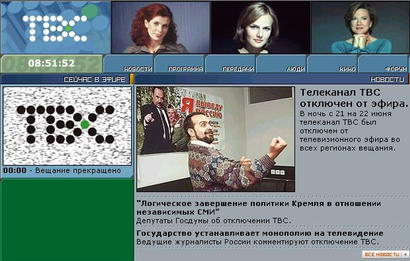
Exactly three years ago, on June 22, 2003, the Ministry of Press of the Russian Federation with a mockery formulation “In the interests of viewers” disconnected the latest nationwide TVS television channel in the country. Perhaps it was on that day that Russia finally lost the right to be called a democratic country. The placed era of the USSR GOSTRODODODRODIO returned to one sixth of the earth's land.
The disconnection of the TVS became the final chord in the three -year struggle of the Kremlin with independent television broadcasting in Russia. The first blow was dealt on the fifth day after the inauguration of Vladimir Putin, when on May 11, 2000, people in black masks with machine guns broke into the premises of the Media-Most holding. Then there was a power capture of the NTV television company on the pre-Passer night on April 14, 2001, while the night shutdown of the TV-6 channel broadcast on January 22, 2002. The TVS was the last and doomed attempt to preserve free television in a non -free country.
In December 2000, the decision of the Czech Parliament to appoint a protege of the ruling party of Irji Khodach to the director of state television brought hundreds of thousands of people to the streets of Prague. In the face of mass protests, power retreated, and journalists continued to work. Free people defended their right to information and their civil dignity.
I well remember the cloudy Moscow morning on June 22, 2003. The indifferent faces of passers -by, everyday conversations in the subway are complete indifference to what is happening.
However, it is unfair to generalize. The history of NTV’s persecution showed that there are tens of thousands of free people in the country - citizens, not subjects - ready to go to the square in defense of their right to information. The signatures under the statement of solidarity with disgraced journalists in April 2001 were put by people whose names are the personification of the cultural and thinking Russia: writers, artists, musicians, scientists ... But the followed events showed that, unlike the Czechs, free people have not yet constituted a “critical mass” of society.
It is not noticed by me: it will not be a worthy life in the country until its citizens are aware of the connection between political freedom and normal human existence. The next proof of this is the “track record” of the Russian government for those three years that it exists in the conditions of an information monopoly. For those three years that Russian society lives in the dark.
Political prisoners reappeared in Russia. Democratic opposition was thrown out of the parliament (the data of Exit-Polls and the parallel vote count in December 2003 showed that the “Yabloko” list overcame a 5 percent barrier, but there was no federal television channel that would tell people about the theft of their votes), and Vladimir Putin himself had already extended his stay in the Kremlin. Before the eyes of the whole world, an expropriation of a successful private company was carried out, which proved the final “basmanization” of Russian justice. The clumsy actions of special services during the tragedy in Beslan led to the death of hundreds of people. In the nominally federal and democratic country, citizens were officially deprived of the right to elect the leaders of their own regions. Electoral rights are limited to the limit - the election blocks are prohibited, the majority districts are canceled, and the passing barrier for parties has been increased. Even civilian and public organizations have practically put under state control. Against the backdrop of hypocritical anxiety about the demographic situation, the most socially sensitive delayed deferrals from the army service were canceled.
How much of this would be able to make power (without the risk of losing not only a reputation, but also its own chairs), if all this time an independent television channel worked in the country, which gave society information, and not propaganda with substantive discussions and alternative opinions?
The current president, like no other, knows the answer to this question.
Independent television in Russia, of course, has a future. Already today through the satellite and on the Internet is broadcasting the TV channel
RTVI, gathering the backbone of the NTV team. On the day when independent information becomes a conscious necessity for most Russian society, when people themselves demand their freedom and will be ready to defend it, the state monopoly on national television will end.
Freedom as air: it is necessary for life. But in order to appreciate the air, you need to want to breathe.
Of all the comments of three years ago, the words of Elena Georgievna Bonner were especially remembered for the closure of the TVS. Their relevance during this time, alas, has not been lost. “Once upon a time in Rus', people who are unwanted to the authorities were eranded, they will break out the tongue. One will fall silent-a dozen of these speeches will not hear. But progress did its job. Now one TVS channel is turned off-a dozen people will shut up, and they will not see millions. So the choice is small: either to blame the progress, or those who turned off the channel. And maybe they still blame those bills that are still to blame the ones that are at the same time Silent? "
The author is the own correspondent of the RTVI television company in Washington, the co-founder of the “Committee-2008: Free choice”.