
Translated material
Voting the country
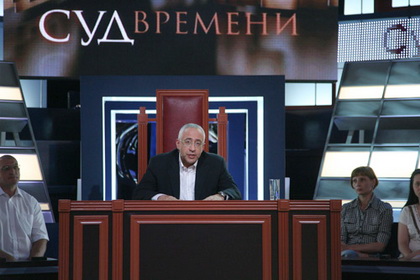
Three months have passed since the release of the transfer “Court of Time” on the fifth channel. After looking at the first issues, I wrote a small critical note . It seemed to me that the format of the show does not provide an opportunity for an objective and thorough conversation, and in such conditions passionate and acting persons with populist views always win, and not intelligent, moderate and knowledgeable.
Nevertheless, I continued to watch the television show. Because with all the costs, the program, gaining momentum, began to look. Although it was still more often more interesting psychologically, less often historically.
Numerous reviews in the blogosphere indicate that many, albeit with a different attitude, but pay attention primarily to the "voting of the country". Some regretfully stating what we are “dense and uncourable”, others triumphing that “no manipulations of Svanidze and Mlechin will deceive our people.”
And this is an amazing constancy with which the television audience the vast majority of the votes invariably gives the Kurginyan position, no matter who he imagines - the prosecutor or defender, - and the same commentary to the “Court of Time”.
Initially, crazy figures of interactive voting of viewers even discouraged. (Although the fact that Kurginyan represents a more massive electorate, I never had doubts.) Then, at least, the realization that the audience of these active viewers was still very small: according to Internet voting, from one to five thousand people. The figure is unlikely to be representative and reflecting, possibly, first of all, the resistance and discipline of fans of rief art Sergey Kurginyan. So the “voting of the country” is not a certain objective phenomenon, but more reminiscent of some kind of focus. They can’t-for all questions-the numbers are hardened, like stone sculptures, as if someone had scared them very much once and for all. It rather resembles some elections in famous republics that give the authorities the votes of their voters “to the mountain”.
But what is really interesting is the vote in the studio. Live. These results are very different from the "all -Russian". What is the reason? It is unlikely that this is a specially selected Moscow audience on which the magic of Kurginyan does not affect. No, something else seems like something else here: in front of these, we will conditionally call them, ordinary people are all adversarial drama-with bills. They are not able to move away from the TV, they see what is happening “from all cameras”, observe a complete range of passions, see and feel a live broadcast, and not a mounting option. And, apparently, for them, as for jury, immersion in the topic contributes to the growth of consciousness. And if we assume that the sociologically correctly selected television audience is to some extent the image of the country in the minimum assembly, which means that not everything is lost, the sheepskin is worth the dressing, and the game - the candle.
In general, over these months, the direction of the program has changed a bit. The host took a more active position, his personal point of view is not limited now by a brief resume at the end of the program, but sounds in the preamble to clarifying issues, as well as in clarifying certificates from the historian Svanidze, it is also felt in the emotionality with which everything is pronounced.
You can, of course, put the arbiter “in appearance” for a certain engaging. But let's not be cunning: there are no impartial characters in such discussions. And now the controversy acquires an increasingly uncompromising character, transforms towards a tough adversarial process, in a sense of an ambition; The “lawyer” and “prosecutor” are trying to catch each other, to use every opportunity to discredit the opponent and take advantage of the situation. Kurginyan set this style, aesthetics, and Mlechin was forced to accept this game almost without rules, otherwise he would have lost in crushing time after time. And therefore, he became more aggressive, angrier, more and more offensive. In some ways it is easier and clearer. And the result was not slow to affect.
The audience in the studio votes for Mlechin and his witnesses. In general, now the famous TV presenter and writer collects more applause, and interest in his favor too. True, I repeat, the initial goal was a little transformed, reduced, and the authors of the program still began to play according to the “Kurginyan rules”, on its territory, where it is more organic. Therefore, in a certain sense, Kurginyan still won. Since it is more about Khrushchev or Gaidar in the “Time Court”, but about the fight of Kurginyan and Mlechin.
This is sad, but such a metamorphosis was laid in the concept of transmission.
The main motto of Sergei Kurginyan is “Fire by headquarters” (the slogan of Mao Zedong, who calls for looking for enemies in the highest offices and laid the foundation for the cultural revolution in 1966). His simple thought, as, indeed, many other supporters of the concept of “real politics”: the elite-clans-group rule the world. Not in the chaos of accidents, not in the maze of laws, but in the bowels of the offices of all kinds of officials and intellectuals, ideas, conspiracies, and intrigues that affect the policy of power, or rather, determine it, are born.
The idea does not leave me that, considering myself to the elite and considering the whole story through the prism of conspiracies and transactions, these people are simply trying to emphasize their own significance. The frankly sarcastic attitude of many of them to the possibility of moral policy is depressing, not to mention what the population accustoms to the idea of the invariability of what was happening: it has always been so, and it will remain like this everywhere. We are not the first and not the last. This is life. This cynical view of the story, which is given out of the pragmatic and wise, corrupts the soul, legimates the law of the jungle, deprives faith in justice and weakens the will to resist.
It is no coincidence that in one of the programs dedicated to the activities of Khrushchev, there was, in my opinion, the indicative moment: the tired Leonid Mlechin suddenly abandoned his right to ask a question to the opposite side. And he argued about this approximately like this : what is the point of asking questions if Stalinists sit on one side, and anti -Stalinists on the other. Some consider Stalin a great criminal, while others consider the great head of the state.
However, it should be noted that the authors and presenters managed to establish a more or less civilized conversation, a discussion, in which these experts usually take part on both sides. Although the dialogue itself still does not work. Yes, it is difficult to achieve in a “ideological” struggle.
... In “Letters on the benefits of studying history”, the English writer and statesman Lord Bolingbrock drew attention to the types of historians, which differ in the degree of harm they do they do. He considered the most harmful those who, by conjunctural processing, creates from a well -known set of facts their or dictated by the authorities of the story, thus turning it into a set of myths, legends and fairy tales. So in modern Russia, attempts to understand our past very often resemble fan showdowns. A fan attitude towards history means not only biases, but, oddly enough, an indescribable look at her. Because fans are worried not so much by himself, for example, football, but the manufacture of banners, the compilation of dwarf speech, screaming and whisting the opponent. So they remind, sometimes, our public discussions are not a clash of historical points of view, but an ordinary fan derby.
The “court of time” nevertheless manages to avoid this, although not completely without a fan pathos.