
Translated material
Realpolitik
There is a firm opinion that cruelty and cynicism in politics are beneficial, simple human neatness is not.
Apparently, there is no general rule, but rumors about the benefits of criminal policy (as I believe, and gang business) are greatly exaggerated.
An example by hearing is the same on September 1, 1939.
What lesson can be extracted from this "Knowledge Day"?
Both Western Europe and the USSR behaved meanly in the 1930s.
True, there is meanness and meanness.
EuropeEurope surrendered to Hitler Czechoslovakia. At the same time, European politicians did not conclude secret transactions and did not capture pieces of foreign territory. Yes, and the Czech Republic went to the idiotic hope of "on the world."
Europe has removed a lesson from this whole story.
The response to the war was the movement towards the united Europe, the creation of the EU, where there are no more war between countries - war, territorial disputes, secret agreements, and the smallest state has (and not even on paper, and sometimes in reality) the same rights as large countries.
 So, a lesson for Europe is a legal policy more profitable than power. It is more profitable - in the humanitarian, social, economic, and therefore in the political sense. Policy in modern Europe is a concentrated humanitarian sociology, because the main priority there is not the volume of GDP, not the volume of production, not the level of consumption, but the quality of life.
This, by the way, manifested itself in such a beloved story in Russia with Serbia. Kosovo Albanians, one must think, did not give bribes to the EU government, not a single EU country has any territorial or economic interests in Kosovo, Kosovo did not become a puppet of any state. The EU and NATO believed that in Yugoslavia - someone else's, distant country - a “humanitarian catastrophe” is taking place and, having no utilitarian goals, intervened as they knew how. And with large overlays, but this disaster was stopped. I do not discuss how reasonable their actions were, maybe it was necessary to act differently - I only talk about their motives. These were not imperialist motives - territorial or other expansion, it was a “humanitarian war”, if you like, “humanitarian aggression”.
We can say that Europe, abandoning real wars and the struggle for living space, lost - will, drive, teeth, “historical testosterone”, will to life. We can say that the promised "sunset of Europe" took place. The end of European history is a historical pension of Europe. Sit, look at the Geneva fountains.
Well - Happy End of the usual story. If you like, the “posthumous paradise”. If not for migrants - what are large social conflicts in Europe, the engine of progress?
The test of guaranteed satiety is a severe exam for a person and civilization.
But I would be worried about burying Europe.
In the end, all this EU paradise is perhaps the most grandiose and so far the most successful project in the history of mankind (maybe the US Project is even more grandiose). The implemented utopia of the universal world.
The end of the story? Or the end of a rude story? And the beginning of another, unimportant to us (and therefore assessed as “boring”) history?
Eurasia
The USSR behaved in 1939 much more than Europe.
Official explanations - they say, “there was no other way out”, it was necessary to avoid “the unification of the West with Hitler against the USSR”, it was necessary to “delay the war” - just a lie.
After in March-April of 1939, England and France gave Poland guarantees against Hitler, it became obvious that there would be no “Western Union with Hitler”.
The USSR had another way out - simply not to conclude any contracts with anyone (if it doesn’t work out with the West - for example, due to the fault and stupidity of the West). Then Hitler would have had a headache - whether to start aggression in Poland in a situation when the West is against, and the USSR remains with untied hands. And even if Germany, risking the war on two fronts, began aggression, she could definitely not attack the USSR. In any case, you can start a war against Russia only in the spring. But before attacking Russia, Hitler had to protect himself in the West, defeat France and England-which happened in May-June 1940. So the spring of 1940 was “busy”. And in the spring of next year, he attacked the USSR. So the pact with Hitler did not disturb the war of Germany against the USSR - Hitler acted in his natural rhythm, and he spat on all these "pieces of paper."
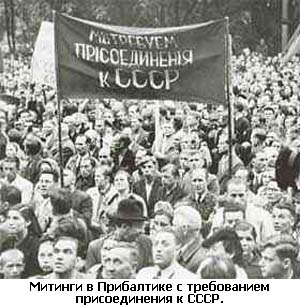
The real motives of the USSR were not that “it was scary to be alone with Hitler,” I repeat that there was no such situation by August 1939. The real motives were different, simple, classic “healthy imperialist” - a secret protocol, capturing foreign territories.
Indeed, in accordance with the secret conspiracy of the USSR, the USSR received (Western Ukraine, Belarus, Baltic states, Moldova) almost without an effort of 300,000 km., 25 million subjects. I received it without a fight, without effort, "for nothing."
 The question is - is it smart, is profitable?
In accordance with the psychology a) Stalin b) the modern Russian political elite c) modern Russian society-this is both smart and profitable, and in general, “correctly-in-all-references”.
“To live with wolves - to howl on the wolf”, “We are not suckers!” These are the main lessons that Russia has learned from this story, which we stubbornly refuse to consider our national shame. And it is true: firstly, “we” (including all the rulers of the power) are always right, “we” cannot have shame and, secondly, in politics it is only possible-cynical calculation and territorial seizures.
Great.
Now let's see the balance of profits and losses.
The benefit consisted-maybe-in June-July 1941, the Germans in different directions needed from a week to a month to “pass” those territories that in 1939-40 received the USSR. Thus, the Germans lingered in moving to Moscow, which probably played an important role.
However, in a million factors of war, it is impossible to clearly assess the meaning of this particular circumstance.
Losses were, first of all, in the fact that the 1939 Pact undoubtedly played the role of the launch mechanism of the Second World War. Again - it is impossible to evaluate the meaning of this particular pact, but, of course, he unleashed Hitler's hands and helped to start a war, which reached the USSR on June 22.
Secondly, these lands were not received bloodless.
In 1941 they shot at the back of the Red Army. In 1944-54, a partisan war was going on there against the USSR-how many died in it (I am talking about the Soviet military) I do not know, but I believe that thousands, if not tens of thousands.
Thirdly, it was the “last gift of Hitler” to the Soviet Union. As it should be in a fairy tale, the evil wizard died a long time ago, but the spoke donated to him in many years pricked it, and the injection was fatal. After all, it was from there-from the Baltic states and Western Ukraine-in 1989-90 the collapse of the USSR began.
Yes, who sits down to dine with the devil, should stock up on a long spoon. 50 years long ...
So was it a profitable deal for the USSR? Or - murderous?
Suspected lesson
Of course, do not generalize.
The imperialist policy is not always unprofitable. But at least, it is far from always beneficial!
And expansion does not always mean increased! Expansion can also lead to extreme weakening - if you need huge forces to hold the captured.
Have we removed, our society, a lesson from September 1?
Or still blindly believe in gross power, we consider the expansion of the lands beneficial, “what is more likely to be weak or stupidity”?
The history of recent years, the creation of controlled modes in Ossetia/Abkhazia, all the rhetoric, causing the unchanging fanly delight of society, the eternal game with muscles (more and more, though the “muscles of the language” ...) proves that we have removed the “lesson” alone.
“He who dared - he ate,” “He has more rights of rights”, “Comrade. The wolf eats everyone and does not listen to anyone. ” "It was so - and it will be so."
Exemplary imperialist psychology of the first half of the twentieth century (and earlier centuries). Quite strange in modern Europe. Yes, and not in Europe, too.
But the very thought that “this is no longer worn” causes indignation and aggression in our society.
Photos of RIA Novosti