
Translated material
We and them
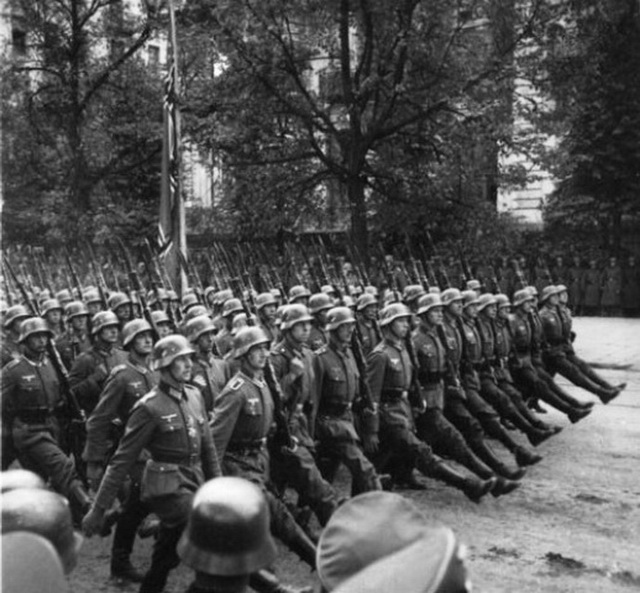 The next anniversary of the Molotov-Ribbentrop Pact again exacerbated the polemic around the events of seventy years ago. In Russia - including from official sources, such as the SVR - words that justify the Stalinist foreign policy are sounded as forced and due to the intrigues of Western democracies, who have sought to direct Hitler's aggression to the east since Munich.
The desire to protect at all costs of the position of your country is quite psychologically understandable if you live in the paradigm "we-on", where "we" are always right. In addition to psychology, there is another reason-for centuries the idea of the immutability of national-state interests, regardless of eras and regimes. The famous French diplomat Jules Cambon wrote seven years after the Versailles world that Philip-August in the battle of Buvina and Joffre defended the same thing-in other words, the geopolitical situation did not change too much during the period from the XIII to the twentieth century.
It would be curious to conduct a small experiment - as objectivistly, to describe a certain international conflict between abstract countries, where the country X acts as unseemly, and find out the opinion of representatives of our elites about its actions. And then to explain that X is Russia (in the form of the USSR or the Russian Empire). It seems that the number of people who defended the initial opinion will significantly decrease - because we are talking about our country, which could not only, but there should have been the most serious reasons to act in this way, and not otherwise. And the task of historians in this case is only to justify such reasons.
The problem is that this point of view is less and less popular in modern Europe. The defending of unconditional interests, recognition of its right side in everything leads to centuries -old conflicts around the disputed territories, be it Alsace or Silesia. The era of national states makes such conflicts even more fierce than during the times of dynastic wars. The Second World War showed that such conflicts are fraught with catastrophic consequences, up to the genocide. To justify your own mistakes and crimes means, at least, the possibility of repetition is not excluded. Therefore, Germany and France agreed to close cooperation, leaving the boundaries alone. Very few modern British and French are ready to protect the Munich capitulary, the shameful surrender of Czechoslovakia. It is not possible to justify the activities of various dictators of the twentieth century. In some new democracies, there were attempts to “create” new heroes from the pronational figures of the past, such as Tiso in Slovakia and Antonescu in Romania, but these projects quickly faded when it became clear that they contradict the European mainstream. However, Russia will not enter the European Union in any foreseeable perspective, so Stalin can be justified, not paying attention to the opinion of Strasbourg or Brussels. By the way, there is reason to believe that if a real European prospect is opened to Ukraine, then part of its elites will have to move their current historical hobbies away - as the Baltic statesmen, now ignoring the marches of Nazi veterans.
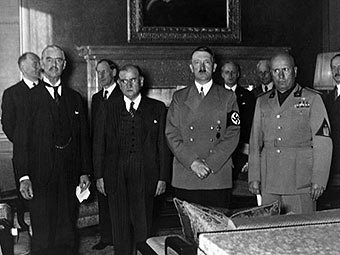
(Signing of the Munich Agreement (from left to right): Neville Chamberlain, Edward Daladier, Adolf Hitler and Benito Mussolini September 30, 1938)
Despite this state of affairs, the importance of honest discussion about the real causes of the Soviet side in dramatic situations like pre -war cannot be overestimated. This is important, first of all, for Russia itself, if she wants to attribute herself to European civilization not only in words. And in order not to turn a dialogue on historical issues with partners into an aggressive conversation of the deaf.
So, what did Stalin achieve in the summer of 1939 from his English and French negotiation partners who preceded the agreement with Hitler? If we carefully analyze the Soviet position during trilateral consultations - both political and the military, who took place in August 1939 - then it becomes clear: Stalin needed territorial growths in the West, which the USSR achieved a little later. The difference was who was the first to agree to authorize his expansion - Chamberlain and Daladier or Hitler. First, the Soviet dictator decided to try to agree with the first, which is understandable. Firstly, they have already shown themselves “wimps” in Munich. Secondly, it was not easy for the Soviet authorities to immediately abandon the course, conducted by the offended by the People's Commissar of Foreign Affairs, Maxim Litvinov and aimed at rapprochement with Western democracies.
To realize his goal, Stalin during a dialogue with England and France harshly insisted on the most vague definition of “indirect aggression”, which was supposed to give him the right to interfere with the affairs of the Baltic countries, Poland and Romania. On July 9, 1939, the Soviet side put forward the following formulation: “The expression“ indirect aggression ”refers to the action to which any of the above states agrees under the threat of power from another power or without such a threat and which entails the use of the territory and forces of a given state against it against it or against one of the contracting parties, therefore, entails the loss of its independence or violation of its independence or its violation Neutrality. " Such a wording created the possibility of intervention in almost any case if Stalin wanted it.
As a confirmation, we give the events of June 1940, when the reason for the capture of the Baltic countries was the functioning of the military union - the Baltic Entente, created long before that and did not show hostile intentions in relation to the eastern neighbor. Interestingly, one of the signs of the "aggressiveness" of this union was the publication of Revue Baltique magazine. Guess what specific actions of neighboring countries could be brought under the concept of “indirect aggression”, it makes no sense - it is important that the prospect itself was quite real.

( Soviet troops in Riga. 1940 )
The list of “above countries” - Belgium, Greece, Turkey, Romania, Poland, Latvia, Estonia, Finland. With six of the eight countries, the USSR at that time had a common border. The absence in the Lithuanian list draws attention, which can be explained simply-Western countries guarantees the integrity of Poland, and with Lithuania Poland had an unresolved territorial dispute due to Vilnius. During military consultations in August 1939-on the eve of the conclusion of the Molotov-Ribbentrop Pact, Soviet representatives sought consent to the British and French authorities to pass the troops through the territory of Poland and Romania in case of aggression. At the same time, it was not clear whether it was a direct or indirect aggression, and if about indirect, then who determines the moment of its beginning. In fact, it was clear to all interested parties that this would depend on the will of Stalin. England and France would not have been able to fight with the USSR in the conditions of a completely spoiled relationship with Germany. The actions of the Soviet side were completely filed in the concept of the use of “meter -propelled contradictions”, which it adhered to since 1922, from the time of the contract in Rapallo.
The French at the last minute (when Stalin had already decided to agree with Hitler), the British refused. Fear of repeating the Munich shame, only in conspiracy with another dictator, was too strong. The British tried to use the last chance - to persuade Hitler to start the war, but at the same time not to “take” Poland, as they did with Czechoslovakia. They could no longer offer anything real to Hitler. It is not surprising that after signing the pact with the USSR, the Nazis rejected this option. After that, the decision on the fate of the neighbors of the USSR became only a matter of time and their ability to defend (Finland was able to achieve its independence).
Chesterton has a story about how Father Brown, during the disclosure of the next crime, tells several reputable people about how the son of a murdered man took revenge on the killer - a dangerous maniac. The priest's interlocutors quickly agreed that the lynching in this case deserves excuses taking into account extreme circumstances. Then Brown explained to them that the murdered maniac is the famous billionaire, one of the pillars of society. And at the attempt of the interlocutors to reconsider his position and condemn the avenger, a quiet priest "screamed abruptly, as if fired from a pistol." He said that there could be no differences: “Choose anything - your rebellious lynching or our boring legitimacy, but for the sake of the Lord Almighty, let it be the same for all lawlessness or one justice for everyone.”
It is very difficult to approach with universal standards to the fate of not only individuals, but also entire countries. There is always a temptation to “play along with your own”, while not forgetting to blame others of double standards. You can continue to act like that, but once you have to stop trying to draw differences between your and other people's mistakes and crimes. At least in order to live not in lies, even if this lie is justified by the highest considerations.
Author-First Vice President of the Center for Political Technology