
Translated material
(not) Hand -cooked Austria
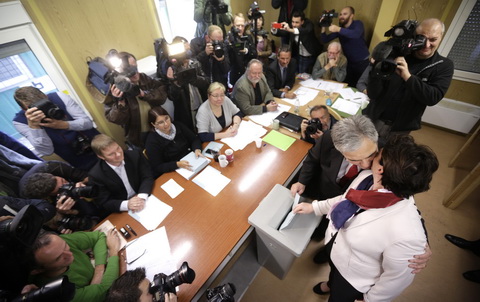
At the beginning of the week in Austria, in the country, which many call the anti -Islamic vanguard of Europe, summed up the results of the parliamentary elections. Despite the next increase (+ 3%) of the ultra-right Party of Freedom, two centrist parties-social-democratic and folk (Analogue of the German CDU) - managed to preserve the majority and form a two -party government. The leader of the Social Democrats Werner Fayman, whom many in Austria consider to be a rather weak politician, as the head of the winning party was nominated for the federal chancellor for a second term. However, not everything is as boring and safe as it seems at first glance.
The election has been the most calm in the last 15 years on resurrection. Throughout the zero, Austria was stormed: several early elections, two terms in the power of the ultra -right, many -month “blockade” from the EU and Israel in 2000, the decay of the freedom batch, growth, falling, and a sharp increase in ultra -right mood. To date, the situation also remains not the most stable. The “large coalition” of the left and conservatives received only a formal majority in the National Council-50.9%-a majority that at any moment may not be read of three to five deputies. Austria is not Germany, where, for example, the “green” for the sake of the current political moment cannot go to the coalition with the Merkel party, because they promised his voter something else, because “the voter will not understand us and then will not vote”. In Austria, this is easier. For example, last fall, when the 81-year-old Canadian billionaire Franc Stronah wanted to engage in politics in his historical Austrian homeland, his chopped party “The Shtronakh team” was in a whipper in parliament without any election procedure. The construction tycoon trumpedly lured five current deputies to its side and formed a faction.
Austria is also interesting for the fact that it was essentially the first Western European country, where the “ultra -right revolution” occurred, and on a completely non -economic basis - on the topic “dominance of foreigners” and illegal migration. From an economic point of view, Austria is quite prosperous and resembles a “little Germany”, so that the voting for the ultra -right ones is quite conscious, not a protest character. It was Austria that was removed “taboo” to unite in a coalition with radical nationalists. This first happened after the 1999 election, and caused a wave of criticism from the countries of the European Union, as well as the first administrative boycott in the history of united Europe. For the first time, the leadership of Europe so pressed on a single state, making it clear that it was not ready to recognize the results of free and democratic elections. The pressure lasted about eight months, after which it came to naught. Today, the ultra -rights are again on the march, the result of the Freedom Party is growing, and the indicators of two large "historical" parties are falling. Throughout the post -war history of Austria, the results of the SDPA and NPA are steadily reduced. Once they had 90% of the vote for two, today they barely restrain the 50 percent bar. We add that the result of Sunday elections was the worst of the history of social democrats (26.86%).
The party system of Austria evolves. Initially, after 1945, there was actually a two -party system. The struggle went between the Socialist Party and the Classical German Conservative Party under the name "People's", as mentioned above, an analogue of the German CDU/CSS. After the defeat of Germany, in the Second World War, the question arose of the inclusion of former Nazis, members of the NSDAP and simply sympathizers, in a new political reality. In Austria, which, as part of the 1943 Moscow Declaration, was recognized as an “occupied country”, with the right to independence and independence,, however, many people involved in the crimes of Nazism remained. About 6.8 million residents accounted for about 1.5 million who served in the Wehrmacht, and about 600 thousand people were members of the Nazi National Socialist Party. Within the framework of the two-party system of the SDPA-NPA, all these people were turned off from the political field, although they made up almost 20% of the potential electorate. Therefore, it is believed that it was for, on the one hand, the sewage system, and on the other hand, to stop Nazi moods by the ruling socialists, the project of the “third party”, a kind of marginal corral, where the former Nazis could go. So the “Union of Independent” appeared, the purpose of which was also to delay the voices of the conservative people's party. In his first elections in 1949, the “Union of Independent” gained 11.7% of the vote and took, as expected, third place. At the same time, no one hid that one of the creators of the party, Karl Hartleb, was a member of the NSDAP. Later, when in 1956 the “Union of Independent” and a number of other small nationalist organizations were transformed into the Austrian Party of Freedom, the former member of the NSDAP Anton Rinintalller also stood at it. The second head of the APS Friedrich Peter generally took part in the executions of “inferior peoples” during the war. And nothing.
At the first two leaders, the “soft version of the National Socialism” was elected by the ideological basis of the Freedom Party. As a result, throughout the 50s, 60s and 70s of the twentieth century, the Freedom Party played the role of a small marginal “third party”, which had about 10 mandates in parliament and sat and packed, while the socialists and the Narodniks shared power. At the same time, supporters of other views begin to come to the party, for example, liberals-riverbits who have no place among conservatives or among socialists. As a result, a rather motley company gathered in the party: supporters of the free market, former Nazis, fans of the thesis “Austria part of Germany” and fans of the thesis “Austria for the Austrians”. All this could end only with a split. At first, in 1967, the most radical nationalists left, forming the National Democratic Party, which quickly disappeared, and in 1993 the liberals-pinters left. They tried to organize their “yellow” party - the liberal forum - a certain analogue of the German free democratic party. The party also disappeared.
Then, in the late 80s-early 90s, everything changed. Austria began to move from actually a two -party system to a three -party. The country joined the EU (1995), opened its markets and plus the streams of migrants from Turkey and the countries of the former Yugoslavia to the Alpine Republic. All this fundamentally changed the agenda. The popularity of the two old parties began to fall, and they already preferred the practice of the "Great Coalition" with each other, which continues to this day. If for neighboring Germany the “big coalition” is essentially out of the ordinary event (which happened only three times, and the third occurs just now, during the negotiations, Merkel and Steinbryuk), then for Austria the practice of “Big Coalition” has become commonplace. Because only the “Big Coalition” mechanism allows us to prevent the ultra-right ones, who gained strength in the 90s, took second place in the elections in 1999 and entered power. This is due not only to the changing agenda of the day, but also to the fact that a strong authoritarian and tough leader, a talented populist Jorg Hyder, who did not hide his Nazi roots, yearned for the Reich and called for all migrants, even legal ones, appeared in the Freedom Party. However, once Hyder paid for this - he was kicked out of the post of governor of one of the Austrian provinces.
Throughout the 90s, Ultra-right, under the leadership of Heider, grew up as the third major party, which, if successful, may well claim real power. The alloy of nationalism, anti -migrant and anti -Muslim rhetoric, Euroskepticism and populism had its fruit. The temptation in a country where about 1.4 million residents of about 1.4 million are foreigners, all sins and problems, from crime to unemployment, write off on visitors. As a result, in the 1999 elections, the Freedom Party receives second place (26.9% of the vote) and makes up the “purple coalition” with the third populists who came. The Chancellor still becomes the representative of the conservatives Wolfgang Schussel, since Hayder himself as a leader in the country, neither Austria nor the European Union would digest. Two years later, the coalition broke up and in the early elections of 2002, the Freedom Party suffers, losing almost 16% of the vote. However, the “purple coalition” with the ANP continues to exist for another 4 years.
A fracture, both in the ultra -right camp and in the entire party life of Austria, was outlined in the middle of the zero. After 6 years in power, the far -right ones split into two parts. In 2005, the Party Party Jorg Haider left the Freedom Party and founded the new party “Alliance for the Future of Austria”. In Austria itself, “small parties” began to breed, which also began to actively enter into political life. In the 2006 elections, the third line is already occupied by the "green", which pushed the ultra -right to fourth place. In the early elections in 2008, two nationalist parties - the Freedom Party and the Alliance for the Future of Austria - again take about 27%for two, thereby occupying a third of the electoral field. It would seem that Austria continues to exist in a three -party scheme, but Sunday elections showed that this is not so. Young Austrian democracy seems to have grown to the German model, when there are two large parties and several middle ones with which you can make a related coalition. The “Big Coalition” model is clearly a thing of the past. The government coalition, concluded this week between the Social Democrats and the Narodniks, most likely the last in the modern history of Austria. The left will now look for the allies in the person of the "green", conservatives in the person of small liberal parties.
The threat of re -passing the ultra -right ones was sleeping today, despite the fact that the result of the Freedom Party grew by 3%. The Second Nationalist Party “Alliance for the Future of Austria” lost 7% and could not overcome the 4 percent passing barrier to parliament. The Freedom Party could not completely return the scattering electorate to both the “Alliance” and its own to its ranks. We can say that Austria was ill with radical nationalism, despite the serious problem of migration. The talented populist Yorg Hyder in 2008 died in a car accident, having a 4-fold excess of a normal dose of alcohol in the blood. He did not find the same talented successors.
Of course, in Austria there will always be a strong middle nationalist party, which, in general, is a normal attribute of healthy democracy, but it will most likely not fall into power. Typically, techniques like accusing migrants in all economic troubles are quite “working”. This does not work in Austria. On the one hand, there are 1.4 million foreigners in the country, Muslims are already about 5% of the country's inhabitants and their number is striking on the streets (we add that the headquarters of OPEC are in Vienna, in which thousands of representatives of the Arab world, who are in the country with families are served), on the other hand, Austria is one of the most prosperous EU countries, its indicators are higher than the average in Europe, and the GDP growth is about 1%, growth of the GDP about 1%, growth of about 1%. The budget deficit is about 3%, unemployment is the lowest in Europe, about 4.4% last year.
The results of the elections held at the end of September showed that voters have a demand for a new variety of left -wing (“green” added 2%) and to liberal parties, albeit with some euroskeptic raid (“Shtronakh team”, 5.74%, and “New Austria”, 4.93%). The Freedom Party, most likely, will also evolve to a more moderate format, because under Hader even far -right parties as the Danish People’s Party, the “Swedish Democrats” or the National Front of France, considered the position and rhetoric of the Freedom Party very strict and unacceptable places. So the story with a very successful ultra -right project of the Freedom Party, which many Russian both moderate and radical nationalists are actively admired, can be considered closed. If Heider’s heirs do not offer another program, except “expel all blacks”, then they are doomed to the next 2-3 election cycles to a 5 percent ghetto.