
Translated material
Corruption - 14. With despair ...
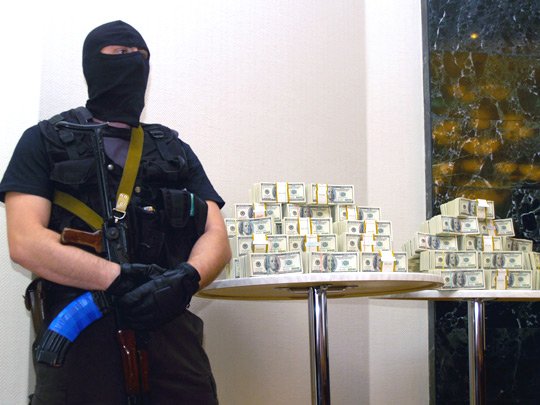
The gloomy picture of the destruction of the economy, drawn by me in the previous article, suffers from incompleteness and the lack of colorful details. For example, I did not touch such a very worthy topic as raiding - illegal tolerance of someone else's business. The absence of details is explained by the limit of the place and time in which this series is sculpted. And then: these details - all kinds of illustrations in the form of specific facts - are available to everyone who wants to open their eyes. My task is different: to help readers understand the reasons and the consequences of the fact that if you wish, you can see yourself. Moreover, the turn has come to discuss the negative consequences of corruption in the social sphere. There are many of them, and in my rather superficial and clearly brief presentation (compared to the scale of the problems), I will not list far from everything.
Following the modern philosopher John Rolza, I will proceed from Maxim: "Justice is the main virtue of social institutions." By translating this into a pragmatic language, you can formulate this way: one of the main functions of the state is a fair distribution of public goods. This is a non -trivial topic, and it is a pity that there is no place to go into details that there is “justice” and that there is a “public good”. What is about, it will be clear from the examples discussed below. To the best of the depths necessary for our series.
Let's start with such an important public good as security. We will consider it only at two levels: military and daily safety of citizens. I will not talk, for example, about terrorist safety. A lot was written about the influence of corruption on it, because we had direct evidence of such an influence, direct and destructive, in cases of the largest terrorist acts.
It was already mentioned above that corruption in the army leads to a lag in modern weapons. This is not only a threat to the integrity of the state. After all, the army with outdated weapons compensates for the lives of soldiers. But the point is not only this. Corruption worsens the conditions of service, the level of military training, leads to grandfathers, ending the flight of soldiers or their suicides. All taken together collapses the prestige of the army and military profession, which entails even greater degradation and corruption in the military sphere. Do I need to continue? We again see the same generator with a positive feedback.
Now let's move on to the second type - everyday security. This issue is resolved in different ways of citizens and entrepreneurs. The latter gave rise to a unique phenomenon in Russia: a hypertrophied market for private security services provided by numerous security companies. If the authorities, carried away by the illegal corruption business, are not able to ensure the safety of legal entrepreneurial activity and property, then the security deficit is replenished in private. Therefore, the business pays twice: first it pays taxes, which contain a police, the prosecutor’s office and other important services, and then pays security companies. But the overstated safety costs are compensated by increasing the cost of goods and services. Therefore, for the fact that the authorities do not fulfill its duties in relation to business and its security, ultimately, we pay - end consumers, ordinary citizens. Again we find ourselves extreme and pay for corruption.
A few years ago, Putin, while still the president, said in one of his messages to the Federal Assembly, as he sentenced: “When a resident of Russia sees a policeman, he moves to the other side of the street.” Of course, there is an element of polemical exaggeration. You can’t get it all with tar. This is also evidenced by the results of our research. But we are judging by the police not by the routine performance by its representatives of their duties, but by the negative information systematically coming to us. And in it - torture, violence, extortion, roofing of prostitution and drug trafficking, constant criminal indifference and unwillingness to deal with our problems. As a result, very often citizens do not turn “to where it is supposed”, but solve their problems themselves.
This is done differently. In cities such as St. Petersburg and Tver, about 60% of respondents try not to go outside without extreme need in the dark. No less meets in such a situation their relatives hurrying home. You won’t believe it, but from seven to eleven percent store weapons, firearms or gas at home (this is two years ago, now the “armament” of the population has grown even more). Approximately the same quantity carry it with them. There are other methods: the establishment of metal doors, code locks, grilles on windows, etc., etc. If there are children at home, these efforts increase.
Our 2006 study showed that the average annual direct costs (in direct monetary terms) for additional efforts to ensure their safety are for citizens of St. Petersburg and Tver, respectively, 2230 and 1770 rubles. These indicators apply to all adults of these cities. Let's try to evaluate whether it is a lot or a little. GDP in 2005 amounted to 26,879.8 billion rubles in market prices. (according to the data from the Site of the GCS). Tax revenues - 35.1% of GDP or 9,434.8 billion rubles. The costs of law enforcement agencies and security agencies amounted to 3.5% of GDP. This means that we send one tenth from the collected taxes to the important function we are considering. This is 943.5 billion rubles. The share of income tax in all taxes is approximately 9.4%. Therefore, we financed the police and the FSB in the amount of 88.7 billion rubles. If we assume that we have about 88.7 million taxpayers (the number of adults is actually more), this means that each of us officially introduces all kinds of (including the struggle with veterinarians and opposition politicians) one thousand rubles. Now compare this thousand with the costs that people from St. Petersburg and Tver carry to compensate for the ineffective work of the authorities. Conclusion: our taxes are in wasted, so we then spend more than we expel in the form of taxes. And these are also the consequences of corruption. Now they are aggravated by a crisis. He accelerates the growth of crime, and the laid out, corrupt law enforcement system cannot cope with this growth and cannot cope. Looked.
I will not repeat the plot that the corrupt traffic inspectorate makes our life more dangerous on the roads. The general conclusion is clear and so: the corrupt authority does not fulfill its basic duties to ensure the security of the country and the state. It makes our life more dangerous and makes us spend our forces and means to replenish inaction or inadequate work of the state.
Another public good for ensuring which the state is responsible is justice. Social thinkers believe that ensuring justice is the most important function of state institutions. And among them the main thing is the court, the basis of statehood, as it does not seem to the ridiculous inhabitants of Russia.
According to the fresh data of the Indem, corruption in the courts is not as great as it seems to be public opinion or is reflected in the media. From the respondents who described their last experience of participating in the trial, almost seventy percent indicated any of the following indirect signs of the corruption behavior of the judge: “The judge was clearly prejudiced against one of the parties,” “there was a feeling that the judge was not completely independent”, “the judge was clear in advance, therefore he was formally led” or “the judge systematically ignored the arguments and petitions of one of sides ". Of course, seventy percent of the staffing of the State Institute is, according to the Hamburg account, there are very few. But the Russian executive branch is far from this indicator.
We draw up an opinion on the judiciary of media reports that “trade” by the fact that it is better “sold” - a negative in relation to sufficiently large and high -profile processes and court decisions, which, as a rule, differ in the presence of an interested party in the person of power. In the total mass, the percentage of such cases is relatively small, but they not only form public opinion, but also entail a lot of negative consequences. Before talking about them, an important clarification.
It is incorrect to reduce judicial corruption only to bribes received by judges from representatives of the parties. Let us recall our determination of corruption behavior from the article of this cycle “Corruption-3”. The following follows from it inevitably. Whenever the judge makes a decision not under the law and the circumstances of the case, neglecting the procedural purity - this is corruption. Whatever it is moved: whether it is a direct bribery, by blackmail, whether the chairman of the court, whether his own fear during his career. In all cases, this is the use of judicial power in their interests, which means the theft of a resource transferred to the judges - the right to make decisions on the fate of people. And this is the betrayal of the principal - citizens from whom he received this power.
Well, now to the negative consequences of corruption in the courts. They are innumerable, because anti -law court decisions are the final or key links of many corruption crimes. For example, crimes became massive when apartments are selected from single elderly people who are not able to protect themselves. Part of many technologies of this robbery are court decisions. The same applies to the raider seizure of someone else's business mentioned by me. The role of judges here is simply invaluable. One of the most famous raider seizures is the case of Yukos. Many inspiring decisions were made by judges in the field that regulates political competition, more precisely, its destruction. The contribution of the judiciary to the destruction of democracy in Russia is simply invaluable. Thus, the courts contribute to different types of corruption, participating in the generation of the negative consequences of these types of corruption.
But corruption in the courts also has its own anti -mission. Perhaps the most important negative, long -term and difficult to overcome the consequence of corruption, which cannot be assessed by any money equivalents, is the loss of faith in justice. Not just in justice as such, but in the fact that justice can be obtained from power institutions. A person, disappointed in the ability to wait for justice from the state, ceases to need this state. The consequences of this are all the more dangerous in such a country as Russia, where most of the population identify the state with the authorities, and society is atomized. What this leads to, we will discuss in the next article when we move on to the political consequences of corruption.
To be continued
Author - President of the Indem Foundation