
Translated material
Sleep after lunch
In society
 Sleep after lunch
June 25, 2013 Nikolai Svanidze
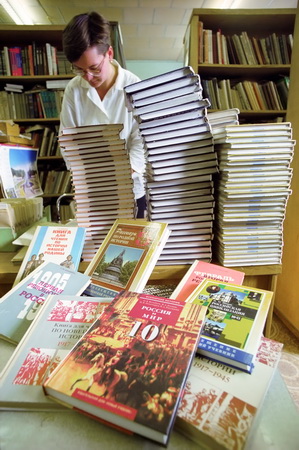
“The conceptual foundations of the historical and cultural standard”, that is, the basic principles of school teaching of history, initially do not cause rejection. Rather, even the opposite.
- The main task is to instill in schoolchildren an interest in history.
- Russian history is an integral part of the world.
- Revolutions and civil wars are not the result of an external or internal conspiracy, but a consequence of objectively existing contradictions within the country.
- It is necessary to form a modern, tolerant personality, ready for the perception of ethnic and confessional diversity of the world.
However, along with these reasonable, indisputable attitudes and, as it were, in development, in clarification, but in fact completely contrary to them, others go. Sometimes carefully, sometimes frankly. Sometimes through silence.
"... in the historical past of Russia there were also huge achievements and successes, but also mistakes and miscalculations."
Great and powerful Russian language! It seems that it is correctly said, really everyone was enough in our history, both bright and dark. But the selection of words clearly means the ratio of the scale of historical victories and failures. “Huge achievements and successes” - “mistakes and miscalculations”. Here Ivan Kalita was mistaken when he surrendered to the Horde of Mikhail Tversky with all his great city and principality. Ivan the Terrible had miscalculations. Say, taking Kazan and Astrakhan, he could not stop and drowned in his blood with acceleration and plundered Novgorod the Great, still conquered his grandfather. Well, Stalin, perhaps, was mistaken a couple of times, what else will be discussed. And with whom does not happen? And on the old woman, as they say ... The one who does nothing is wrong.
And further, in the same insinuating, but intelligible style:
“In the school course, the pathos of creation, a positive attitude in the perception of domestic history, should prevail. The tragedies, of course, cannot be silent, but ... "
The peculiarity of the dividing union “but” in all languages of the world is known: the important thing is what is said after it, and what before it can be put anywhere.
Further - more. That is more frank.
"It should be emphasized that the stay in the Russian Empire was of a positive importance for its peoples." A very positive thesis. True, not indisputable. I wonder if the Finns, Poles, citizens of the Baltic countries will agree with him? And the peoples of other, now sovereign states?
Now - about the high.
"The history of religions, primarily Orthodoxy, should be described systematically and permeate the whole content of the textbook." Well, systematically - this is good, everything should be set out systematically, and the textbook. But why "pierce"? After all, we are talking about a secular school in a secular state separated from the church. And why "primarily Orthodoxy"?
The very idea of a single textbook was put forward by Putin at a meeting of the Council on Interethnic Relations and had a very specific basic goal - to establish some pacifying uniformity of historical interpretations in all regions of Russia. The goal, by the way, is good, another question is how achievable. But how, how is the emphasized priority of Orthodoxy with all the clear predominance of this faith in our country are consistent with it?
But it doesn’t agree in any way, there is simply another task, it’s at a least the first: to give children the story is correct, useful, like a set of polyvitamins or afternoon sleep, illuminated by the light of spirituality and fatherly smiles of power. And at the same time, knock the soil from under the feet of the leaning and critics of all stripes, to repulse the falsifiers and their foreign patrons. And the decisive field of the battle - of course, Stalin, his era.
Here the accents are set firmly and definitely.
After the listing of numerous achievements of the second half of the 20-30s, the authors are phlegmatically noted that in the period under review, “the possibilities of developing civil society were reduced”. Such an assessment, being addressed to the latest, today's realities, would seem inadequately soft. In relation to the period of dispossession, the hunger component and large terror, it looks only like a mockery.
But the apotheosis is ahead. Here it is: "Following the Constitution of 36, for the first time in the history of the country, equal political rights declared all citizens, the period of severe mass repressions began, which aimed at eliminating the potential fifth column in the context of growing military danger."
In this passage, in its own way, even talented, everything is present.
Hypocrisy: “fierce repressions” are mentioned, but unobtrusively justifying a good goal.
Hidden lie: with a complimentary mention of the Stalinist constitution, there is not a word about what relation it had to reality.
Direct lies: Big Terror - Factory of Death. Just a factory. With planned attitudes for the destruction of people who descended to the regions, and oncoming plans with additions that were sent to the center. No beautiful explanations, “fifth columns”, “military dangers” and other rubbish invented by the late generations of the Stalinists.
Finally, the authors obviously suggest that mass repressions were limited to the period of the late 30s, which also does not correspond to historical truth.
As the expressive figure of silence about the most important facts related to the war does not correspond to the truth.
Nothing is said about how and when the Soviet Union entered the Second World War. The day of September 17, 1939, when the Soviet troops, in accordance with the secret agreements between Stalin and Hitler, invaded the territory of Poland, among the historical dates recommended for memorization.
Cashed, a sampling and without decryption, a certain “deportation” is mentioned by the unknown who and where. So it is not clear what is in mind, and there is no certainty that the authors intend not to tell, but at least to report the terrible, epic tragedy of many peoples of the Soviet Union, about the actual and largely successful attempt by an ethnic genocide, carried out during the war of the Stalinist authorities.
Here again there is an insoluble political contradiction, which is built into the very idea of creating a single historical concept. On the one hand, to reassure the peoples who survived the national disaster and those millions of Russian citizens who, regardless of nationality, due to family, educational or other reasons, keep a vigilant memory of relatively recent history. On the other hand, not to offend even more numerous groups of the population who do not want truths or completely otherwise imagine and at the same time constitute a social and electoral support of power.
There is another contradiction: worldview, value, and even deeper. To tell the truth means to admit that the right of a person and a citizen is higher than the law of the state. To lie or silence means to confirm that the elevation of the state or even the preservation of power justifies any victims. That power is the right, and while you are in power, you are right.