
Translated material
RAS is almost not visible
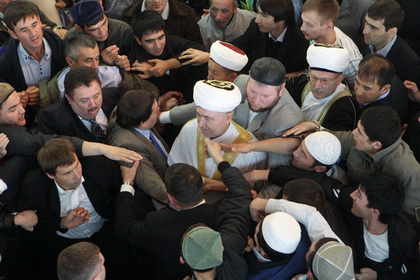
On December 7 of this year, a strange religious organization was established at first glance in Moscow - the Russian Association of Islamic Consent (All -Russian Mufti. RAS). It included the mufti of the Perm region Muhammedgali Khuzin, the head of the spiritual department of the Muslims of the Stavropol Territory Muhammad Rakhimov, representatives of the clergy of Mordovia and for some reason, the Ryazan region. However, the Ryazan Muslims disavow their participation in the new organization.
Actually, the influence of this event on Russian Muslims is almost zero. And the composition of the participants of RAS, immigrants from the second echelon of the clergy, is not impressive. The question arises, why did this association be created and who is it, so to speak, a real unofficial initiator?
Obviously, the main reason for the creation of Rais was another attempt to “transmit” the organizational structure of Russian Islam, and most importantly - to reduce the role of the Council of the Muftis of Russia (SMR), headed by Ravil Gainutdin. Between Khazrat Ravil and his opponents, primarily Talgat Tajuddin, chairman of the Central Spiritual Directorate of Muslims (Tsuchu), there is a longtime rivalry, occasionally interrupted by lethargic negotiations about unity and the creation of a common centralized structure. The eternal and unsolvable issue remains who will lead this hypothetical single structure. The latter, once again, is an inaccessible, attempt took place a year ago.
I must say that in the highest echelons of the Russian authorities, at first, they really wanted to unite Muslim structures, creating something similar to the patriarchate with the “main Muslim”, who would be responsible for Islam before the political leadership. But then they abandoned this, deciding that it was quite acceptable, and in some ways even productively dealing with several religious groups at once, in other words, with “fragmented Islam”.
However, the final common opinion on this account was not developed among the highest Moscow officials. In addition, the Russian Orthodox Church has an indirect influence on the state of affairs in the Muslim community of Russia, whose opinion should also be taken into account. It is known that some Muslim spiritual authorities seek to strengthen their influence in the eyes of the authorities precisely through friendly relations with the Hierarchs of the Russian Orthodox Church.
Both the secular administration and the Russian Orthodox Church have, so to speak, Muslim pets and “stimuli”. And struggling to control the Muslim community, Mufti, of course, use their connections in political and Orthodox circles in order to discredit and squeeze their rivals. At the same time, they accuse their opponents of all mortal sins, first of all, of course, in Wahhabism. It seems that this kind of denunciations were made on all any noticeable mufti and imams of Russia.
Following the creation of Rais, a wave of criticism Ravil Gainutdin began. It is possible that the very moment of attacks on the chairman of the SMR was not chosen by chance, in particular, this can be explained by the resignation of the Moscow mayor Yuri Luzhkov, with whom Gainutdin had the closest relationship. Discussions are used against Gainutdin about the construction of new mosques in Moscow, and the construction under its patronage of the new building of the capital's cathedral mosque, during which, as some say, there were many financial ambiguities.
As for Gainutdin, he, in turn, called the newborn association “puppet”, and its very creation is the result of the machinations of Islamophobes close to power, their desire to “crush Islam”. At the same time, he secured the support of the deputy head of the presidential administration Vladislav Surkov, at a meeting with whom he stated that "the rights of Muslims in Russia were not infringed on anything." The Chairman of the SMR is an experienced political fighter, and he enjoys authority among Muslims. For him - and many note this - relations with the head of Chechnya influenced Ramzan Kadyrov have developed. For now, no one has succeeded in squeezing Gainutdin both on the religious and political arena.
The intra -Islamic conflict, already called the journalists of the “Islamic Revolution of the Cabinet”, is developing against the background of an aggravation of interethnic relations in Moscow and some other cities, which will almost inevitably lead to an increase in Islamophobia. And the leaders of Muslim communities will have to give difficult more than once, I would like honest comments about what happened. Moreover, there is a probability of repeating sad events.
And from the undertaking with RAIS, most likely nothing will work. In this regard, the assessment given to her by the chairman of the coordination center of the Muslims of the North Caucasus is characterized by cautious Ismail Berdiev, who said that "time will tell whether there will be benefits from her or harm." It seems that nothing will happen from her at all, unless, of course, at the very top they suddenly decide once again that on the basis of a new association you can finally combine all Muslims under one roof. But this is also unlikely.