
Translated material
: Bonds of art

One of the mandatory lessons of a regular comprehensive school is a lesson of iso - there is some kind of confidence that everyone needs the basics of it. The purpose of these lessons, in fact, teach to see. But the system of teaching and evaluating the work of children contradicts this goal. The paradox is that the art of teaching in schools is based on the art of socialist realism, and there is no longer any state system to which this style belonged. There is no ideology that justified such an approach to art, there was a primitive template - you need to draw only “like”.
The congenital talent of children to "see" goes to the age of 7-11 years. Is it because he disappears that we ourselves teach children to clicked ideas about how life should look, although they perceive it much better than adults?
Children want and can depict the flow of time, sensations of the body, and we stop it in the bud.Here is an example from the book by Oleg Zayonchkovsky “Petrovich” about the kindergarten of the fifties: “... in his drawings there were neither tanks with airplanes, nor houses with haze, nor solar pastorals. Long stripes through the entire sheet could mean a rushing car or wind that claimed a petin hat; The pulsating circles, diverging from the red point, depicted a visual temperature of thirty -nine and five. The red Bayran, looking once, snorted and sentenced: “Kalya-Maly!” Since then, she repeated her court regularly: "Kalya-Maly!" - Bayran cried out a piercing fistula, sneaking to Petrovich from the back.
And today he tried to draw a dream, a night city: houses and windows in houses that went out one after another. A sheet of paper was shaken thicker until the only black pencil found by Petrovich was stood ... ” You could play further with a sheet, wash pieces with an eraser - and these were windows of waking up townspeople.
Nor adults do not want to play, but want obedience. Comic "Kolobok at night", drawn by a child at a master class for the smallest, conducted by designer Andrei Logvin in the eagle pioneerlaire in 2001
Zayonchkovsky described the obedience system, forced education of vision in the 50s, but did it in the 2000s, that is, this is relevant now. In order to show the reason why for many schoolchildren the lessons are punishment, it is worth quoting a fragment from the book of Adolf Wolf “Man on the Wall”, which is very popular among parents and bukinists - which means they believe that we did not publish the best textbook in art. But we have not been published for such a long time at all - there are third -rate Western manuals on how to draw “any animal in 30 seconds”, or “how to draw a vampire”.
They take it with speed or fashionable theme, but this has nothing to do with art.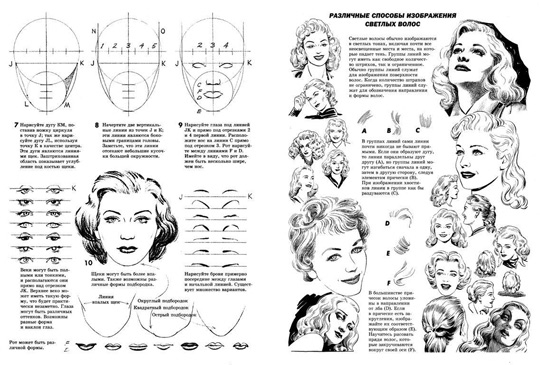 From the book of Jack Hamma “How to draw the head and figure of a person”, “Potyrri”, 2011 - one of the manuals that teach to copy low standards, and not create
The book of A. Volovik seems to teaches attentiveness and life -like, but is a guide for strict norms. Dad teaches his son Dimka to draw correctly, and makes him imagine that he was in his drawing and should live in it. Due to the fact that the boy drew the train rails not in the direct perspective, but their device in axonometry, two straight line rails, and ladies, and the train to the profile, the train gets into the catastrophe. The painted heroes judge the boy for the death of the train with passengers. “All residents of the country gathered for the court. The chief judge made the indictment and offered to come up with a punishment for Dimka. One of the little men ascended to the rostrum and said:
-I think that he needs to make the same legs-sticks as ours. Let him go to them and suffer as we are tormented.
A little man appeared in a winter coat.
-And I propose to make him go in a fur coat all his life. Let him catch like me. What he did, he immediately painted the sun and clouds and the cloud from which it rains. You look outside and do not know whether to put on galoshes and a raincoat or sunbathe in the sun. ”
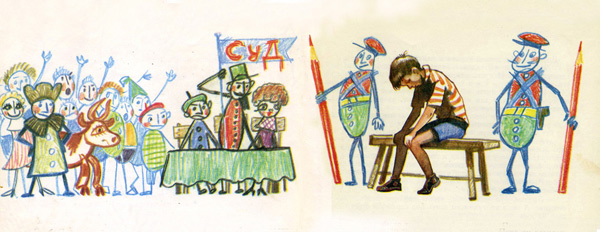 From the book of A. Volovik “A little man on the wall, or fourteen stories told by Dimkin’s dad ...”, “Children's literature”, 1968
Judges and not know that art is not the same as the weather forecast. And what is a certain difference between a terrorist who launched a train with living passengers, and a boy who painted the world as he knows. It is just as strange to judge Dimka for rightly considering the rails parallel to each other, and the sleepers are perpendicular to them as to demand from the builder of the railway to build it in full accordance with the pattern of the realist artist-then the catastrophe will be inevitable. Can a real train go along the routes, which, according to the laws of direct perspective, will decrease as the composition to the horizon is followed?
The requirement from a two -dimensional image of the full correspondence of reality is an isxic. Take the picture of Vasily Surikov “Menshikov in Berezov” - if the exiled Menshikov rises to his full height in this hut, the roof will break his head. Is this a mistake in the proportions for which Surikova should be planted in the same close closet? No, this is a brilliant embodiment of the story of the nobleman, whose aspirations were higher than historical circumstances, it remains to be like this or to bend.
Following the blind norms in the teaching of ITO would have killed both Surikov and other artists from the Tretyakov Gallery if they were executed from childhood for the mismatch of the norm of philistine vision.
But so far, according to most teachers of secondary schools, trees in the summer can only be green, and a good portrait of a mother can only with red lips.The book of the Soviet writer Alexander Raskin “How Dad was Little” is recommended by each other in vain all parents on forums on the Internet. Among the instructive stories about how to poorly betray friends, lie to parents, offend small, and other undoubted truths, there is a story “How the Pope painted”. In it, as another crime against humanity, Papin is described by the method of drawing: “When dad was very small, he loved to draw very much. When he was presented with colored pencils, he drew all day. There was a pipe on each house. Smoke came from each pipe ... It was a very beautiful picture. But each person, seeing her, asked the same thing:
- Where did you see blue trees and green birds?
Until dad went to school, he thought he could draw well. But he drew so badly that the drawing teacher did not say anything to him. He said to other children: “Good!”, Or badly, or “Correct here.” He did not even say to the little dad even: "Bad." Looking at the drawings of the little dad, the teacher silently grabbed his head. And on his face was such an expression, as if he was eating a large sour lemon without sugar. ”
At the parent meeting, the teacher announced everyone from excellent students to lagging behind. And then, with a sour face ... "And there is another boy, not just lagging behind, in my opinion, he has some kind of illness that prevents him from drawing."
It was a shame to hear about the child about the child. But dad successfully graduated from the institute. But at the same time he was able to draw only a cat. Yes, so bad that preschoolers did better, and dad envied them. “True, dad saw one artist who painted as badly as he is. But at the same time he said: "I see this face, this tree, this horse ..."
How sorry that the little dad did not guess this to his drawing teacher. How he grabbed his head! "
Papino “bad” drawing from the story of Raskin is equated with unambiguously bad deeds. But a man with a well -mannered vision would tell this teacher that the trees are blue in certain lighting, and the birds do not always look like ticks about attendance in a school journal.
Such teachers should be sent to their own drawings as a punishment - let them be unbearably bored.And develop a new teaching system. To try different techniques, something else than a brush and gouache: create a collage made of garbage, turn unnecessary into an interesting, make an object from a broken object. The teacher should know the history of art, not so in order to retell it to children, but to represent how diverse the approaches to the image of the world were. The sun and moon, summer and winter can converge in one picture - so they painted on basts, book miniatures, as it was in the “twelve months” of Marshak. The figure of a person can be almost a ball - like a paleolithic Venus, it can have arms and legs like sticks - in a picture of a battle, where hundreds of figures are, and mass, and not individuality, are important.
The teacher needs to be a psychologist, not an executioner - to understand the characteristics of the child’s vision and help him draw what he wants, and not what he needs. It is impossible to explain to whom “it is necessary” so that the future astronaut or doctor learned to draw, as at the 19th century Academy, is impossible.
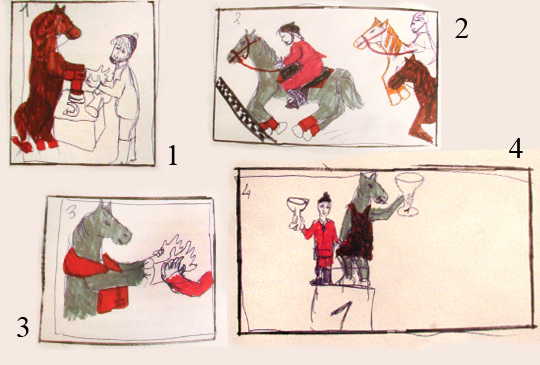 From the book “A Brief Illustrated History of the Future”, published in 2004 following work with children in the DEZ No. 5 studio: - the project “Hands for a horse”, which should give horses rights equal with people