
Translated material
Migrants in Europe: the main risks
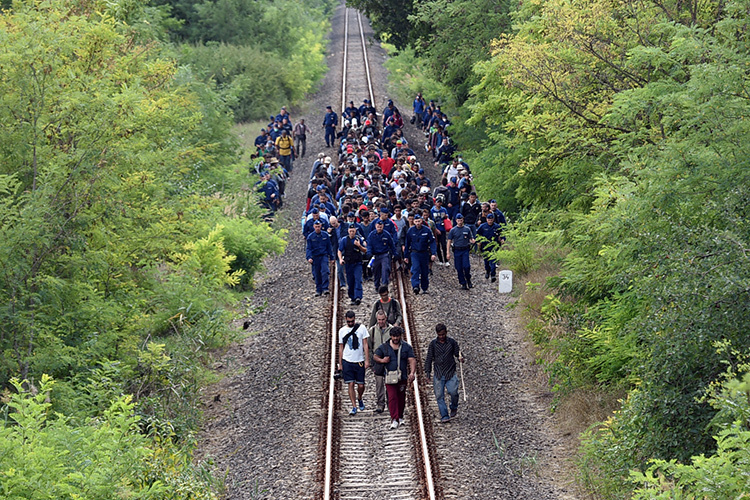
COLTA . RU publishes two texts that consider the crisis related to the flow of refugees and migrants to European countries from different angles: the text of Ivan Yakovina about the main risks of the situation and an interview with an expert in integration and right extremism Alexander Taevda-Barmuli .
Dublin's failure
The Luxembourg government initiated the EU Summit on September 14 in Brussels, within the framework of which it is planned to discuss a single migration policy. Participants will try to find ways to solve a number of problems that have become especially acute against the background of a crisis caused by a stream of hundreds of thousands of refugees from Asia and Africa, rushing in the EU this summer.
The current migration policy based on the Dublin agreement (its last editorial office entered into force in July 2013) does not work quite obviously. According to its provisions, refugee status applicants must submit documents only and exclusively in the country of arrival in the EU. In the current conditions, this rule is not respected for two reasons. Firstly, refugees enter the EU countries mainly through Greece and Italy, which are physically unable (and do not burn with desire) to accept everyone. Secondly, the status applicants themselves in the vast majority do not want to submit documents in countries with more stringent legislation (their chances of a positive outcome are less) and in economically less developed countries, where the level of benefits, salaries and social support for newcomers are lower.
Due to these two factors of a reasonable and uniform distribution of refugees according to the EU countries, alleged by the Dublin agreement, it is not possible. The vast majority of the new arrivals settled in the rich countries of Northern Europe - Germany and Scandinavia, where migration laws are more liberal, and the economy is stronger. Thus, there is a significant bias that creates unnecessary stress and does not allow you to find a pan -European solution to the problem.
At the same time, the current crisis has revealed a number of other problems that may be more serious than the imperfection of the migration legislation of the European Union.
Direct to sink
The path to refugee status for most applicants is associated with huge risks and costs. Throughout their route to the countries of Northern Europe, numerous gangs of smugglers are operating, transporting refugees across the seas, countries and borders. So, the usual dachshund for crossing one person through the Aegean Sea from Turkey to Greece starts from a thousand dollars. In the direction of Libya - the lampsatuza prices are even higher. Of course, there is no need to talk about any comfort and/or safety: hundreds, if not thousands, people are drowning or suffocating from faulty engines in the holds. But even upon arrival in Europe, their further journey, as a rule, is also associated with significant expenses, risks and deprivations. The question arises by itself: why do they pay thousands of euros for such an unreliable and dangerous way of movement, and do not fly by ordinary aircraft for 200 euros, for example, Turkey to Germany, which announced the readiness to accept all Syrians who reached its territory?
The answer is the Directive of the European Union 2001/51/EU . According to this document, the airline, which took on board the potential immigrant following the European Union without a visa, is obliged to return it back at his own expense if the status of refugee is not granted. Yes, the same document promises the provision of refugee status in the EU to those who really need it. But in fact, the decision about who is worthy to receive such a status should be made by the airline clerk working on the registration of passengers. Of course, neither he nor the airline can take such a risk, therefore, they automatically refuse to land everyone who does not have a visa of the country of following. Thus, the European Union forbade applicants to use normal transport by its own decision, forcing him to resort to alternative routes. (The drowned boy, whose photography bypassed the world media, is a direct consequence of the inability to get to the EU by plane.)
Here, before the leadership of the European Union is an extremely unpleasant dilemma. On the one hand, the directive really condemned people to great dangers (sometimes even death) and expenses, and also created a mafia that makes it earned at illegal refugees across the border. On the other hand, she at least slightly restrains the flow of refugees and migrants who want to move to Europe. In the event that it is canceled, the next day flying to Europe will be crowded with people from the dysfunctional regions of the world, and each will have their own history of torment and suffering in their homeland. True or not is a topic for a separate conversation. In any case, migration pressure on the old light would have increased repeatedly.
According to the EU directive, the airline that took on board the potential immigrant, next without a visa, is obliged to return it at his own expense if he is not given the status of a refugee.
The dynamics of the crisis
Experts who write about the crisis unfolding in the EU often emphasize that Europe as a whole and even Germany in particular are quite capable of cope with the situation. Typically, the following arguments are given: the half -billion population should not experience serious difficulties, absorbing only 800 thousand refugees (the forecast of the Government of Germany for the current year). It sounds completely logical. But then two points are lost.
Firstly, Berlin voiced the forecast only for Germany . According to German estimates, this is about 40 percent of the pan -European number of refugee status applicants. That is, their total amount this year will be about two million. Onlyfive thousand people arrive daily in Munich.
Secondly, these two million are not the end of history at all. The acceleration and relief of the procedure for obtaining the cherished status, the resolution of a number of European countries already declared to Germany freely, the planned increase in quotas to the reception of refugees by other EU countries and other measures aimed at accelerating the process of their integration into European society give a signal to those who still think about the risks: “We must go!” In this sense, much will depend on the results of the summit in Brussels. Apparently, among other things, decisions will be made there to increase the level of security of applicants on the way to Europe. For example, we can talk about the organization of ferries on which people will be delivered from Turkey to Greece, and trains from Greece to Germany. Some categories (women, old people, children) can allow the use of aircraft-up to the complete abolition of the unfortunate directive.
The Syrian conflict is aggravated, the refugee camps in Turkey, Lebanon and Jordan are crowded and suffer from acute lack of resources. Against this background, those five million Syrians who moved to neighboring states, and at least some of the 15 million still remaining inside the warring country can take advantage of the EU hospitality. Citizens of Bangladesh, Pakistan, Afghanistan, Iraq and other countries can also join them, where life is now full of hardships. These are potential immigrants who will not leave attempts to get to a more calm, prosperous and safe place of residence. Europe needs to prepare for millions of refugee status applicants every year. Moreover, if the current trends remain, the flow will only grow: the current crisis is not an event, but a process with an open date of completion.
Climate bomb
Observers, observers, politicians and experts adhering to left -wing views often and unreasonably warn of numerous dangers that the global climate change. At the same time, they insist that Europe has a moral duty to accept all people whose life has been in jeopardy in their homeland. However, few people have yet to unite these two positions and present possible consequences.
The essence of the problem is that the very real warming, rapid growth of the population of Asia and Africa, thoughtless attitude to nature and extremely backward methods of agriculture lead to an acute lack of fertile lands and fresh water in a number of regions of the world.
There are many examples of this. Lake Chad, feeding the huge region of the Central Sahel (Savann and semi-desert south of Sakhara), since the 1960s dried up 90 percent , repeating the fate of the Aral Sea. The places where there were water, fields and, accordingly, life, now turn into a desert. Millions of people living in the lake basin are forced to leave their native places so as not to die. Moreover, this applies not only to the territories adjacent to the child, but also of the entire Sahel .
The most populated country in the Arab world - Egypt - will encounter the most severe water crisis by 2025. The corresponding report of the UN says that by this time the almost 100 millionth population of the country will no longer have enough Nile to maintain even a minimum level of water consumption, which is still reduced every year. The coming crisis in the report is called "absolute."
Norman Mayers believes that climatic changes will force more than two hundred million people from the inhabited places.
If in Africa there are not enough water in Africa, then in South Asia people do not know where to go from it. In Pakistan, the ocean quickly steps on the fertile delta of the Indus River, making an unsuitable life there for entire villages. In Bangladesh, millions of residents of coastal regions squeeze the same problems inside the country. The capital of this country - Dacca - has become the most fast -growing city of the planet in recent years, and the vast majority of its population are the inhabitants of the catastrophically poor slums.
In some countries, the situation is even worse: due to increasing the level of the ocean, they can simply disappear from the world map. Such a prospect, in particular, threatens Kiribati - a small island state in the Pacific Ocean.
In 2005, professor at the University of Oxford University in Prague presented the results of a study of this problem, according to which, in the near future, climatic changes will force more than two hundred million people around the world. This process will go in parallel with explosive population growth and appropriate food deficit in poorly developed countries, for example, in the same Sahel .
To dozens and hundreds of millions of people put on the brink of physical survival, it will be possible to run only to Europe (unless, of course, they do not dare to conquer the oceans). In the vast majority of other regions of Asia and Africa, the situation will be slightly different. Endless wars, overpopulation, lack of water, food and other resources are already becoming widespread. For example, the Pakistanis and Bangladesk residents make up a considerable part of the route heading to Germany along the “eastern” route - from Turkey through Greece, Balkans, Hungary and Austria. And the natives of Sahel and the bleeding of Black Africa are drowning on the way, but are still eager for Italy from Libya on the boat -in -law boaters.
Terrorist threat
A striking example of the country where the war and poverty will drive new flows of refugees is Yemen, where, in the conditions of almost complete information silence, civil war, foreign bombing and intervention, the humanitarian catastrophe of epic proportions unfolds .
Due to the air, land and sea blockade, the arid 25 millionth country, which in peacetime depended on the import of fuel and food, was now on the verge of hunger and catastrophic lack of water. There are no rivers and lakes there, and artesian pumps are due to the lack of electricity (there is no fuel for generators either). No matter how the events develop there, in the case of the removal of the blockade, the Yemenets will almost certainly be in the position of the current Syrians who are massively running to Europe.
Yemenic immigrants may well become a particularly problematic contingent for the special services of the host countries. The north of this country is under the control of the Husitian rebels, whose official (and very popular) slogan is “God is great! Death to America! Death to Israel! Damn the Jews! Victory to Islam! " In Yemen, there are practically no Americans, or the Israelis, nor Jews from other countries, the Husites do not encroach on the outside world, so their danger is small. But in Europe, the listed categories of citizens are present.
An even more alarming situation with the south of the country, where al-Qaeda firmly settled, more precisely, the local, Yemenic, its department , which is considered in the United States the most dangerous franchise of the global terrorist network. The views of the ideological heirs of Osama Ben Laden on Europe and the Western world are well known: they want to destroy it in any possible way, which they have repeatedly proved. For example, a terrorist attack against the satirical magazine Charlie Hebdo was inspired precisely by the Yemenian al-Qaeda. In the event of a massive and uncontrolled Yemenis flight to Europe, with a very high probability, if not the terrorists themselves, then at least people who sympathize with both the north and south of the country.
The same applies to the situation unfolding in Europe now. Syrians and Iraqis, who previously lived exactly in those areas where the Islamic State (the Al-Nusra Front banned in Russia) (Syrian branch of Al-Qaeda) now runs to Germany and other countries. Of course, the vast majority has nothing to do with the most dangerous Islamic organizations in the world, but it would not be extremely naive to hope that IG and FN did not take the opportunity to introduce our people into Europe.
The German intelligence services have already promised to check for involvement in prohibited groups of all to a single refugees, but it will be unusually difficult to filter them. The general flow of arrivals is too large, for a thorough check of everyone, there is simply not enough resources. This applies to a slightly lesser extent to refugees who are massively arriving in Italy from Africa. In Libya, for example, a local branch of the Islamic State has been operating for a year, which managed to celebrate a number of high -profile terrorist attacks. In addition, in Sahel, significant territories are controlled by the Islamist organization Boko Haram, which swore allegiance to the Irako-Syrian caliphate, that is, IG.
In any case, the situation when tens of thousands of refugees from the regions wars are completely uncontrollably penetrated into the EU across external borders, gives active participants in terrorist groups a unique opportunity to get into the “territory of the enemy” unhindered and in large quantities and bring the fulfillment of their strategic goals.
Rise right
All the world media went around the scenes of the joyful meeting of refugees at the Munich station, where ordinary Germans greeted people who suffered terrible deprivations to get to the final goal of their journey. Many residents of various regions of Germany really try to facilitate the integration of Syrians, Iraqis and others into local life. The same efforts are made by residents of other countries, which turned out to be side by side with refugees. But in the event that the flow will increase (and wars, hunger and overpopulation do not disappear anywhere), the internal stress will increase both in European society and between the countries entering the EU.
The EU states, which are stronger than others, encountered the problem of growth of the number of refugees, demonstrate the growth of right and extreme right sentiments. This, of course, happens not only because of the influx of visitors: there are other factors, but this one cannot be discounted. In Greece, where ships from Turkey come, the third in the number of deputies the parliamentary party - the Golden Dawn - is essentially fascist. In Hungary, from where the path of refugees in the Schengen zone in Germany begins, the extreme right are already in power, and the second place is occupied by the ultranationalists from the Yobbik party. In France, where the largest Muslim minority in the EU lives, in the elections to the European Parliament in 2014, the National Front Marin Le Pen won. Even in ultraliberal Sweden, where the largest percentage of migrants from Asia and Africa in the EU, in the 2014 parliamentary elections, the third place was taken by the ultra -right “Swedish democrats”, which improved their result compared to previous elections. According to summer surveys, SHD for the first time in history became the second most popular party of the country.
All these parties and movements are not only carriers of dangerous ideological attitudes that are in many respects contrary to generally accepted European values. All of them, to one degree or another, oppose integration with the EU neighbors, urging them to abandon the euro, Schengen agreements, participation in NATO and the general migration policy. Populistic slogans that the Brussels bureaucracy "is too expensive for taxpayers" and at the same time "ineffective and useless," from marginal turned into mainstream. The current crisis only fuels such attacks on Brussels.
The parish of the ultra -right party into power in at least one of the most influential countries in Europe is fraught with serious troubles for pan -European institutions and values. Трудно даже представить возможные последствия победы, например, «Национального фронта» во Франции. Сейчас, правда, такой вариант представляется чисто гипотетическим — популярность Ле Пен и ее партии не настолько высока. Однако в прошлом в Европе как минимум один раз электоральные предпочтения граждан радикально изменялись буквально за один день. Теракты, проведенные в Мадриде в 2004 году за три дня до парламентских выборов, радикальным образом изменили результаты голосования. Правящая Народная партия, лидировавшая всю кампанию, с треском проиграла «аутсайдерам»-социалистам, выступавшим против участия Испании в иракской войне. Террористы добились своей цели: вскоре после формирования правительства социалисты вывели испанский контингент из Ирака.
Террор станет вполне предсказуемой реакцией на рост праворадикальных настроений и наоборот. В условиях почти неизбежного увеличения объемов массовой неконтролируемой миграции два этих явления будут развиваться, питая и укрепляя друг друга. Подобное развитие событий несет в себе еще один серьезный фактор риска для Европы.
Разногласия в ЕС
Те, кто говорит, что массовый наплыв беженцев способен привести к скорому развалу Евросоюза, безусловно, сгущают краски. Даже намного более серьезный кризис, вызванный экономическими проблемами и задолженностью Греции, не привел ни к ее выходу из еврозоны, ни тем более к отделению от ЕС.
Тем не менее отсутствие нормально работающей миграционной политики и заранее утвержденных квот на прием переселенцев, а также различия в отношении к проблеме у разных стран Евросоюза уже привели к разногласиям внутри него.
Страны «Вышеградской четверки» — Польша, Венгрия, Чехия и Словакия — выступили против введения обязательных для всех стран ЕС квот на прием беженцев . Они раскритиковали соответствующую инициативу Франции и Германии, подчеркнув, что решение о том, размещать на своей территории беженцев или нет, должно быть суверенным и исключительно добровольным.
Страны ЕС одна за другой пытаются оградить себя от десятков тысяч соискателей убежища, оставив их на попечение Берлина.
В Берлине на нежелание Восточной Европы взять на себя хотя бы часть ответственности отреагировали довольно жестко. Канцлер Ангела Меркель намекнула , что готова будет рассмотреть выход своей страны из Шенгена, если прочие страны ЕС «не проявят солидарность», забрав хотя бы часть сирийцев и иракцев к себе.
Но даже столь серьезная угроза не сработала. Более того, из-за беженцев между бундесканцлерин и венгерским премьером Виктором Орбаном начался открытый конфликт. Орбан требует, чтобы Берлин прояснил свою позицию: готова ли Германия принять всех беженцев, как заявляет, или же хочет, чтобы они все-таки регистрировались в других странах? Ответ Меркель был довольно расплывчатым: «Мы делаем все необходимое с точки зрения морали и закона. Не более и не менее». Раздражение венгров легко понять: ФРГ объявила всему миру, что примет столько беженцев, сколько потребуется, но не хочет давать им шенгенские визы, когда они пересекают венгерскую границу, считая, что это задача Будапешта, который беженцев не звал, а, напротив, хочет от них избавиться.
Пока Берлин и Будапешт бодаются насчет того, кто именно должен оформлять прибывающих в ЕС людей, Дания тихо и почти незаметно ужесточила свое миграционное законодательство, проинформировав об этом потенциальных переселенцев через несколько ливанских газет. Копенгаген объявил , что вдвое сокращает пособия, для получения постоянного статуса будет требовать знания датского языка, а также существенно усложнит процедуру оформления документов. Общая суть объявлений в ливанских газетах примерно такая: держитесь от Дании подальше, вам там не рады. О солидарности с Германией в этих условиях говорить пока не приходится. Скорее, идет обратный процесс: страны ЕС одна за другой пытаются оградить себя от десятков тысяч соискателей убежища, оставив их на попечение Берлина. И пока ничто не указывает на то, что они готовы изменить свою позицию.
Тенденция к обособлению стран ЕС сейчас только наметилась, однако с нарастанием потока беженцев она вполне может получить развитие, пойдя по пути, уже обозначенному Меркель в ее рассуждениях о взаимосвязи солидарности и продолжения действия Шенгенского соглашения.
Summit
Перечисленные риски, вызванные небывалым для современной истории наплывом беженцев, вполне можно снять, если Евросоюз сумеет все-таки выработать единую миграционную политику, основанную на разумном компромиссе между строительством стен и позицией «примем всех».
Сейчас в столицах Евросоюза идет работа над соответствующими предложениями, которые будут представлены на брюссельском саммите 14 сентября. Каким именно будет финальное решение, сейчас сказать невозможно, но о чем-то европейцам договориться остро необходимо, поскольку нынешнее положение вещей в среднесрочной перспективе может вылиться в очень серьезные неприятности как для ЕС в целом, так и для отдельных государств в частности.