
Translated material
Was there a crochet?
In the lecture of the Polytechnic Museum , the Laureate of the Enlightener Award, Doctor of Biological Sciences and the leading researcher at the Paleontological Institute of the Russian Academy of Sciences Alexander Markov spoke about the evolutionary path, which went through the sea hedgehog and barbeling from the Ethiopian Tan, as well as about what transitional forms are and why it is important to study them.
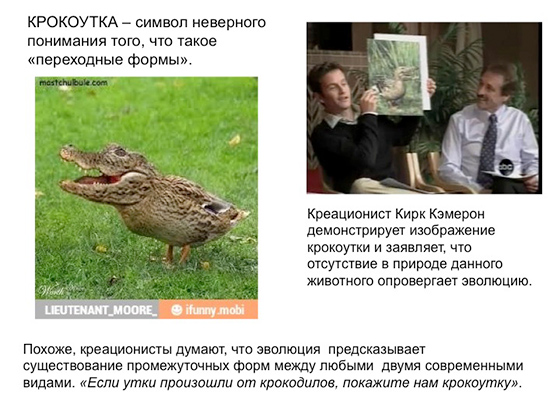
What are transitional forms? Here, for example, a well -known animal in narrow circles, which is called a "crocodette." And this is such a symbol of the incorrect understanding of what transitional forms are. There was a story about how one American creationist, speaking on television, showed a picture with a crocodile and stated that since there is no such animal in nature, evolution is a lie. Everything was presented like this: if the ducks descended from crocodiles, then let the evolutionists show us the crocodile. That is, apparently, creationists think that from the theory of evolution it should be, as if transition forms, intermediate between two modern species, must exist in nature. Is it so? In general, in a sense-yes. But you need to understand what this actually means that we can find as transitional forms.
Here is an evolutionary tree. Related ties between organisms are at least the highest, in the evolution of which the horizontal transfer of genes plays a not very important role. Evolution is more or less adequately represented in the form of a genealogical tree, at the ends of the twigs of which modern species sit. Here, say, a turtle and a bird. The bird here symbolizes all birds, and the turtle - all reptiles. Accordingly, the branches symbolize the course of evolution, which predicts that two of any modern species had common ancestors in the past, and maybe to this day their little changed descendants. But in general, if you strictly talk about what a transitional form is, then, of course, this is already an extinct creature. Because no now living creature can be a common ancestor of some other two now living species.
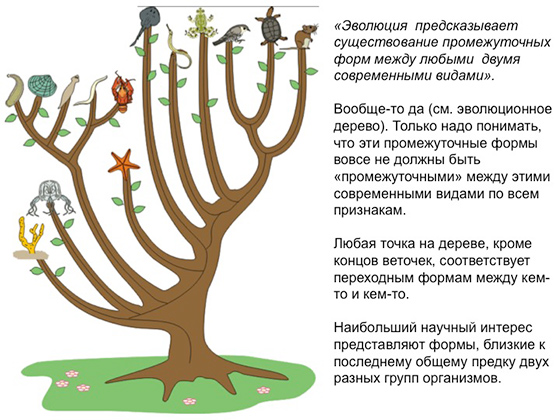
Transition forms were to exist in the past between two modern species, but of course they were not obliged to be intermediate between these two species - by all signs. In principle, any point on this tree-except for the very end of the twigs-corresponds to any transitional form. But the greatest scientific interest is formed by forms close to the last common ancestor of some two modern groups, that is, close to the places of branching.
In the real annals, we have little chance of finding a fossil organism, which was strictly on a branch leading to some specific species, that is, an absolutely direct ancestor. And we are unlikely to recognize him when we find, and if we find, we are unlikely to prove that it is he. As a rule, we find representatives of some small side twigs, branches, something similar, something close, some of the extinct relatives.
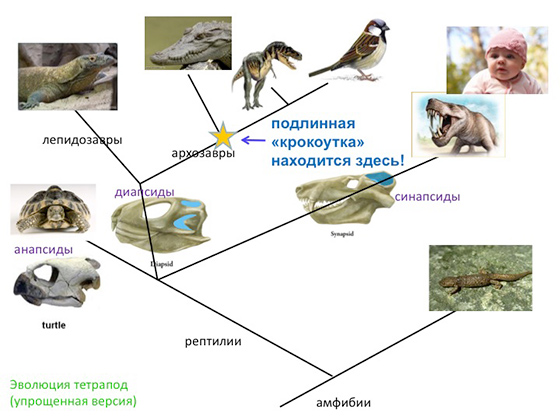
As for the crocker, then - what should we actually expect to see in this fossil annals in the place of the crocepa? So, this is a very rough, primitive, simplified scheme of the evolutionary tree of tetrapods (vertebrae of vertebrae, four -legged ones that have passed to life on land and in the air. - Ed. ). Here is their common ancestor - when the fish went to land, so to speak. The first branching - one branch leads to modern amphibians, the other to everyone else. Reptiles are divided into three branches, the relationship between which is controversial, but we are not talking about that now. The largest branches are the dicks with two holes in the skull for the passage of chewing muscles and synapsides with one hole. Sinapsides are our direct ancestors. Between the first synapsides and mammals there are a number of remarkable intermediate forms - the so -called rash reptiles. The linences, in turn, were divided somewhere in the Perm, and maybe even in the coal period into the lepidosaurs, which include lizards, snakes and all their relatives, and to archosaurs, which include crocodiles and dinosaurs. Birds also belong to archosaurs, since their closest relatives are the same dinosaurs. Accordingly, the analogue of the crocepa is actually somewhere here, and it is correct to call it not with a crockery, but "the last common ancestor of all modern archosaurs." Paleontologists have found several forms of a suitable age, a suitable structure, that is, basal archosaurs - forms close to the last ancestor of archosaurs. Here is one of these forms, which is called the Archosaurus Rossiucus, from the very end of the Perm period described by our academician Leonid Petrovich Tatarin.
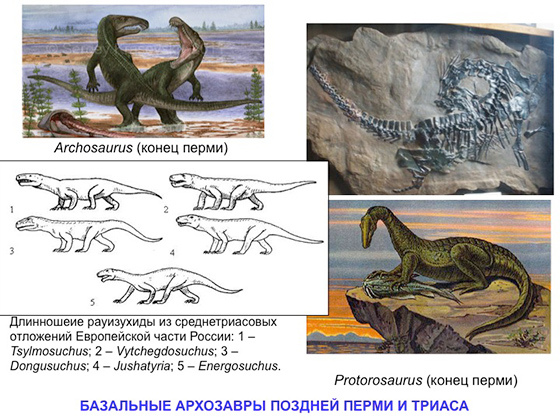
This is what the last common ancestor of all birds and crocodiles looked approximately. Here are a number of reconstructions of basal archosaurs. All of them were more or less close to the very form that was the last common ancestor of crocodiles and birds. Which of them was specifically the closest to this ancestor, we do not know and is unlikely to someday someday someday. But we know for sure that there was an animal of about such a building plan - the basal archosaurus, and then, on the one hand, crocodiles were evolved from it, on the other hand, the first dinosaurs occurred at the end of the trias period, which were then divided into liner and poultry, and one of the branches of lizard dinosaurs gave rise to birds. That's what really was instead of a crocheted.
Now we will analyze individual examples - we will start with flounder. The question of the origin of Kambal seemed to be one of the most difficult in the theory of evolution. Because the theory suggests that the body evolves slowly and gradually, by accumulating minor changes (and each subsequent change should be useful, should be supported by selection, should bring some benefit so that organisms with this new sign can leave more offspring than organisms without it). And accordingly, it seemed to many - and above all, creationists insisted on this - that it is impossible to imagine the existence of transitional forms between normal fish and flounder.
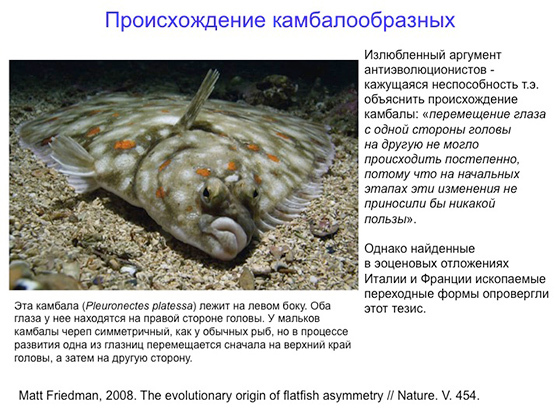
Cambalas, as you know, lie on their side at the bottom, and both of their eyes are on the same side of the head. It is clear that in such a complete form this adaptation is very convenient for them: lying, hiding, and both eyes look up from where the prey may appear. It would not be so convenient if one eye was on the other side of the head and looked into the sand. The initial stages of the process of moving the eye on one side of the head could not bring any benefit to the other - after all, the eye could not immediately take and jump. He was most likely to move gradually, from generation to generation, moving a millimeter of a thousand years. And it is completely incomprehensible what benefits the ancestors of flounders from the fact that their lower eye - the one that is pushing into the sand could get - will shift a little to the side. That was the snag. And creationists said: this is an example of adaptation, which cannot develop in a gradual way, because transitional forms cannot exist, cannot be supported by selection.
It would seem such a convincing argument. But it was possible to refute it in 2008, when paleontologists found fish, which contrary to all these ideas, just demonstrate transitional morphology. And this also needs to be explained. Cambala is born with a normal head. In the course of the individual development of Kambala, one of her eyes makes an amazing journey. In a small fry, both eyes are located like normal fish - one on the left, the other on the right, but then, during the development of the fish, one eye begins to shift and first appears to the crown, and then crawls completely to the other side, and as a result both eyes are nearby. This story is repeated, it is played again at the birth of each flounder. This is an example of how some evolutionary changes are recapitulated, repeated in individual development.
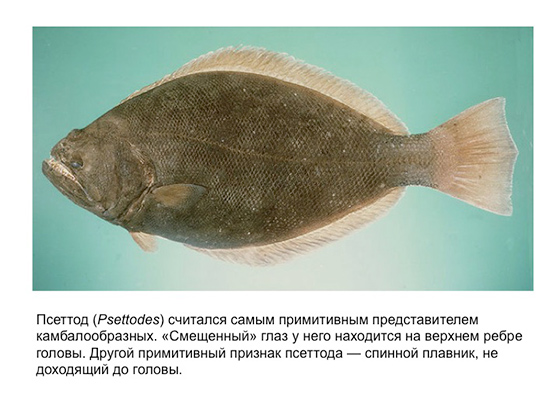
What could the intermediate forms of flounder look like? There is such a psettod. A primitive flounder fish, which differs from the rest, more advanced, flounder in that she has this eye on the edge, on the verge of the head, and not on its side, that is, is in such an intermediate state. This is not a real ancestor of real flounders, but a modern fish that shows us how ancestors could be arranged. But all the same, the psettod of the eyes already sees something when he lies on his side, he is already useful. But what about transitional forms that have a second eye even below? And just such fossil fish were discovered.
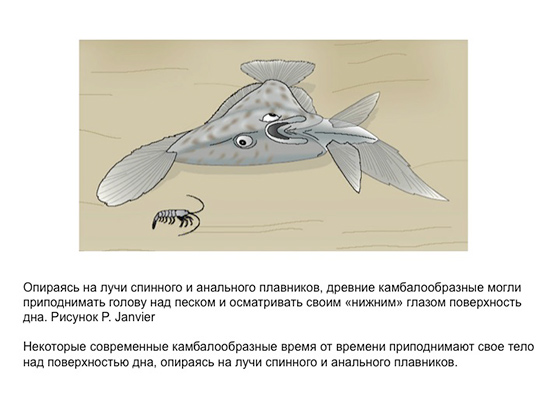
Two kinds of fossil fish - amphistium and Heteronectes , in which the eyes (namely in adult fish) are in an intermediate state. Both the left and right forms were found, that is, in some, the left eye was shifted to the top of the head, in others the right. Actually, in this way, paleontologists have proven that intermediate forms between normal fish and flounders are possible. They were definitely - here they are. Another thing is how to answer the question: why were they? Why did these fish needed such a displaced eye if he still looked into the sand? And it is very difficult to answer, relying on fossil material, because we do not know how these fish behaved. But observations of modern flounders made it possible to express a plausible hypothesis. The fact is that some flounders raise the body above the surface of the bottom using fins. And intermediate forms - between normal fish and flounders - could in this way examine the bottom with their displaced eye. They could rise on the fins and see if something tasty crawls on the surface of the bottom (the second eye looked up). For such a peeping, the displaced eye is much more convenient than the one in its original position on the side.
Then I wanted to tell you about the sea hedgehogs, which I originally engaged as a paleontologist. Usually, at my lectures, I set out what I read in books, but today I decided to make an exception and tell something about what I myself, with my own hands, was engaged in as a scientist. In the paleontology of sea urchins there are a lot of interesting transitional forms. True, in order to understand that they are transitional and that they are interesting, you need to get to know them in detail. On the example of sea urchins, we see that sometimes, when the paleontological chronicle is in sufficient detail (and for the sea hedgehogs it is just that because they are well preserved in fossil condition, especially those that buried in the ground, so to speak, digging lifestyle), many well -studied, detailed evolutionary series is known. And in the sequence of layers - the deeper the layer, the ancient remains - we meet the gradually changing sea hedgehogs.
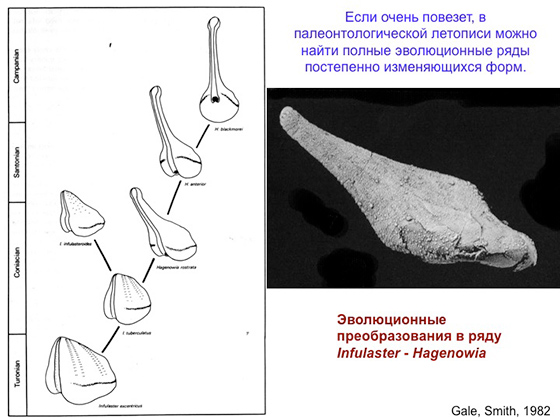
Here is the evolutionary series of unusual sea urchins Infulaster - hagenowia . They buried in the ground. However, the buried hedgehog needs to have access to the surface, so that fresh water enters its hole and precipitate from the bottom that he eats. Many other digging sea hedgehogs solved this problem, but it was this group that came up with something unusual. She ultimately grew herself such a growth on the shell that stuck on the surface while the hedgehog itself was sitting in the ground.
Here is an example of the evolutionary series, studied in great detail. In the left column you can read: Upper Turon, Cognac, Santon, Lower Campan, Upper Campan. These are all units of the upper chalk - temporary intervals. Each pair of pictures corresponds to one chronicle, that is, species that replaced each other in time. And here, morphological changes from the layer to the layer, from the most ancient forms to the youngest are shown here. For example, the mouth was originally here, and then gradually shifted upward, closer to the front edge of the shell, until he was completely ahead. And this is a morphological feature that changed directed. Such a course of evolution was associated in this case with the fact that the hedgehogs adapted to instillation in a more fine -grained precipitate. With transition forms here, too, everything is clear: each species is a transitional between the previous and future species. And this is a rarity and great luck, when the full evolutionary series can be found laid out according to layers of different ages - as in the picture. But there are much more complicated cases. And now I will talk about transitional forms that were in the evolution of the so -called incorrect sea hedgehogs.
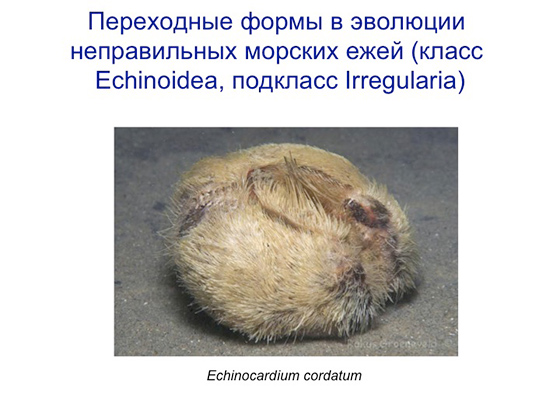
In general, the class of sea urchins is divided into two subclasses - correct and wrong, and we will talk about the wrong now. This is a sweet fluffy do not understand that there is a typical representative of the wrong hedgehog Echinocardium Cordatum . But this is not a wool or fluff, but thin lime needles, which it is necessary to have a sea hedgehog. Echinocardium - digging creature. In the picture he is all in needles, but if he removes them, then the shell will remain. And in order for you to understand what I will talk about, I will have to introduce you to the structure of sea hedgehogs and terms, without which it will be completely impossible to tell anything ... Sea hedgehogs are generally little known to the general public, so this acquaintance will be very useful.
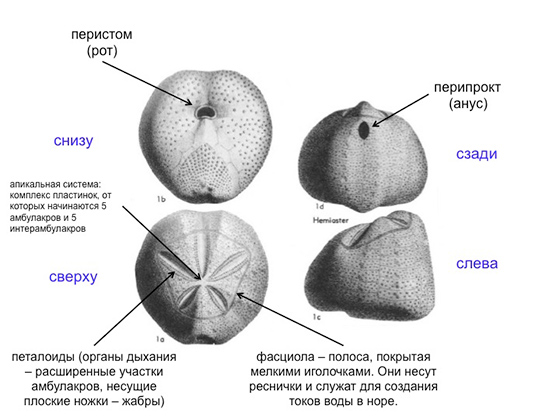
Here is the shell of a typical incorrect sea urchin. Top view, below, view and side view. Everything is signed in the picture. The shell is cleaned of needles and epithelium, that is, in front of us is actually a skeleton of the sea hedgehog. From below and in front he has a mouth - and this hole in the shell is called peristoma. On the back of the shell, it has a periprect in which the anus is located. Top view: the front groove, the digestion of the structure, there outpatal long legs are sitting, which build a vertical channel in the ground. Four petals, like a flower, are called petaloids - these are respiratory organs. Extended areas of rows of plates with legs called outpatients. In general, the sea hedgehog has a five -beam symmetry, and their shell consists of five double rows of outpatient plates, they have holes from which outpatient legs stick out. Five outpatients and five double rows of plates between outpatient clinics - this is called intrambulacrac. The front outpatient clinic in the wrong hedgehogs forms the front furrow, the remaining four - the so -called petaloids, where the legs turn into gills through which the water entering the hole, where the hedgehog sits. Water washes gills - a hedgehog breathes. Often on the shell in irregular burnt sea urchins, there are strips, usually forming closed contours and covered with very small needles. Needles, in turn, are covered with ciliary epithelium, which creates water currents washing the shell of a hedgehog. These strips are called fasciols and serve for ventilation of the hole. The hedgehog sits in the hole, and he needs to be washed always fresh water so that he can breathe, he needs to remove the products of his life from the hole, and it is necessary that the water leaks through his hole all the time. And these currents, so necessary hedgehogs, are created precisely by fasciols. That, in fact, is all that you need to know about the morphology of sea urchins.
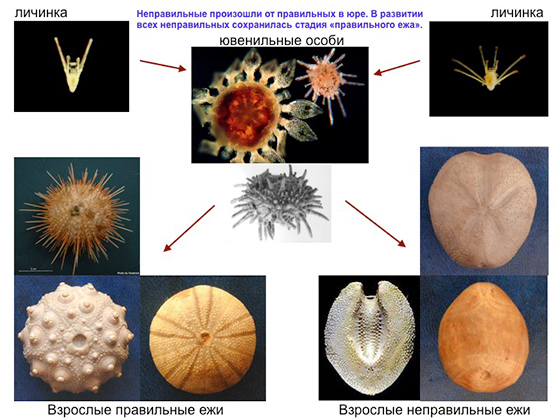
Incorrect sea hedgehogs appeared in the Jurassic period and descended from the more ancient right hedgehogs. The development of the sea hedgehog begins with a planktone larva called echinopluteus: a small sea hedgehog is obtained from it as a result of metamorphosis. It always turns out at first correct, that is, radially symmetrical. Whether it is a young irregular hedgehog or a young correct, tiny hedgehog (about a millimeter or even half a million in diameter) will always have the correct five -beam symmetry. But then the development breds them in different directions. In the correct hedgehog, a five -beam symmetry is preserved, and in the wrong time in the process of growth, the five -way symmetry turns into double -sided, that is, it unevenly develops different sides of the shell. Further, the curtain shifts forward. But the most interesting thing happens on the upper side: the anus is almost in the center, like the right hedgehog, but then begins to shift back. And, finally, in an adult irregular hedgehog - with already developed petaloids and with the front furrow - the anus goes to the back of the body, and it is not visible from above.
What problem did the wrong sea hedgehog faced? Their appearance was associated with the development of a new type of nutrition. Correct hedgehogs are animals that live on the surface of the seabed, they are more or less omnivorous, they have a gnawing oral apparatus (the so-called Aristotelian lantern) with five very strong teeth, which they all screech with something. In other words, they can eat algae, different animals that grow stones and other objects at the bottom, can eat someone dead if they find. That is, these are omnivorous forms that actively choose what to eat to them, and their anal hole is at the very top of the shell, which does not interfere with them at all.
Incorrect sea hedgehogs - and their appearance, I will remind you, it was just related to another type of nutrition - they relate to detritophages. They began to eat simply soil-whether it be sand or silt at the bottom. They swallow the soil in large quantities and are saturated with the organics that is in it. Of course, this is a very low -calorie diet. You have to swallow a lot of soil to get a sufficient number of calories. Accordingly, there are many waste. И если бы у ежа-детритофага анальное отверстие осталось на вершине панциря, то все отходы падали бы на него обратно и он бы повторно заглатывал материал, который уже прошел через его кишечник. Для грунтоеда, как мы понимаем, этот вариант неприемлем. Поэтому первое, что происходит с ежом, переходящим на грунтовую диету, — смещение анального отверстия из центрального положения на бок. Перипрокт должен сместиться из центра куда-то назад. Но как этого добиться? У всех морских ежей с незапамятных времен и по сей день развитие так устроено, что в результате метаморфоза из личинки появляется ежик, у которого перипрокт находится посредине панциря, окруженный пластинками апикальной системы. И оказалось, что это не так-то просто изменить. Очевидно, что древняя связь перипрокта с апикальной системой очень прочная. Апикальную систему нельзя передвинуть, потому что это не просто какие-то там десять пластиночек, а зона роста всего панциря. Именно вокруг апикальной системы формируются новые панцирные пластины. В итоге нужно было оставить апикальную систему наверху, а перипрокт убрать куда-нибудь подальше. На первых порах эволюция неправильных морских ежей выглядела очень причудливо: в разных эволюционных линиях параллельно предпринимались разные неуклюжие попытки сдвинуть перипрокт назад, не убирая апикальную систему. Большинство вариантов оказались тупиковыми и вымерли. Но некоторые оказались успешными, и от них произошли все современные неправильные морские ежи.
Как реально происходит открытие каких-то новых переходных форм? Как палеонтологи это делают? Чтобы объяснить, я расскажу о самой интересной и важной переходной форме, которую мы с моим учителем Андреем Николаевичем Соловьевым открыли и описали, — это переходная форма между двумя семействами неправильных морских ежей. Обычно — и часто так бывает — переходная форма давно найдена. Она лежит в коллекции с этикеточкой, на которой все написано, но при этом никто не догадывается, что это переходная форма между какими-то двумя группами. Чтобы это понять, нужно правильно разобраться в ее развитии, в ее строении и указать то место на эволюционном древе, где она находится.
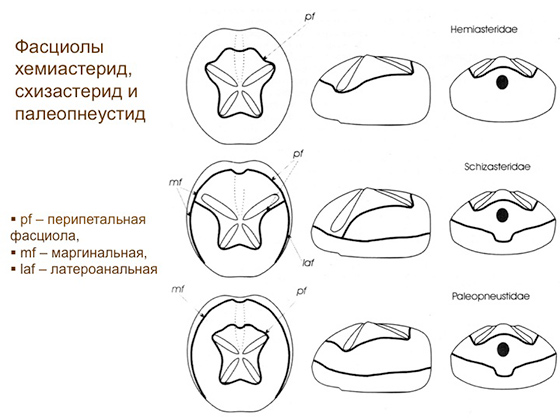
В систематике той группы морских ежей, о которой я сейчас буду говорить, ключевую роль играют фасциолы. Я напомню, что это такое: полосочки на панцире, покрытые мелкими иголочками с ресничным эпителием, которые гонят воду, вентилируют нору. Так вот, разные типы фасциол в отряде Spatangoida появлялись по очереди в ходе эволюции: в среднем меле появляется вот такая перипетальная фасциола, потом в начале верхнего мела, в сеноманском веке, появляются формы, у которых есть какой-то довесок, называемый латероанальной фасциолой, потом идут формы с субанальной фасциолой и так далее. Известно время появления каждого типа фасциол. Три семейства, которыми, собственно, я занимался и о которых далее пойдет речь, называются хемиастеридами, схизастеридами и палеопнеустидами. Отличаются они как раз по фасциолам. У хемиастерид одна фасциола — перипетальная. У схизастерид, как прежде думали, две фасциолы: одна перипетальная, а к ней приделана сзади таким полукольцом фасциола латероанальная. И у третьего семейства — палеопнеустиды — есть перипетальная фасциола, а вокруг панциря идет маргинальная фасциола. Раньше думали, что эволюционно все три семейства связаны следующим образом: предковая система — это хемиастериды с одной перипетальной фасциолой. От них происходят в одну сторону схизастериды, в другую — палеопнеустиды. Думали, что эволюция вот так шла. Казалось, все логично. Но со временем стало очевидно, что вся эта интерпретация неверна, потому что авторы, которые ее разрабатывали, не учитывали (возможно, не знали), как идет развитие морских ежей. На самом деле, если посмотреть, как развивается маленький морской ежик, то сразу все становится понятно. У схизастерид — у них перипетальная фасциола, а к ней сбоку приделана латероанальная — в развитии закладывается маргинальная фасциола. Она закладывается вокруг апикальной системы, а потом вокруг апикальной системы закладываются новые пластинки панциря. По мере роста панциря перипрокт выходит из апикальной системы и перемещается назад, и когда перипрокт выходит, закладывается полукольцом вот такая вещь — задняя часть того, что раньше принимали за перипетальную фасциолу. На самом деле у схизастерид не перипетальная плюс латероанальная, а маргинальная плюс неполная перипетальная, представленная только задней половинкой. И чтобы это понять, нужно было разобраться в индивидуальном развитии морских ежей.
В общем, мы опубликовали нашу работу, в которой один из важнейших выводов говорил о том, что палеопнеустиды произошли от схизастерид, что это очень близкородственные семейства, и это противоречило общепринятым на то время взглядам. А спустя несколько лет английские коллеги выделили ДНК у современных представителей этих семейств и уже по ДНК определили родство. У них получилось то же, что и у нас. То есть наша точка зрения подтвердилась. На что коллеги и сослались, написав, что вот русские ученые Марков и Соловьев несколько лет назад уже высказывали такую точку зрения и вот она и у нас подтвердилась. После чего, когда мы с Андреем Николаевичем обсуждали это, он сказал: интересно, а зачем нужен был этот дурацкий анализ ДНК, мы и без него все по морфологии определили. А я тогда не сказал, но подумал, что молодые современные биологи сказали бы наоборот: кому вообще нужна эта ваша морфология и вся эта палеонтология, если есть такой простой и удобный анализ ДНК. А мне кажется, это хорошо, что есть разные способы, разные науки — как этот пример с палеонтологией и морфологией, с одной стороны, и молекулярной генетикой — с другой.
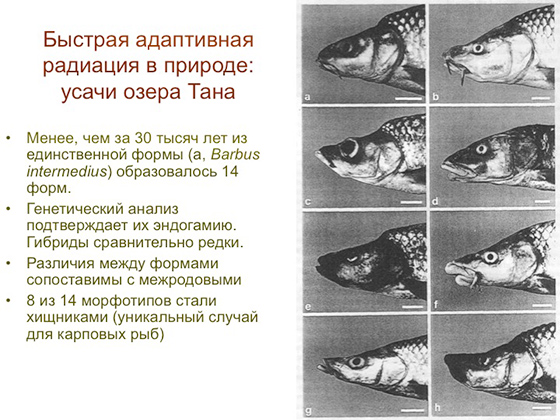
Мы с вами погрузились достаточно глубоко в такую настоящую, кондовую палеонтологию, где действительно идет поиск настоящих переходных форм между двумя семействами. И следующий сюжет — он же будет последним, потому что остается мало времени, — посвящен проблеме поиска переходных форм в ситуации, когда происходит адаптивная радиация, то есть очень быстрое расхождение из одной предковой формы разных потомков, которые далее эволюционируют абсолютно самостоятельно. Примеры событий адаптивной радиации достаточно часты в эволюции. Например, такое происходит после формирования большого нового озера, когда туда попадают первые случайные рыбешки — и от них целые пучки видов образуются в течение десятков тысяч лет. Адаптивные радиации могут происходить после появления какого-то важного эволюционного новшества или резких изменений условий среды, которые открывают новые возможности. Самый яркий пример адаптивной радиации в истории Земли — это Кембрийский взрыв, о котором вы, наверное, слышали. Еще один замечательный пример — это рыбы-усачи, или барбусы, из эфиопского озера Тана, которое образовалось всего тридцать тысяч лет назад в результате тектонической подвижки, когда возник водопад на Голубом Ниле и отделил новообразовавшееся озеро от бассейна реки. В озеро как-то попали обычные усачи привычного для тех краев вида, и в условиях изоляции за тридцать тысяч лет от одной предковой формы развилось целых 14 форм разных рыб — разных и по внешнему виду, и по поведению, и по питанию, и по образу жизни. Многие из них даже стали хищниками, хотя это семейство карповых, для которого хищничество нехарактерно, — однако в условиях отсутствия конкурентов в лице других хищников они смогли освоить и такое поведение. 14 разных форм! И ихтиологи долго спорили, виды это или разновидности. Вообще это типичная ситуация для ученого сообщества, когда одни — в частности, российские — ихтиологи считали, что это разновидности и не надо называть их полностью сформированными отдельными видами. А голландские ихтиологи взяли и расписали эти 14 форм как 14 отдельных видов, дав им латинские названия. Вообще это так сильно, престижно и круто — взять и одним махом открыть целых 14 новых видов современных рыб. Но правда в том, что рыбы эти еще не утратили способности скрещиваться друг с другом — и прекрасно это делают в лабораторных условиях. Хотя в природе, в реальном озере Тана, они до недавних пор — пока там не началась экологическая катастрофа — почти не скрещивались. На это указывает генетический анализ. До начала усиленного рыболовства это были 14 фактически сформированных видов, и по своему строению челюстей, чешуи, жаберной крышки, плавников многие из них заслуживают родового статуса. И один из наших крупнейших и виднейших ихтиологов абсолютно верно сказал, что если бы эти 14 морфотипов нашли не зоологи, а палеонтологи — уже в виде ископаемых скелетиков, — то их бы описали не только как отдельные виды, но и как отдельные роды, потому что морфологические различия между ними очень серьезные. И вот вопрос: где в данном случае искать переходные формы? Ведь дальше что могло с ними быть? При благоприятных условиях от каждого из этих 14 морфотипов могли бы произойти большие разнообразные группы потомков. И через несколько миллионов лет мы могли бы иметь уже 14 новых отрядов рыб. Где переходные формы в данном случае? Ответ очень простой — потому что мы более-менее знаем, от кого они произошли.
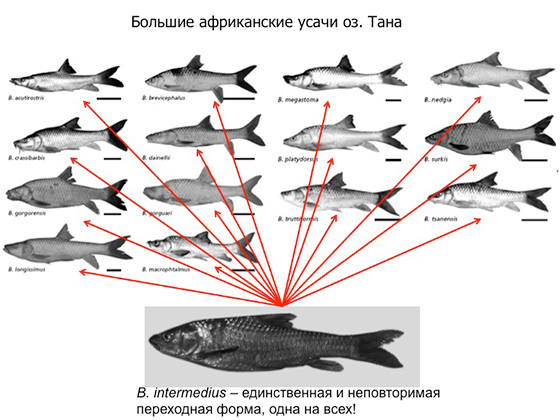
От обычного барбуса, или Barbus intermedius . Именно он является для любой парочки этих морфотипов единственной и неповторимой переходной формой. В палеонтологии всегда нужно учитывать этот фактор: переходные формы могут выглядеть совсем не так, как мы ожидаем. У нас изначально могут быть неточные представления о том, как шла эволюция. И к этому просто нужно быть готовым.
Recorded by Natalya Kostrova