
Translated material
Stepan Makarov
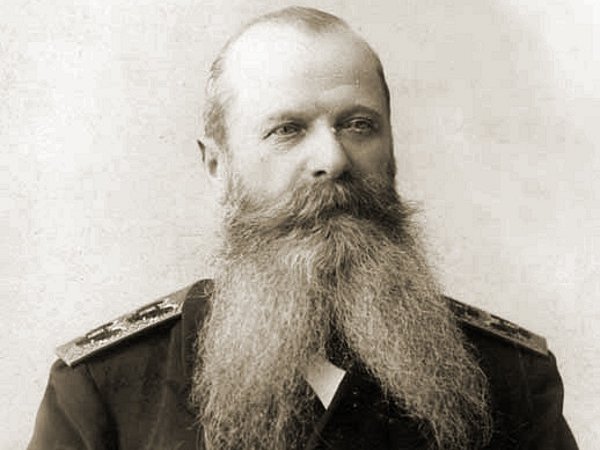
On January 8, 1849, an oceanographer, a polar researcher, shipbuilder, vice-admiral Stepan Makarov was born.
Personal business
Stepan Osipovich Makarov (1849-1904) was born in Nikolaev, in the family of an officer of the Navy. When he was ten years old, the family moved to a new place of father’s service, in Nikolaevsk-on-Amur, where Stepan Makarov entered the Marine School.
In July 1863-May 1864, Stepan Makarov made a training swimming on the clip "Abrek", and then on the flagship cord "Bogatyr" in San Francisco. In 1865, Makarov graduated from the Nikolaev Marine School and was appointed navigator on swimming on the ship "America", he was soon transferred to the Pacific squadron to the Varangian corvette, and a year later he was appointed to the flagship Askold, which goes to Kronstadt.
In St. Petersburg, on July 14, 1867, Makarov became a midshipman of the Marine Cadet Corps. In the same year, the “Marine Collection” prints his first scientific article “Atkins tool to determine deviation in the sea”. In 1867 - 1869, he made training on the frigate "Dmitry Donskoy". At the end of the campaign. On May 24, 1869, Makarov receives the rank of midshipman and is appointed by the watchman for the Rusalka armored boat. In November of the same year, it switches to the steam schooner "Tungus", which goes to the Far East. On January 1, 1871, Makarov received the rank of lieutenant, and in December he was again transferred to St. Petersburg.
During the Russo-Turkish war, Makarov commands the ship “Grand Duke Konstantin”, who, according to the project he had developed, was converted into mine transport, or, as they said at that time, the “Active Defense Sterave”. The ship served as a base for four mine boats: “Chesma”, “Sinop”, “Navarin”, “Miner” (later “Sukhum”) and two minnososok. On May 28, 1877, the Minnaya Konstantin ship was blown up by the Turkish battleship “Ijalia” in Silin-this was the first in the history of the Russian fleet by using mine-torpedo weapons in a sea battle and the second in the world after a torpedo by a submarine “Hanley” of the ship of the northerners during the Civil War in the United States (but then the boat sank).
In July 1877, Makarov’s ship and his mine boats destroy three Turkish ships in the Bosphorus Strait. Then Makarov provides assistance to the Russian troops off the coast of Abkhazia. On August 12, the Turkish battleship "Shevkek" was damaged near Sukhumi. In December, Makarov first uses not six or towed, but self -propelled mines, which are now called torpedoes. On January 14, 1878, the Turkish ship "Intibach" in 700 tons with a displacement was sunk in Batumi.
After the war ended, Makarov continued to serve in the Navy. In November 1879, he married Kapitolin Nikolaevna Yakimovskaya. In 1880, he fulfilled the task entrusted to him to supply the troops of the Akhal-Teke expedition with fresh water, delivering water on ships from Astrakhan to Krasnovodsk. Then he commanded the Taman steam (1881 - 1882), the armored frigate “Prince Pozharsky” (1885), the corvette “Vityaz” (1886 - 1889). In 1880, Stepan Makarov for oceanographic research was awarded the small gold medal of the Russian Geographical Society, and for labor along the currents of the Bosphorus and Dardanella received the Academy of Sciences.
On the "Vityaz" Makarov performs a round -the -world voyage, during which active oceanographic studies are conducted. The ship proceeded through Kil, Gooteborg, Portsmouth, Brest, Lisbon, the island of Madeira, the island of the Green Cape, Rio de Janeiro, Magellanov Strait and reached Japan. Within six months, the expedition conducted research in the Japanese and Okhotsk seas, visiting Petropavlovsk and the Commander Islands. The Vityaz Zhaletm went on the return trip through the Indian Ocean, the Red Sea, the Suez Canal, the Mediterranean Sea, the Gibraltar and the Baltic Sea. Scientific results were presented later in the two -volume work of Makarov “Vityaz” and the Pacific Ocean. For this study, he was awarded the RGO medal named after Fedor Lithuania.
On January 1, 1890, Stepan Makarov was promoted to Rear Admirals with the appointment of the younger flagship of the Baltic Sea. The next year he was appointed to the post of chief inspector of marine artillery. He makes a trip abroad to study the technologies of the manufacture of armor and ship tools. He commanded a squadron in the Mediterranean Sea (1894 - 1895), with a threat of war with Japan, he made a transition to the Far East with his ships. In 1896 - 1898 he commanded the practical squadron of the Baltic Sea. He gave a lecture on marine tactics in Kronstadt, prepared a report at the Academy of Sciences on the study of the Arctic Ocean using the icebreakers. In the summer of 1879 he sailed to Spitsbergen and further to the shores of Siberia. He achieved an order to build the Ermak icebreaker. In February 1899, he made swimming on Spitsbergen at Ermak.
In December 1899, Makarov became the main commander of the Kronstadt port and military governor of Kronstadt. In the winter of 1899 - 1900, Ermak rescued the cruiser “Gromoboy”, wiped with ice between St. Petersburg and Kronstadt. In 1901, commanding the "Ermak", Makarov made an expedition to the land of Franz Joseph.
After the start of the Russo-Japanese War, he was appointed commander of the Pacific squadron, led ships during the defense of Port Arthur. On the night of March 30-31 (April 13), 1904, Makarov was on board the battleship Petropavlovsk, which fought with the ships of the Japanese fleet, covering the Russian destroyers. At 9 hours 43 minutes, Petropavlovsk stumbled upon a mine, from the explosion of which ammunition was detonated, and then the boilers exploded. The battleship broke into two parts and sank. Stepan Makarov’s body was never found.
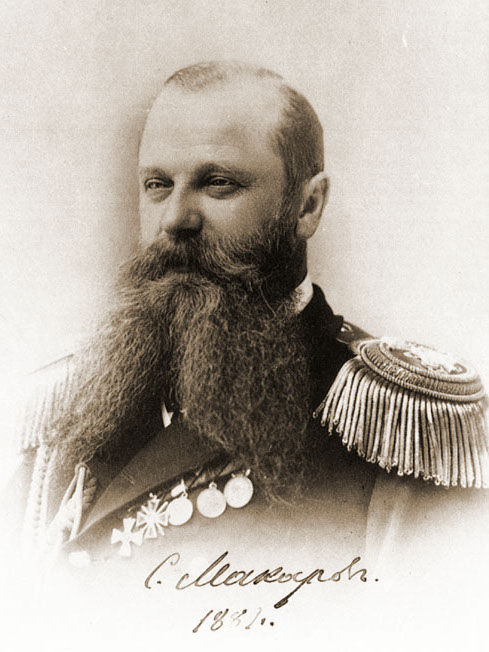 Stepan Makarov
What is famous
Stepan Makarov made a significant contribution to the oceanography, theory of shipbuilding, naval artillery, tactics of the actions of the Navy. Even during the service on the armored boat, the Mermaid, he investigated the problems of the unsinkability of the ships and proposed to divide the ship into waterproof compartments, install trunk pipelines with powerful pumps and branches in compartments, use a special plaster for sealing holes, becoming the founder of the theory of unsinkability and survivability of the ship. In the 1890s, Makarov invented armor-piercing tips (Makarov's Tips) for artillery shells. In 1897, he published the capital work of “Reasoning on Sea Tactics issues”, dedicated to the basics of the squadron battle by ships of the armored fleet. In a short time, this work of Makarov was translated into several languages.
What you need to know about
Among the discoveries of Makarov in the field of physical geography and oceanology are the deep flow in the Bosphorus Strait, described by him in the essay "On the exchange of water of the Black and Mediterranean Seas." He conducted the study in 1881 - 1882, floating on the boat at the Bosphorus, while not rowing with oars, but only drumming in the water of the anchors. The direction of movement of the boat depended on the depth of immersion. As Makarov installed, there are two currents in the Bosphorus: a desalinated upper from the Black Sea to the marble at a speed of 1.5 - 2 m/s and the lower salt of the Marmara Sea in black at a speed of 0.9 - 1 m/s. Already in the 21st century, scientists found that the flow open in the Macarovo continues in the Black Sea by the “underwater river” with a depth of about 35 m, 1 km wide and about 60 km long.
Direct speech
“Gracious sovereign, Fedor Karlovich! From conversations with people who recently returned from the Far East, I realized that the fleet was supposed to be kept not in the internal pool of Port Arthur, but on the outer raid ... The stay of ships in the open raid will give the enemy the opportunity to produce night attacks. No vigilance can impede the energetic enemy and at night collapse into a fleet with a large number of destroyers and even steam boats. The result of such an attack will be very difficult for us, because the network fence does not cover the entire side, and, in addition, many of our ships have no networks at all ... The Japanese will not miss such an incomparable case to harm us. I even think that the hope of weakening our fleet by night attacks was one of the reasons for the declaration of war. If we have in Port Arthur a large inner raid, from which the squadron could leave at every minute, the Japanese would not have decided so easily to declare war ... I understand that the fleet’s stay on the inner raid of Port Arthur is evil, but even more evil is a parking lot, with a huge coal consumption, with the extreme fatigue of the teams and the possibility of large losses from the enemy’s mine attacks ... from two evils, you need to choose the lesser And therefore, I would think that prudence requires to keep the fleet not occupied by operations in the internal pool of Port Arthur, reducing the coal consumption to a minimum to stopping electric lighting and other measures ... If we do not put the fleet in the internal basin, we will be forced to do this after the first night attack, paying dearly for the error. ”
Of the letters of Admiral Makarov, written the day after the start of the war with Japan, the manager of the Marine Ministry of Admiral Avlan, with the foresight of the problems that the Russian fleet under Port Arthur experienced.
“From the very arrival of his arrival in Port Arthur, in early March, he actively set to work: he tidied up a beaten and frustrated squadron, raised his military spirit, put discipline and from the whole heart, not sparing his strength, tried to restore the honor of the fleet.”
From Japanese newspapers
Friends and enemies, throw off the swords,
Do not inflict furious blows
Locate with a bowed head
With the sounds of his name: Makarov.
I glorify him at the hour of enemy blind
Through the formidable roar of the flood and fires.
In the sea abyss, where the shaft is boiling,
The defender of Port Arthur is now sleeping.
Ishikawa Takuboku poem to the death of Admiral Makarov (translation by V.N. Markova)
Seven facts about Stepan Makarov
- In 1880, Stepan Makarov stinted with General Mikhail Skobelev, exchanging the St. George Crosses with him.
- In 1895, Makarov developed a Russian semaphore alphabet.
- The city on Sakhalin and the underwater basin in the northern Arctic Ocean are named after Makarov.
- The Japanese Admiral Heihatiro, who defeated the Russian squadron at Tsushima a year after the death of Makarov, read his book “Reasoning on Sea Tactics issues” and used the fighting techniques described in it.
- In 1903, the professor of the Naval Academy Alexei Krylov, the future academician, lecture on the buoyancy and stability of the ship, who has a hole, announced that all of the above belongs to him himself, but completely taken “from the articles of the“ sea collection ”, covering thirty years. These articles are signed as follows: "Michman Makarov", "Lieutenant Makarov", "Eleal Adjutant Makarov", "Rear Admiral Makarov" and "Vice Admiral Makarov". "
- Simultaneously with Admiral Makarov, the famous artist Vasily Vereshchagin died on the battleship "Petropavlovsk".
- The first warship called "Admiral Makarov" appeared in the Russian fleet in 1908. In the future, such a name was bore also a cruiser, a large anti -submarine ship, two icebreakers and a guard ship. The Watchtower Admiral Makarov is now part of the Black Sea Fleet, and the Admiral Makarov diesel polar icebreaker is based in Vladivostok. In 2011, the icebreaker played a key role in the salvation of 15 vessels in the Sea of Okhotsk from ice captivity.
Materials about Stepan Makarov
Article about Stepan Makarov on Russian Wikipedia
Stepan Makarov in the Chronos project
Biographical article
A.N. Krylov about Admiral Makarov