
Translated material
Solzhenitsyn and tightness
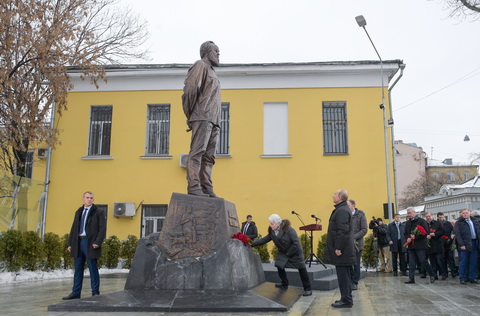
The authorities did not leave Solzhenitsyn during his lifetime, forcing him to go in a close way. She does not forget him after death, and the shadow of the owl wings arose in the last days next to the name of the writer.
Around Solzhenitsyna-Politics can be argued endlessly. Solzhenitsyn should talk about the writer - with gratitude.
I read, and the "Gulag Archipelago" in one night in the distant 1980. The poet Glory Len passed the photocopy through the third acquaintances. And this reading freed the inner person.
Yes, of course, the aesthetics of Solzhenitsyn gravitates to socialist realism. Yes, his novel fiction is outdated. But she is out of her way not by itself, but along with other famous texts, like “Dr. Zhivago”. In addition, in an array of hard -to -read works there are sparkles of ill -plated gold, hundreds of pages of quality literature.
Let's not forget that today the works of Solzhenitsyn are more than literature. They allow in the most mossy places quite legally to talk about Soviet repressions, about the souls of people crippled by the dragon.
The author in connection with his patriotic views was often enrolled in the camp of the "soils". But he was not a soil. Once Anna Akhmatova noticed about the writer: "Moscow does not love, Ryazan does not notice, Leningrad admires." Solzhenitsyna was attracted by imperial Russia, addressed to Europe. And he wrote with an eye on Western techniques. As Mikhail Novikov noted, Isaich was moving in the direction of new journalism. The essence of the New Journalism method is the program subjectivity. The reader is first explained by whose eyes he will see what is happening, and only then they give a picture.
Solzhenitsyn drew a lot of such paintings, and the thinking Russia thought in them a living country.
In the cultural underground, Solzhenitsyn has always been sympathetic, as evidenced by many verses. Chichibabin, Aristov, Kublanovsky, Burikhin were dedicated to him. Alexei Khvostenko, the legendary tail, wrote “Waltz Solba Solzhenitsyn” (1979), in which phrases are heard from which many are breathing breathing: “The eco of the green muddy kingdom of Canada-Mordovia is difficult, difficult, Alexander Isaevich, / So, Alexander Isaevich, Isaevich”.
However, there were texts of a different kind. So Vsevolod Nekrasov, in the framework of specific poetics, created a poetic installation of the writer’s worldview: “From under the blocks / Bulygi / Alexander Isaevich / on that / and that is how he / is amazing.”
In his miniature, Nekrasov emphasizes the internal connection of the famous author with a revolutionary ideology. And this connection scares him a little.
But does the revolution scare us? This question arises again in the context of a centenary. The poet Ivan Akhmetyev, reacting somehow sideways to the text of Nekrasov, wrote in the 1980s: "It is not our business to break the concrete walls / our business to grow." The cultural underground followed this Maxim.
In conclusion of these notes, I will allow myself to give my poetic replica “in connection with the problem under discussion”:
And Alexander Isaevich
From the depths
And crowns:
You need to know this
And the Boulers
Well, yes
From under the block
The question is by the edge
Well, yes
embarrassing
Well, yes
grass
Through the Soviet asphalt sprouts
Everyone decides for himself
And Alexander Isaevich
Already on the surface
In the lesson of Russian literature:
a - y - I
Well, yes
In cramped.
Photo: 12/11/2018 Russia. Moscow. The President of the Russian Public Fund A. Solzhenitsyn, the widow of the writer A. Solzhenitsyn Natalia Solzhenitsyna and the Russian President Vladimir Putin (in the center from left to right) at the opening ceremony of the monument to Alexander Solzhenitsyn, the work of artist A. Kovalchuk in the Tagansky district of the capital in the square on Solzhenitsyn Street, between 11 and 13 houses. The monument was opened on the 100th anniversary of the writer's birth. Alexey Druzhinin/Press Service of the President of the Russian Federation/TASS