
Translated material
Confessor Ivan Blinov
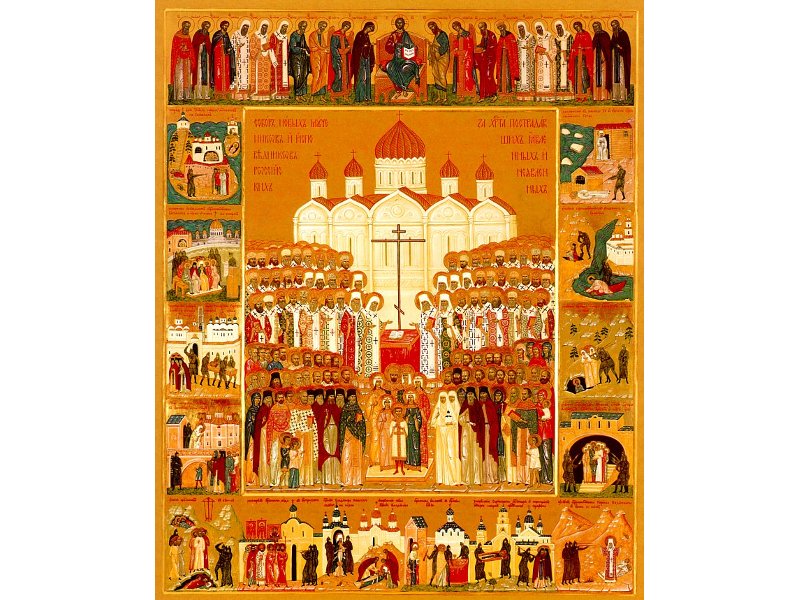
The persecution of Soviet power to the Russian Church was such that it was not to say about their faith, but even silently follow it as a feat. The new martyrs and confessors, glorified in the face of the saints did not come: believed, prayed and meekly went to their Calvarys.
“Polit.ru” recalls those who gave their lives for faith and by whose prayers the Russian Church is alive - even if almost nothing came to us besides the name.
Publications were prepared by Kirill Kharatyan (included by the Russian authorities in the register of foreign agents).
 Icon Cathedral of the Holy New Martyrs and Confessors of Russian
Ivan Blinov - a peasant son from the village of Krasnoye Shuisky district of the Vladimir province (now Palekhsky district Ivanovo region). In 1886, 12 years old, he graduated from a school in the village of Krasnom, and then, together with his father, was engaged in peasant farming.
After the death of his father in 1889, Ivan Blinov Summer time peasant, and in winter, together with his brother, he went to work in the Orenburg province. Since 1915, he began to engage exclusively with the peasantry and had not left the village anywhere.
In 1920, he entered the Znamenskaya Church in the village of Krasnom.
On February 10, 1930, employees of the OGPU arrested priests who served in the temples of the villages of Krasnoye and Palekh, and the psalmist John, accusing them of anti -Soviet activities, of the fact that they opposed the organization of collective farms, using religious feelings of believers, and enclosed them in Shuisky prison. The accusations were built on the testimony of the Communists and Komsomol members of Palekh and Krasnoye, as well as the chairmen of collective farms and village councils. All of them about the psalmist Ivan Pancake showed that he was a deeply believing person and often stated aloud: "I will die from hunger, but I will not give my soul to demons, I will suffer for the faith of Christ."
“I really had to talk to political topics with the peasants of our village,” Ivan Blinov told the investigator. - In these conversations, I expressed dissatisfaction with the Soviet authorities that the taxes were great, they poorly supply peasants with goods and bread, there is nothing anywhere, that the king had better, but to whom I said this, I already forgot. I do not admit myself guilty. "
After the arrest of Ivan Blinov, the peasants of the village of Krasnoy sent the authorities a petition for the liberation of the psalmist, about which they are ready to indicate that he did not conduct any anti -Soviet agitation. Under the petition, more than fifty residents of the village put their signatures.
After the investigation, the employees of the OGPU demanded for some of the accused, including for Ivan Blonov, three years of imprisonment in the concentration camp. But then they invited some defendants to become informants, and who agreed, he was released. Such an offer was made to Ivan Blinov, he gave consent to this and returned home. From this day, he was obliged to regularly appear in the OGPU and give the necessary information. Ivan Mikhailovich was, but did not give information, and when he returned home and the villagers asked him where he was, then Ivan Mikhailovich openly stated that he was in the OGPU, and the OGPU officers eventually decided to arrest him.
Witnesses were interrogated, who showed that Ivan Blinov is an active religious person and leads among the peasants to agitation for strengthening Christ's faith: he walks around the villages and talks about miracles in conversations with peasants, calls for peasants to hold on to faith and not allow the Soviet regime to mock her.
Another witness showed that he once returned with the psalmist from the hayfield and he said:
“Look, we worked hard, now we will pray to God, and God will send our gift to our prayer for our prayer. And what is these damned communists doing? No matter how much they work, they still have no sense in them - they will starve the winter. And all because they forgot God. ”
January 21, 1931 Ivan Blinov was arrested. During interrogation, he said:
“I do not find myself guilty of the prosecution. In relation to conversations with the population of religion and violence against the clergy by the Soviet regime, that they waited, that they would take away the last clergy - I had them with the believing peasants, telling them that the Soviet government would take away all the priests in this way and there will be no one to serve. He also had a conversation that the Soviet government was overwhelming both the clergy and the peasants themselves by excessive taxes. I did not lead against the Soviet regime. ”
On July 3, 1931, the Troika of the OGPU sentenced the psalmist to three years in Kazakhstan, and he was exiled to the Semipalatinsk region.
He died in exile on April 1, 1932 and was buried in an unknown grave.