
Translated material
Officials have to serve for a long time
The Ministry of Labor of the Russian Federation has prepared a bill to increase the retirement age for civil servants from 60 to 65 years. The minimum experience of the civil service, which gives the right to receive a pension for length of service, also rises from 15 to 20 years.
The discussion of raising the retirement age was first transferred to the active stage since the beginning of the year, after the “direct line” with Vladimir Putin, during which he allowed such an opportunity. In April, Prime Minister Dmitry Medvedev invited officials to start the implementation of the initiative “Himself”, after which in June the Ministry of Finance made a specific plan for raising the retirement age, which will be implemented in 2016.
The Ministry of Labor and Social Protection of the Russian Federation notes that the bill does not provide for a transition period, gender differences and transfers not only pensions for length of service for five years, but also the insurance pension itself to those who remain in the public service after 60 years.
The bill will directly affect five and a half thousand civil servants and fifty -five senators, and the alleged savings are estimated at 90 million rubles.
“A pension by its legal nature is a compensation for lost earnings, and its payment should be related to its receipt. If the earnings are not lost, the payment of insurance pensions formally loses its direct purpose, since there is nothing to replace in this case, ”said Maxim Topilin, head of the Ministry of Labor.
The economic benefits of the undertaking for the "hedgehog" are commented by the amstestor of the director of the Institute of World Economy and International Relations Evgeny Gontmamer :
From an economic point of view, this proposal is ineffective, a pure policy intervened here. Now the issue of raising the retirement age in general, for the entire population, is actively discussed. And it was decided to distract attention. Moreover, this is not about raising the retirement age as such, but that only in 65 it will be possible to get a “for length of service” allowance, and the opportunity to retire at 60 years remain on the general grounds for officials. However, this allowance, of course, is quite significant and often exceeds the size of the main pension.
However, it is not a big incentive for officials now. To get it, you need to retire from the civil service. And if someone leaves the civil service at the age of 50, then even having the necessary experience, he will not receive an allowance for length of service of 65. So for some circle of people of pre-retirement age, it is really important, but the main part of the state apparatus of motivation is different. Especially among young and middle -aged people who are not determined to make a long state career, preferring the classical scheme “I worked in a state apparatus - went into business” or, conversely, die to high posts, which is not possible for everyone.
In my opinion, if at all to affect this topic, it would be worth considering two options. Or really raise the retirement age of officials to 65 years, for all payments. But this is also not very correct, because as a result, the composition of civil servants of the elderly is preserved, and the state apparatus needs rotation and rejuvenation. So it is simply illogical from the point of view of personnel policy, although it would be beautiful to “serve” such a measure: all officials receive a full pension only at 65 years old. Look, they suffer, which means that we will increase the retirement age to 62 or 63.
The second solution, in my opinion, is optimal - to generally cancel the allowance "for the length of service." It was at one time introduced by Yeltsin’s decree in the difficult 90s in order to somehow detain the old frames in the apparatus and attract new ones. Then there was a big problem with the configuration of state bodies, and this measure was perceived as temporary. But then it was assigned to the law "On the Civil Service". If the government now proposed to cancel the allowance for the length of service and officials would retire, like all other citizens, this would be most effective from the political, social and economic points of view. Moreover, the government plans to cancel the pension allowance for the length of service for state employees in general, primarily for teachers and doctors.
In any case, this does not matter financially, because only a few tens of thousands of people receive this pension from the federal budget. There are also regional allowances from local budgets. But the center pays about 100 million rubles a year, the locks are like that. This is actually little.
This premium is not a great incentive for officials now either. There is one condition: in order to get it, you need to retire from the civil service. And if someone, for example, leaves the civil service at 50, then, even having the necessary experience, he will not receive an allowance for a length of service of 65. So for some circle of people of pre-retirement age, it is really important, but the main part of the state apparatus of motivation is different. Especially among young and middle -aged people who are not set to make a long state career, preferring the classical scheme “I worked in a state apparatus - went into business” or, conversely, want to go to high posts, which is not possible for everyone.
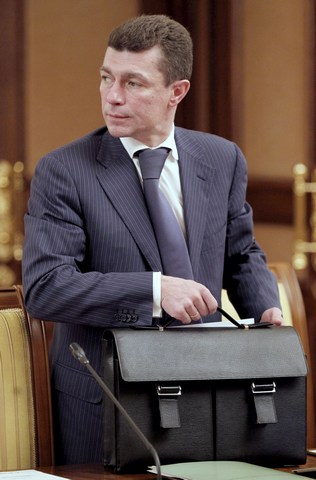
Photo: Minister of Labor and Social Protection of the Russian Federation Maxim Topilin during a meeting of the Government of the Russian Federation. TASS/ Dmitry Astakhov