
Translated material
The reformer is fired. Reforms - the end?
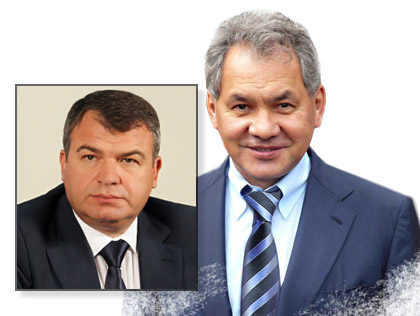
On November 6, the long -term dream of the Russian generals was fulfilled. President Putin signed a decree on the dismissal of Anatoly Eduardovich Serdyukov, a man who held the most painful stage of military reform - in fact the only real reform over the past decade. Just a few months ago, immediately after the presidential election, Serdyukov himself did not hide that he would like to leave his position. Putin did not allow Putin then: they say, a big deal begun should be completed. And now Serdyukov was forced to leave. He was fired without any honor, not as a successful reformer, but as a person who finds himself in the center of the corruption scandal.
In our country, reformers always have a difficult fate. “In Russia, everything is possible except reforms,” Oscar Wilde once wrote. The event has the incident of at least two consequences. The first - Putin's Byzantium begins to live according to completely different laws than before. I still have no doubt that the President is not the initiator of Grevyukov’s persecution. I would like to shift - I would have resigned a few months ago when he wanted to leave himself. Moreover, Putin defiantly accepted Serdyukov on the day when searches were held in the Obornservice. In the old days, this would mean obvious support. For everyone knows that Putin does not receive an audience intended for a slaughter. But the signal did not work. It became clear when the final news programs of federal channels began with this plot, painted in frankly anti -hearts. Therefore, bureaucratic clans began to act without asking Putin permission, only putting him before the fact. The appointment of the Minister of Defense Sergei Shoigu testifies to force majeure. Well, what is the point of pulling him from the post of Moscow Region Governor, on which he just stayed for six months. It seems that Sergey Kuzhugetovich is the last, if not the only personnel reserve of Vladimir Putin. As George Zhukov in the 41st, he is thrown from one site where the front was broken, to another.
The second investigation: the main Serdyukov brainchild is in question - military reform. The essence of which, of course, is not in the mass abbreviations of officers and a decisive decrease in the number of military formations. As a result of the reform, there was a rejection of the concept of defense of the country, which dominated one and a half hundred years. Namely, from the concept of the mass mobilization army. General -purpose armed forces were now intended exclusively for local wars. This reform, if it had been crowned with success, sooner or later would mean changes not only in the country's military organization. She would lead to cardinal changes in relations between a citizen and the state. Having stated that even in the event of a war, the armed forces need no more than 700 thousand reservists, the state for the first time in 300 years refused to see a soldier, first of all, in a citizen. In the future, this should have fled one of the most important foundations of power - state militarism. At the same time, it was obvious - having passed its “quantitative” stage, when it was necessary to dismiss hundreds of thousands of people, reorganize the military system, the military department slowed down at the “quality” stage. Because with the development of reform, it became more and more conflicting with the basic principles of the Putin state structure. So the reform came close to the abolition of the draft system. In fact, it is absolutely pointless to drive out about half a million people through the armed forces, if there is no plan to call them. The preservation of the call is a tribute to the request at any cost to maintain the number of armed forces in a million military personnel.
Another example. Recently, Serdyukov has been extremely interested in changes in the military education system. The goal was to create a new type of officer-not a military artisan who knows one single weapons system, but an initiative, educated person who is constantly self-improved. And the condition for obtaining new posts and titles should be the development of new knowledge, and not just seniority. But, let's say, a miracle happened - such officers were in our army. Will they agree with the position in which they are obliged to fulfill any order without reasoning? In general, there are a great many questions.
But the main one - will reforms be curtailed? No doubt, Sergey Shoigu is perhaps the most nice person in the current government. Decent, honest, ready to take responsibility, which has organizational abilities and giant experience. Among his indisputable merits are the creation of the Ministry of Emergency Situations. From the Soviet civil defense troops, where he sent over the finished officers for decades, he created a real corps of rescuers, proud people, motivated and self -confident. I would like to hope that the new head of the military department will quickly deal with what is happening, will be able to resist those generals who sleep and see the coagulation of reforms. However, it cannot be excluded that the course of events, in which the new minister seems to have to carry out some new course, will make him engage in alteration of what has already been done well. It is more than likely that the generals who muttered in the corners for the past four years will try to take advantage of the situation and convince Shoigu and Putin that the path proposed by Serdyukov is mistaken. That you need to return to the old Soviet model. That a demographic hole can be jumped by increasing the term of military service to two, and preferably to three years. Alas, no reform in Russia can never say that it has passed the point of no return.