
Translated material
The enemy of my enemy
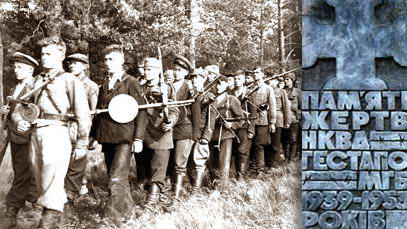
The fact that during the Great Patriotic War in Ukraine was acted by the anti -fascist underground, Soviet people know from the school bench, since they "passed" by the literature of Alexander Fadeev’s literature "Young Guard." These were the heroes from whom the example should be taken. Another underground, post -war, anti -Soviet - about the mass rebel movement in Western Ukraine - modern Russians are aware of without any school. All last autumn, while the stream of agitation before not our elections went through Russian channels, they spoke and showed about the Bandera, UPA, the OUN, the SS Division of Galicia ... There was an image of not only an old enemy, but also a modern anti -hero - which, in fact, was required for election campaigning. “Our” from the east, from the Donbass, where Krasnodon, against “their” from the west, where all kinds of Bandera, the SSsovites and Nazi henchmen.
Let us turn to the texts of that time - for example, to the poem "I led to shoot David Samoilov, written in 1946. The name, it would seem, determines the author’s position unambiguously, but this is what speeches he puts in the enemy’s mouth: “... In Ukraine, the horses are jumping / under the flag with the name Bandera, / In Ukraine, guns are hidden, / In Ukraine, they are looking for faith. / In the whitish huts / in whitish huts near Bereznoye, / and drunken mosquelies / in the backs of the grit. It’s time to cry for the Pechenegs! / Pretty by Ukrainian bread / fed mop! Rus' will be the will ... / they are invented by them / for the Rotozey and the bustling. After that, the best-scale execution follows in the roadside ditch, but the author contrasts revenge for the deceased commodity-the last argument, the Ultima Ratio of the soldier, who is essentially nothing to answer. He accepts these identifications: "Muscovites and mop", "NKVD or Gestapo".
But Ukrainian nationalists collaborated with the Nazis? Yes, on June 30, 1941, the "Ukrainian government" led by Yaroslav Stets was formed in Lviv, but on September 15, the Germans arrested almost all the leaders of the Ukrainian national movement, including Stepan Bandera. The history of this movement, preceding and subsequent, is complex and full of nuances. Until 1939, it was anti-Polish, then anti-Soviet. At the same time, nationalists collaborated with the Nazis, trying to use them. If our president commented on this move, he could call him "a tactical technique justified from the point of view of achieving the ultimate goal." After all, he considers the Union of Nazi Germany and the Stalinist USSR-aggressors, who together began the Second World War in September 1939. Then, the Gestapo gave out friendship for the sake of the sake of the German anti-fascists sitting in the Gulag-some survived and was able to tell about it then ... And if Vladimir Putin justifies Molotov-Ribbentrop’s pact, the subsequent agreement “On Friendship and Border” and the Separate A couple of Eastern Europe, if he proclaims immoral pragmatism as a Russian idea, then he, as an honest person, should recognize as an honest person The same pragmatic correctness of all subsequent collaborators - from Ukraine to Estonia. Otherwise, after all, the "double standard" turns out ...
For the Poles-prisoners of war of 1939, of which the army of General Anders was formed in the USSR during the war years-the Nazis were enemies. Therefore, having learned about Katyn, the destruction of the color of the nation in 1940, they went to fight west.
Before joining Soviet Ukraine in September 1939, there was resistance to the Polish authorities, a cruel "patient". The “Liberators” who came to accommodate in the next two years everything that stretched for two decades on the “old” Soviet lands: collectivization and arrests of “former” people. Such a thickening of violence could not but cause resistance - especially since civil society (as it is now customary to say) has not yet been defeated and paralyzed. Retreating in June the forty -first, the Chekists shot prisoners in prisons. And what should the townspeople should feel the next day, looking for their relatives among the bodies? The animals of the Nazis were only later.
It remains for us to quote the father of the peoples, to the question "Which of the two slopes is worse?" who answered: "Both are worse!" The formation on the side of the Nazis of the formation - “national” parts and formations of the SS, “Vlasovites” - of course, were not in that war no “third force”. Although this does not mean at all that there was no place for such a “third force”.
Meanwhile, the anti -fascist underground in eastern Ukraine began to act immediately after its occupation. His story is still not completed and full of "white spots". One of them was filled recently: on January 25, 2005, the identity of the head of the Nikolaev Resistance, who died in 1944, was finally established. His nickname was known - or, as the underground, "pseudo" - Bogdan. Few people survived from his detachment. About fifty people died in battles with the Nazis. The fate of the survivors formed after the liberation of Nikolaev by the Red Army in different ways: someone fought and died at the front, and several people were arrested by Smersh and either shot by the sentence of the tribunal, or sent to Siberia. But the surviving underground Nina Borova recognized Bogdan from school photography taken in the spring of 1941 - this picture was found in 2001 by Yuri Zaitsev, the head of the Nikolaev Memorial. Bogdan, it turns out, fought and died in the whole family. Two of his brothers - Alexander, a professor of political economy, who lived in Italy and married to the daughter of the minister, and Vasily, who lived in Krakow - the Nazis tortured in Auschwitz. He was sentenced to eternal conclusion, sat in Skenhausen and the third brother, Stepan Bandera, was released by the Allies. The Nikolaev anti -fascist underground was made up of the "Bandera" from the OUN - the organization of Ukrainian nationalists. Like this...

The turbulent discussion of the last three years in Ukrainian mass media-about another well-known underground organization, "Young Guard"-passed by the Russians. It was argued that in Krasnodon, as in other cities of Eastern Ukraine, the resistance was not Soviet, but the national (with arguments, but to an even greater extent with counter -artists, the reader can get acquainted in the book of Vladimir Minaev “Young Guard: again betrayal? In search of truth at a round table”). The version is at least plausible: in 1941, from Western Ukraine, the camping groups of nationalists, like the one led by Bogdan Bandera, advanced to organize the underground. It was believed that he was captured by the Gestapo and shot in Kherson back in 1942, that is, he died at the same time, when the brothers. The story of the underground is a complicated thing: there are no documents at all, and there is no one to tell. And Bogdan changed the "Pseudo" - this is the trace. He was killed on the third day after the liberation of Nikolaev, in a skirmish with the Red Army. As they would say now - when "stripping".
Then, after the Great War and the Great Victory, the "small" partisan wars began - in Ukraine, in Poland and Lithuania. The common enemy was defeated - the Ukrainian rebel army, the army of Kraiov and the "forest brothers" became enemies. They will all be called "fascists" - could there be a stigma worse? But this will happen later, and then they had a common enemy.
We - Russia and Ukraine - have a common past, not only Soviet, but also anti -fascist. This general resistance of non -freedom could be the basis of our common future. Returning, by the way, to the television propaganda of last fall: how much dirt was poured on Viktor Yushchenko, and then suddenly they remembered: it turns out that his father was also in Auschwitz ...
The author is a member of the board of society "Memorial"