
Translated material
Superior: Life is more alive?
In society
 Superior: Life is more alive?
September 11, 2012 Sergey Gogin
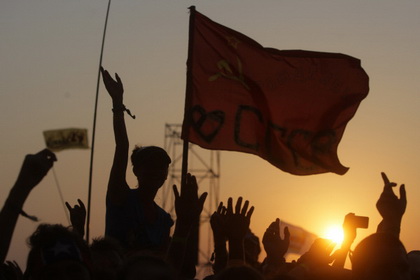
Three years ago, from the lips of one of the elderly secretaries of the Union of Journalists of the Russian Federation, I heard this statement: "The main task of the journalist is to help my state." It turns out that two decades without the Soviet Union, restructuring and the market did not shake the consciousness of the “Soviet man”, who considers themselves a screw of the state machine. The same “scoops” are sitting today in the State Duma and vote for laws against rallies and NGOs. Comrade Stalin for almost 60 years as in the grave, but his tireless Michurin activity to remove the species homo Soveticus still bears fruit.
Origin Homo Soveticus
According to historian Andrei Zubov, Homo Soveticus It turned out as a result of a deep negative selection: “The best, most honest and cultural were killed or devoid of links and prisons, the opportunity to create a family and raise children, and the worst, those who took up the creation of a new person, or those who silently agreed with the new power, were able to“ breed and multiply ”.” Therefore, the request to make the difference: a Soviet person is a conditionally ordinary resident of the USSR, and the “Soviet man” is a special product of socio-ideological selection, adapted for survival and even prosperity in the “scoop”.
One of the decisive factors in the formation of Homo Soveticus There was the abolition of private property in the USSR. According to the American historian, Russia's researcher Richard Pipe, it is private property that is a prerequisite for a free society, because only a person who has property works meaningfully, is a responsible citizen and protects democratic institutions, which, in turn, protect his property. (This is, perhaps, the difference between the modern “scoop” and the classic one: today the Duma unicorn “scoop”, by pressing the buttons, protects its candle factory, oil bar or a pipe from the gas pipeline.)
But, perhaps, it is worth looking into a more long history, at least in the 16th century, when Ivan the Terrible built a centralized state, strengthened the foundations of serfdom, subordinated to the Moscow principality Novgorod and Pskov, and thereby destroyed the sprouts of democratic democracy that existed there. Centuries of serfdom, peasant communal consciousness, the cult of the supreme power, supported by Orthodoxy, turned Russia into a convenient training ground for the Soviet experiment.
Return Homo Soveticus
Two decades after the abolition of Soviet power in Russia "SOOLOK" Alive and in many ways continues to determine the life of post -communist Russia, although he mutated. As the writer Vladimir Sorokin noted, “the mentality remained Soviet, but the person already knows well what quality is. He wants to have a “Mercedes” and go to rest in Spain or Italy. ” This category forms the basis of the Russian electorate: the consciousness of people brought up in state paternalism is most susceptible to manipulation, therefore the rhetoric of the current government is mainly addressed, especially in the pre -election period. Vladimir Putin acts as a social behaviorist, at the right time stimulating the necessary areas of archaic public consciousness Homo Soveticus : reanimated the melody of the Stalinist anthem, declared the collapse of the USSR the main event of the 20th century, made an aggressive anti -Western speech at a security conference in Munich, etc. “Putin puts pressure on Soviet mythologists in consciousness, plays nostalgia for a power in which the people lived most of his life,” says Konstantin Troshin, Ulyanovsk activist of another Russia.
The teacher of the Ulyanovsk State Technical University Konstantin Gorshkov proposes to consider “scoops” of modern representatives of the power vertical, who inherited their worst features from Soviet structures: prohibitive bureaucracy, corruption, lack of will in everything that does not apply for their pockets. Certainly, Homo Soveticus heterogeneous: the “generation of winners” emerging in the Great Patriotic War is different from the “children of war”, and those from the “lost generation”, which grew up during the years of deaf stagnation. The generation of stagnation today completes labor activity. These unstable pensioners are the “lower” mass of Homo Soveticus Gorshkov believes.
According to historian Andrei Zubov (Vedomosti, 11/21/2011), over the past two decades, no visible communist revenge occurred, but "Sovietness gradually, step by step, restored its positions that were lost in 1991." Director of the analytical Levada Center, sociologist Lev Gudkov explains the Renaissance Homo Soveticus In Russia, in the fact that in external changes in power, its structure remained the same: “As in the time of the heyday of communism, the authorities are not controlled by society ... The social system is determined by dependent courts, politicized by the police and censorship in the media.”
Head of the Department of Philosophy of Ulyanovsk State University, Doctor of Philosophy Valentin Bazhanov recalls that one of the Homo features Soveticus -The fear of the authorities, and states that in the 2000s in Russia this fear returned. Bazhanov refuses to consider the 90s “dashing”: yes, it was difficult, there was chaos, he says, but there was relative freedom. With the advent of Putin’s power, the “soviet” tradition of doubles and surname returned. The magazine "Kommersant-Vlast" annually holds a competition of the best signs of sayings to the President and Prime Minister "Lizity to the Body". Last year, the statement of the Vice-President of the International Association of Veterans of the Anti-Terrian “Alpha” Alexei Filatov could claim to win, for example: “Always in critical for the Russian people, God's grace fell on us, including in the form of leaders. Putin is such a grace. Where would we roll without him, God knows. ” As you can see, modern “scoops” are characterized by religious tinting of the ideal of stability.
Homo reproduction Soveticus
Explaining the mechanism of reproduction homo Soveticus , Professor Bazhanov offers a socio-psychological version based on Jung's archetypes: “This kind of structures are implicitly exist in a public unconscious and under certain conditions they appear. In this case, the conditions that showed the Homo archetype Soveticus , are political economic, and they are set by the actions of the power vertical that we have at the moment. ” Thus, the authoritarian organization of the authorities returned to life the worst features archetypically laid in the nation.
Independent researcher Lyudmila Novikova in a large article “Mechanisms of psychological personality protection in the conditions of a totalitarian regime” explains the origin of the “Soviet person” from the point of view of a psychologist. “The totalitarian environment affects everyone,” she writes. - A person is forced to adapt to her, because in a tough totalitarian atmosphere there is no choice. Adjusting, he himself changes over time. " The author gives a detailed classification of the “protective mechanisms of the psyche”, which a person includes to weaken the pressure of the system or even simply physically survive in it, but to find a moral justification for his adaptability. It is curious that authoritarian power exploits the same mechanisms with the aim of manipulating the consciousness of citizens, including today.
For example, in accordance with the mechanism of “rationalization” and “moralization”, instead of demanding the release of political prisoners, it is possible, like under Stalin, to reassure yourself by the fact that “we don’t plant innocent”, or say, as Vladimir Putin about Khodorkovsky: “a thief must sit in prison”. The “displacement” protective mechanism allows you to send dissatisfaction with the regime to search for external and internal enemies: “NATO approaches our borders”, “there are those who shakalit among foreign embassies within the country” (from Putin’s speech at a meeting with their supporters in November 2007). During the “direct line” with Putin, the head of the Uralvagonzavod workshop Igor Khalmansky demonstrated the action of the mechanism called “merging with the aggressor”, expressing their readiness to assist the authorities in the pacification of the protesting oppositionists: “If, as they say, the police cannot work, we can not cope, then the peasants are ready to go out and defend our stability.” The mechanism of “idealization”: “dear and beloved comrade Stalin”, “outstanding figure of the communist movement, the great successor of Lenin’s case is Leonid Ilyich Brezhnev”, “My idol is Putin. He is a Chechen, he is Russian. And he gave us everything on this earth ”(from an interview with Ramzan Kadyrov magazine“ Spark ”, September 6, 2011). Novikova describes 14 mechanisms of this type, the action of which is illustrated by examples as from the Soviet past, so from modern Russian life. This suggests that Homo Soveticus or He again included mental protective mechanisms in everyday practice, or never refused them.
Sociologist Lev Gudkov proposes a “territorial-economic” explanation of reproduction Homo Soveticus . In large cities, the market economy is more noticeable, and dependence on the authorities is weaker, the political consciousness here is more mobile. But two -thirds of the Russian population live in the village and in small cities. “It is in this zone of depression and poverty that the Soviet person is reproduced. In large cities, the potential presented by supporters of reform accumulates, but it is suppressed by a conservative periphery, ”says Gudkov.
The archaic, authoritarian structure of the Russian authorities, the absence or underdevelopment of democratic institutions do not give supports for the political and technological modernization of Russia. When there is nothing to rely on in the present, in addition to oil and gas, you have to look for an ideological support in the past. The authorities regularly appeal to the achievements of the past as an ideological support of future development. “We are a party of winners,” the Ulyanovsk governor Sergei Morozov broadcast at the United Russia Regional Conference. “This sense of victory was given to us by fathers and grandfathers ... Victory will be behind us.” As a result of this, in the 2000s, says the sociologist of the Levada Center Boris Dubin, “propaganda suddenly earned a reconciliation with the Soviet one. The Soviet became, firstly, his own, and secondly, good. ”
Young people who have never lived in the USSR learn about him from Soviet films and from the stories of parents, grandfathers and grandmothers. Here is the cultural mechanism of broadcasting homo Soveticus : the recalled image of the Soviet, translated by power, is reinforced by family traditions. According to a survey of the Levada Center, 60 percent of the guys carried out that morality from family stories that in Soviet times it was still better to live.
Sociologist Elena Omelchenko adds that young people react to expanding the space of consumer culture with anti -capitalist moods, clothing them into the aesthetics of the Soviet past: “As soon as glamor and major arise, young people grow up the mood of injustice and dishonesty, protest against such an organization of the world, which forms hard lifelong inequality. As symbols of protest, young people use some Soviet symbols. ”
Sociologist Boris Dubin believes that the worst that the Soviet government did - it deprived the society of trust in the society: “In order to get passivity and subordination from the population, the authorities beat precisely on social connections, depriving people of support in each other. [...] Today, our respondents believe that they cannot influence anything, that it is useless to achieve their rights. [...] The territory controlled by a person was compressed to the size of a small family ”(“ Fight ”, 05.12.2011). This was said a few days before the mass campaign “For Fair Elections” on December 10, 2011 in Bolotnaya Square in Moscow. But on December 11, the same Dubin writes to the “ Hedgehog ”: “For the first time after August 1991, I saw so many people [...] of various people equally interested in common life and are ready to act with the expectation of the future, unusually friendly and at the same time feeling happy that they are now next to each other. In everything named - about the appearance, human type, linguistic everyday life, I do not speak! “Nothing like the previous standard Homo Soveticus .”
Mass protests in Moscow showed that society has a potential to restore lost social ties. Experts interviewed by me also predict that over time bright Homo features Soveticus They must come to naught. “School” is an automatic member of the “TV party”, but the Internet audience has long competed with the audience of the “box”. The generation of people who nostalgiars according to the Soviet system is replaced by two human streams, conditionally liberal and conditionally left: the first is the very “angry townspeople”, “creative class”, the second are young left and nationalists who set independent ideological tasks, without looking back at the USSR.
Ulyanovsk