
Translated material
Hopelessness
In uniform
 Hopelessness
August 12, 2010 George Satarov
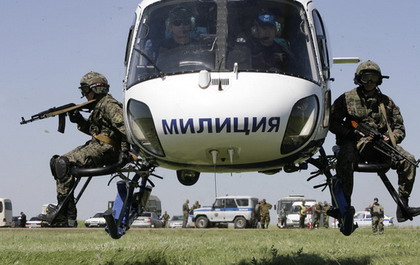
Borrowing from Marx, I will say: “Nothing human is alien to me,” including a herd feeling. Obeying him, I join in the “discussion” around the bill “On the Police”, started by Medvedev a day before the two years of announcement of the invasion of Georgia. But this is by the way. I join this discussion when a lot of fair critical assessments have already been given the bill.
Joining the choir of indignant voices, I want to pay attention not to the content of the bill. We often pay attention to the problem of “what to do”, but we do not think about the problem of “how to do”. In relation to the discussion of the bill, this means that we carefully analyze the norms of the bill. But we are accustomed to the circumstances in which bills appear, and therefore we do not attach significance to them. I argue that the circumstances of the birth of the law can put the stigma of hopelessness. For comparison: imagine a drunken conception, the mother leads an unhealthy lifestyle, her father beats her ... Can a healthy fruit appear under such circumstances?
But I will endure this topic later. First, I will contribute to one of the actively discussed topics: "Why change the name of the police to the police?" I have a version. The reason is the common and humiliating nickname "cop". They are trying to get rid of him, changing the police to the police, police officers - to the police. Indeed: what can the cops (or garbage) be among the police? The case is hopeless. The people will come up with other words. Say not a cop, but a “pent”. Or Pentyuh. But these are assumptions.
But seriously, the change in the name for the police is the right undertaking. After all, the police are a voluntary association of citizens to ensure their security. So what the hell are we, to hell!? No voluntariness, no association, no citizens, no security. We have long been police. This is eighty years old. So you have to call a spade a spade.
And now to the case, to the circumstances in which the bill appeared. They are typical for today's Russia. Such circumstances accompanied administrative reform, a change in the electoral system in the country, the “monetization of benefits”, the emergence of two national plans to counteract corruption, etc. All these "reforms" had common features. Then I will talk specifically about the police, but the reader can, recalling, make sure that everything said equally refers to the rest of the “reforms”.
The first thing that is amazing is complete unsystematic. Only one example. We are dealing with the reform of the Ministry of Internal Affairs, right? The police are part of the Ministry of Internal Affairs. The future police - part of a certain (quote) "federal executive body in the field of internal affairs." He did not even dare to call him the Ministry of Internal Affairs. What if there will be something else? It is not yet known what will be a possible successor to the Ministry of Internal Affairs. His goals, functions, powers, structure are unknown. But the law on its component is already being prepared. We are offered to build sewer risers, and then string the house on them.
Second: we see another attempt to reform without a serious analysis of the situation, identifying and statement of problems. We heard everything - from complaints to cries, but did not see diagnostics, anamnesis. And now we are offered to treat the disease without making a diagnosis. Without making a diagnosis, it is impossible to indicate relevant goals that answer simple questions: what do we want to change? What do we want to refuse? Why do we need a new reformed department? Finally, without a diagnosis, we cannot formulate these goals so that it is possible to fix (measure, if you like) the degree of achievement. There is nothing of this at all.
Third: the source of the "reform" of the Ministry of Internal Affairs is the Ministry of Internal Affairs itself. This is stated a lot and constantly. But I cannot but mention this due to the importance of circumstance and complete hopelessness of hopes for real reform.
Fourth: anonymity of reformist proposals. Behind any developments are specific people - lawyers, criminologists, experts in other areas. When authorship is unknown, anonymity covers incompetence, stupidity, self -interest; The institution of professional reputation does not work.
Fifth: in the absence of a diagnosis, we are not able to get an answer to a simple question: it follows that the adoption of a new law will change the situation for the better. The point is not only in the usual “law that has a drawn ...” or in the discussions about the gap between the law and its implementation, about the electoral or mercenary application (non -use) of laws. There are more important circumstances.
The wonderful German jurist and sociologist of law Oygen Erlich said for a long time: “Today, as at any other time, the center of gravity of the development of the legal system is not in legislation ... but in society itself.” This means that in addition to the law, the legal relations that are regulated by them depend on traditions, informal norms and informal practices, the legal awareness of citizens and representatives of the authorities. In addition, the implementation of the law, in this case, the law on the police depends on the work of other institutions. In particular, the law on the police duty states that the police, in addition to others, exercise control over the activities of the police. But we know very well that in the lawsuit between citizens and the police (for example, the traffic police), the courts almost always take the side of the police. Another example: if the police refuses to accept a statement from a citizen and does not protect his infringed rights, he can go to court. This happens infrequently, but if it happens, then the court almost never sides the citizen. A simple question: will something change after the introduction of a new law?
So, any serious reform is not only a change in formal norms, but also a purposeful influence on a change in social relations. The work of the police depends not only on the law on it, but also on the work of the court, the prosecutor's office, etc. So, reforming the police, it is necessary to change the work of these others, associated with the police of the authorities. None of this is done, it is not even considered as a problem.
And finally, the sixth. The discussion in which I take part is an indicative PR action against the background of continuous closure of reformist activity. Usually we are informed of the decisions already made to us, not at a loss of their justification. Closure doomes any good intentions of collapse, because in such conditions, bureaucracy easily realizes its interests, ignoring public interests.
Representatives of the authorities love to say that criticism directed against them is not constructive. Lie. Nevertheless, I answer the expected question "What is needed?" From what was said above, an obvious answer follows. Here it is, according to the points.
1. All actions on the implementation of reform should be open, public, accompanied by a wide discussion, expert and public, at all stages of reform.
2. The reform of the authorities should be not only in changing the formal norms regulating the work of this authority. It should include the necessary changes in other authorities associated with the reformed. It should also include impact on the necessary social changes. In this sense, the reform should be systemic.
3. Any reformist proposals and development should have specific authorship.
4. The reform of the authorities cannot be entrusted to this authority. An independent temporary commission responsible for the preparation and implementation of reform should be created to implement the reform. The commission must include independent experts and human rights activists.
5. The reform should begin with a thorough and qualified independent diagnosis of the situation and with the formulation based on the diagnosis of measurable reform goals.
All of the above - the necessary conditions for the reform can become relevant, meaningful, productive.
And the last. Why will the current government never carry out reforms in this way, and especially the police reform, which is considered by the authorities as one of the main defenders of the current regime?
The objective and comprehensive diagnosis is unprofitable for the authorities, for there is a danger of the appearance of unnecessary issues in the heads of citizens: “Did they not see this before?”, “Or maybe they all beneficial is it all?”, “And who will be responsible for all these ugliness?”
The setting of obvious and measurable goals is dangerous due to the ease of control over the actions of the authorities and to identify its failures. In addition, when the goals are not familiar and vague, you can give out anything for success.
Independent planning and implementation of the police reform is unprofitable for neither the police nor the authorities as a whole, since there is a risk that the police can do what it is supposed to do, and will cease to protect the regime.
Anonymity of authorship allows you to cover any interests of bureaucrats that are extremely far from public. The same applies to the publicity of the reform as a whole.
The chance of reform, satisfying at least any requirement I have listed, appears only with the appearance of a new government, not burdened by shadow interests. This is what justifies the regularity of the change of power. The current government will do nothing, even if it wants. For them, any real reforms are suicidal.
Badge, brothers.
Photo by RIA Novosti