
Translated material
Elephants know how to remember
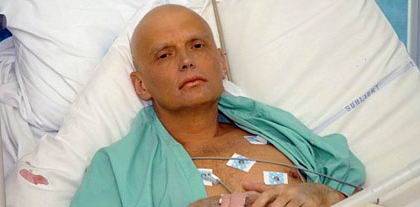
Our security forces have trouble again: on the air of the BBC, a senior officer of the English intelligence services said that the Russian authorities are worth the murder of Alexander Litvinenko.
This statement, apparently, will lead to a new wave of angry income to foreigners and reasoning on the topic "Who needed this?" Most likely, they decide that it took BP - here, they say, Russian shareholders get it in Moscow, and the British play the same game in England.
Meanwhile, the answer to the question “who needed this” is simple and unpleasant for the Russian authorities. It took justice. In normal states, it is not accepted that their citizens are poisoned in the middle of the capital.
For example, the Bulgarian dissident Georgy Markov was killed as many as thirty years ago - an umbrella on the Waterloo bridge, and nevertheless, for the second time in the last three months, a group of British investigators flies to Bulgaria because they have known new information.
Already the Bulgaria of that Soviet, no, no, and no one infringes on Bulgaria in Bulgaria, and from the point of view of the public the crime is disclosed, because back in 1992 Oleg Kalugin said that Markov was killed on the direct order of Todor Zhivkov - and investigators are flying and digging, because justice is not politics. This is justice.
Alas, the investigation of the death of Litvinenko is required by not one specific customer, but a much more terrible and irresistible opponent - public opinion.
Last week in London, a senior intelligence officer Alex Allen was found in a coma in his apartment. The newspapers immediately wrote that either al-Keda or Russian special services are to blame for his illness.
Frankly, I strongly doubt that Alex Allen's Russian special services on the teeth. Dischard the bus in Nalchik, or the market in Sukhumi, or the pipeline leading to Georgia, or even ask Koresh Litvinenko, who boiled some strange things with him, pour Polonia into tea at the next meeting and still get into this-this is please.
But Alex Allen? Do not laugh my slippers. People who are used to shooting in the market in Nazran unarmed guys and then photograph their corpses with fitted weapons simply lose their qualifications necessary to get Alex Allen.
The same last week, the London court accepted the lawsuit of entrepreneur Mikhail Chern against GO against Oleg Deripaska - Black accuses his former partner that he had not paid him for the shares of Russian aluminum.
I do not want to anticipate events, but I think that the black claim to Deripaska is not worth a damned egg. The fact is that at one time the industrial empire of the Black (which once included Oleg Deripaska) was associated with exclusively informal ties within itself. Roughly speaking, it seemed that the ownership of Mikhail Semenych to a particular company was ensured by the opportunity to get any manager who disobey the Izmailovsky lads. When such an opportunity disappeared or when the manager, as at one time Deripaska, grew up, this ownership right turned into a fiction that was unacceptable in court.
The paper that Black really has and which they signed with Deripaska is rather a conceptual character. Again, roughly speaking, such a paper is good for a thieves' gathering, but not for the London court. But the judge accepted the Black's claim with the motivation that he was deprived of the opportunity to seek justice in Russia - and this, alas, is indicative: for the London court, the reputation of Russia at the moment was worse than the reputation of Mikhail Cherny.
The first half of your life you work for a reputation, the second half of your life the reputation works for you. Cesare Borgia is unlikely to sleep with his sister. He simply sent the murderers to stab her husband, and when the killers could not cope, he sent them a second time - to kill the wounded already in the bedroom in front of his sister's eyes. Cesare was an excellent commander, a brilliant statesman, and hardly killed even half of those who are attributed to him - but such a reputation was such.
So Russia now, after the Litvinenko case, is a certain reputation. And this reputation will not change until the investigation is completed, and the deputy Lugovoi, instead of the interview, will not testify.
But someday it will happen. Not five years later, so after ten, or after thirty. For you know what is the difference between the dictatorship and democracy? The dictators sincerely believe that everything changes to everything and everything is the subject of bargaining and personal relationships; That any murder can be played back in the oil business, and, conversely, the investigation of the murders you committed occurs solely due to the fact that the investigator does not love you or infringed on you in business interests.
Democracies believe that there are things that are not exchanged, and things that are not the subject of bargaining. The murder is Markov Lee, Li Litvinenko - one of these things.