
Translated material
The resistance of the "brain"
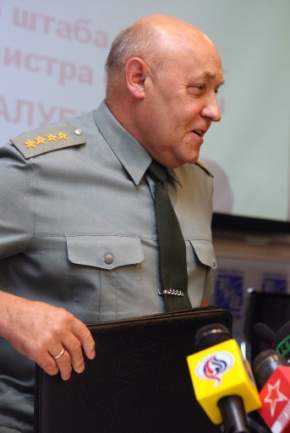
Whoever says what, and even in Russia institutions are more important than personality. Just in the Russian press there were reports of the possible resignation of the chief of the General Staff of Yuri Baluevsky, who allegedly came into conflict with the current Minister of Defense Anatoly Serdyukov. It is practically impossible for those who know Yuri Nikolaevich that this general, who held high General Studies with all the ministers of the defense, the general, to whom the president extended the service life of three years in December, will conflict with the head of the military department. However, it seems that these rumors have some reason. At least Baluevsky allowed himself to publicly disagree with the Minister regarding the transfer of the Main Staff of the Navy to St. Petersburg. The main contradiction between the Minister and the head of the General Staff, according to leaks, is that Baluevsky is sure: the most important decisions in the field of defense should be made by the "brain of the army", and not at all a civilian minister who surrounded themselves as civilian advisers and managers who came from a business sphere.
I must say that the permanent conflict between the head of the military department and the head of the General Staff was a distinctive feature of the last ten years. At first it was a real war between Igor Sergeyev and Anatoly Kvashnin, as a result of which strategic missile forces were almost destroyed (the head of the General Staff proposed reducing them to almost two divisions in the heat of the fight). Then the sluggish tug of war began between the same Kvashnin and the next minister Sergei Ivanov. Then it seemed that the reason for everything is limited and the whispering character of the then head of the General Staff. But now it turns out that the calm and extremely flexible Yuri Nikolaevich Baluevsky went along the same crooked path.
That is why I think that the matter here is not in personality, but in institutes. One of the most serious problems of the military organization of Russia is that two of the most important functions of the military leadership are still not divided: strategic planning and operational command and control.
At first glance, it’s more logical not to disconnect, but, on the contrary, unite them. The government of leading European states made this mistake on the eve of the First World War. As a result, both the monarchs and the presidents turned out to be, in essence, the hostages of their military planners: as soon as the mechanisms of universal mobilization were launched after the shots in Sarayev, not the will of the supreme rulers, but the railway schedule, according to which reserved reservists delivered to the areas of concentration. And during the war, the General Staff always insisted that the military solution to any problem was the best. Say, the German General Staff several times broke off attempts to start negotiations between the warring parties. The General Staff, which takes on the entire management of the armed forces, inevitably serves as a source of militaristic influence on all spheres of the state of the state. So, according to a number of experts, it is the Soviet General Staff with its constant requirements of more and more military expenses in order to maintain strategic parity with the United States, in fact, ruined the USSR economy.
I must say that the politicians of the leading world powers saw and realized this danger. In the same United States, the Committee of Chiefs of Staff is an body that develops strategic concepts. He acts as a collective adviser to the president on military issues. And nothing more. Operational management of the Armed Forces is carried out by the Ministry of Defense through operational commands. So, the entire leadership of the fighting in Afghanistan and Iraq is carried out through the central command responsible for the Great Middle East.
At some point, in Russia they tried to share strategic planning and operational leadership. Getting rid of Kvashnin, Sergei Ivanov pushed that the General Staff should concentrate exclusively on analytical work. In 2004, the law “On Defense” was edited, from where the provision that the General Staff was carrying out operational leadership disappeared. If we take into account that Anatoly Kvashnin fought to turn the General Staff into the main and only body of military administration, leaving the Ministry of Defense only some vague “political” functions, it seemed that Putin was decided almost on a revolutionary step. However, quite soon, as a result of subcover intrigues, the provision on the operational leadership crawled to the Regulation “On the General Staff of the Armed Forces of the Russian Federation”.
It turned out that it is impossible to tear out the General Staff from the command chain without determining who in this situation will carry out the operational leadership of the armed forces. In Russia, the next department of management is military districts. However, they, in principle, are not able to prepare and carry out military operations. After all, their main task is to carry out mobilization in the so -called threatened period, the provision of some higher military body (that is, the same General Staff) with the necessary number of staffed divisions. As far as one can understand, an attempt to create strategic commands instead of military districts, with which the same Baluevsky came up, came across opposition to the Russian generals.
However, the combination of operational leadership and planning inevitably leads to a conflict in the military leadership. Just because the generals, by definition, will always resist the innovations in a military organization. Well, in fact, why the General Stans who develop plans for universal mobilization in the “threatened period” agree to get rid of unnecessary property, to state production facilities? After all, when transferring the country to military rails, all this may be needed! Their tasks do not include the rationalization of expenses for military purposes. And if Anatoly Serdyukov with his civilian managers took up the implementation of such rationalization - this is an unconditionally positive trend. But in this case, the conflict with the General Staff was inevitably began to begin. Honestly, it is a pity if Yuri Nikolaevich Baluevsky-one of, alas, a few intellectual generals-will be a victim of this institutional confrontation.