
Translated material
Olmer reservation
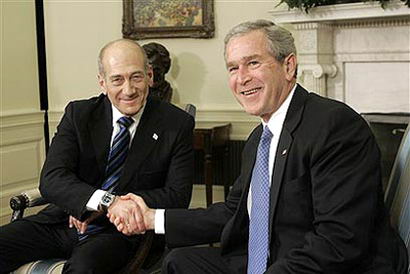
Tired and satisfied Ehud Olmert and Benjamin Natanyahu flew out of Washington. In a little more than 24 hours in the capital of the United States, the Israelis received the assurances of George Bush that the White House would not begin bilateral negotiations with Iran. Simply put, the United States will not surrender to the United States, and the Iranian embassy in Washington, located near the residence of Richard Cheney, will continue to be empty. Nevertheless, the Kremlin’s stubborn position in Iran was bothering both Bush and Olmert. The latter even made a reservation at the final press conference in the White House, confusing Russia with Syria.
If Bush, who promised to leave Ramsfeld in the Pentagon to the end of his presidential days two weeks ago, then the States does not plan to talk one on one with Tehran in the near future.
Even after the unlikely to fulfill Washington’s requirements for the termination of Uranus and the admission of inspectors to verify this step Ahmadinejad. The US President stated that in this case, a conversation with Iranian representatives will be held in the presence of the EU, Russia and China member countries.
By the beginning of negotiations with Iran, the White House, apparently, is pushed by a whole group of former high-ranking officials of the administrations of the presidents Reagan, Ford, Carter and Bush Sr.. It includes Lawrence Igelberger, Brent Skokucroft, James Baker (now heads of the situation in Iraq), Zbignnev Brzhezinski and the new US Minister Robert Gates.
In 2004, the last two made the co -chairs of the report of an independent group of experts (released under the auspices of the Institute "Council on International Politics"). In this document called “Iran is the need for a new approach”, the administration proposes a policy of involving Tehran in some world processes.
In particular, the US assistance to Iran to join the WTO, the revival of economic relations, the refusal to change the regime in Tehran and the beginning of direct bilateral negotiations with the Akhmadinejad regime.
Attempts by the current administration to find a balance between carrots and sticks for Tehran, that is, offers of Brzhezinsky-Gats report and declared tough position of the White House, at least not convincing. The scatter and stagger caused by disagreements on the Iranian problem in Washington are not visible only to the blind.
On the one hand, Bush announced the desire of the United States to help Iran in the development of a peaceful nuclear program, accept Tehran Washington conditions. The other day the White House went even further. For the second time in the last year, he announced the possibility of direct negotiations with Ahmadinejad to stabilize the situation in Iraq. And finally, on Monday, one of the Bush administration employees announced the lack of a desire to change the ruling regime in this country.
On the other hand, you can recall serious warnings to Ahmadinejad, voiced by almost all officials in the White House, responsible for the solution of the Iranian problem. From the US Ambassador to John Bolton to his head of Condolisian Rice and Vice President Richard Chaini.
George Bush on Monday, once again joined them, saying that Tehran had every chance to be in the economic blockade if he did not agree to Washington and the world community.
However, Russia on the same day again proved that her view of sanctions against Iran is seriously different from the proposals of the three EU countries supported by Washington. As you know, the project of “delicate” Kremlin measures made to discuss the Security Council was rejected by the United States and European Member States of the UN Security Council as ineffective.
It would seem that after the decision on the signing of Moscow and Washington, the protocol on the entry of Russia into the WTO later in Hanoi, the Kremlin had to make concessions on Iran. But the countess, or rather, the count behind the red wall said "by no means."
In my opinion, there are four options explaining Putin's behavior. I think that few doubts will arise that it is he, and not the Foreign Minister Lavrov makes decisions on the Iranian problem.
So, the first thought tells me that the Russian president doubts Bush’s ability to convince the Congress to vote for the regime of normal trade relations with Russia and the cancellation of the amendment of the Jackson-Vannik.
In this case, the Kremlin’s consent to sanctions leading to the economic and diplomatic blockade of Iran will deprive Putin of the most important political lever that he uses in a conversation with his Washington friend.
It may turn out that the Iranian topic was not discussed at all in the package agreement on the protocol on the WTO between the Kremlin and the White House. True, I doubt it very much.
Perhaps the Kremlin asked the White House for some time in order to observe decency. That is, a delay in the sale of Moscow Tehran. It is doubtful, since what to follow there if the deal has already taken place.
And, the last, most unpleasant option for me. Washington removed the Iranian plot from the agenda of the discussion of the package agreement as part of the signing of the protocol on the entry of Moscow to the WTO. Leaving attempts to persuade the Kremlin, who insisted only on economic exchange.
In this case, the reservation of Olmert, who answered the question about the possible negotiations of Israel with Syria, becomes more understandable. “I hope,” said the Prime Minister of Israel, “that the day will come when the attitude of Russia, excuse Syria, will undergo changes in these main directions (the support of Hamas and its leader Khalid Mashal, the main supporters of the terror against Israel, the destabilization of the situation in Lebanon and Iraq).
It seems to me that the fair indignation caused by the Russian position on Syria and Iran, discussed in the White House, made Olmert resident. I will not argue with those who say that the Israeli prime minister was disturbing the supply of weapons by the Kremlin Damascus. But let me remind you that the main topic of the negotiations of Olmert and Bush was Iran, not Syria.
At the same time, the Israeli delegation flew from Washington very pleased with the results of negotiations. What made the existing situation even more confusing. It is possible that Bush and Olmert really agreed on the ways of solving the Iranian problem, which was informed to reporters at the final press conference in the White House. Or the US President notified his Israeli colleague that Moscow would still agree with a tough package of sanctions.
I think that the first should push the Kremlin to make a reasonable decision. Although waiting for a sober approach from the “wall” is equivalent to the dates of the tips to the waiter before he began to serve you.
Author - special correspondent of the ID "Kommersant"