
Translated material
Bomb for Ayatollah
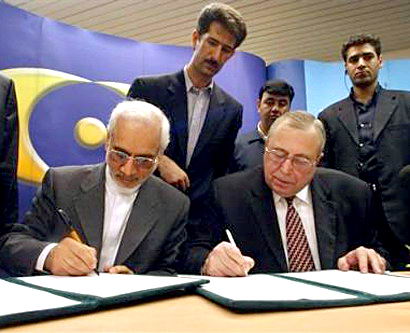
As expected, the signing by Russia on February 27 of the Agreement on the supply of nuclear fuel for the nuclear power plant under construction in the Bushera caused a sharp reaction of the United States. Senator John McCain once again called for excluding our country from the Big Eight. “The last step of Russia towards Iran should cause a tough reaction on our side,” he said. Meanwhile, immediately after the Bratislava meeting of George Bush and Vladimir Putin, it seemed that the parties managed to agree on approaches to the problem of Russia's cooperation with Iran in the nuclear region. A senior representative of the American administration told reporters: “We are grateful for the fact that Russia explained: it will not supply nuclear fuel to Busher without agreement with the Iranians that all used fuel will be returned to Russia.” I must say, Moscow has achieved such an agreement from Tehran.
But the problem seems to be that Washington believes that Moscow has also taken on other obligations. The same administration officer said that the Russians would not begin to implement the transaction, until the Iranians present the international community convincing evidence that they abandoned the program for creating nuclear weapons. The very next day after the signing of the Russian-Iranian agreements, the Director General of the International Nuclear Energy Agency (IAEA) Mohammed al-Baradei said he was still waiting for Iranian explanations on the nuclear program. Moreover, al-Baradei considered it necessary to emphasize the particular importance of these explanations, because Iran "led the program secretly for almost 20 years."
In this, in fact, the core of Russian-American contradictions. No one actually disputes that the nuclear power plant in the Bushera is an object of a purely peaceful, fully meeting the requirements of the IAEA. The Americans fear otherwise: does Russia prepare as a result of cooperation of Iranian specialists whose knowledge can be applied during the implementation of another program - military. It is already known that Iran is trying to create a full cycle of enrichment of uranium, explaining this by the desire to produce not weapons, acerexious nuclear fuel. The Iranians even make the assurances of such a hot champion of cooperation with this country as the head of the Federal Atomic Energy Agency Alexander Rumyantsev. In his opinion, "the creation of a full nuclear fuel cycle ... is economically effective if at least 8-10 thousand megavatts of capacities are in operation." And the first block of the Bushersky nuclear power plant, which should go into operation next year, is designed only for a thousand megawatts.
The Americans recall that the USSR at one time insisted on the extremely peaceful nature of the DPRK atomic program. And then Pyongyang took and left unilaterally from the contract on non -proliferation of nuclear weapons and stated that he was already having such weapons. Washington also does not really understand why Russia is not afraid of the appearance of a nuclear state in its lines.
Only one thing can be explained to such frivolity: Moscow wants to have at least some trump cards for bargaining with America. On the eve of the summit in Bratislava, representatives of the administration repeated that Bush intends to put the problems of departure from democracy in Russia at the forefront, and Putin immediately met with a senior Iranian official and publicly announced that he did not believe that Tehran had the intention to produce nuclear weapons. In a word, in spite of my mother, I will freeze my ears.