
Translated material
Putin is not good
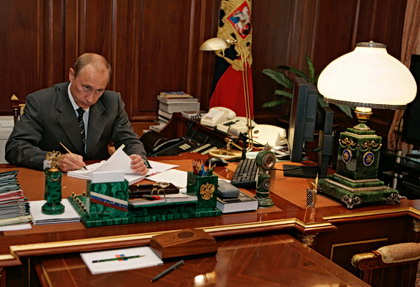
As always, I got acquainted with great interest with the next article by Vladimir Putin “Russia concentrates - the challenges that we must answer”, published by Izvestia. It was an unusually exciting activity, especially since Dmitry Peskov said, the author wrote it with his own hands during the New Year holidays.
Of course, it is obvious that Vladimir Putin was covered with a bunch of reference materials and memos, and did not sit all these days only in front of a clean sheet of paper. But the distrust of speakers and advisers sometimes fails. I want to draw the attention of the author of this article to a number of annoying inaccuracies, which are actually talking about his shallow immersion in the material.
1.
Let's start with the simplest: poverty.
The author claims that "10-11% of our citizens remain in their income below the poverty line." A strange statement (maybe the wrong certificate peered?). According to the latest data from Rosstat, according to the results of 9 months of 2011, the share of the population with cash income below the subsistence minimum was 14.3%. The statement of Vladimir Putin at a meeting of the Presidium of the Government on January 12 this year is even more confused: “According to our assessment system, today it is 12.5% of citizens, and there were almost 2 times more. But if you translate it all into an understandable international language of numbers, then, yes, this number has decreased by 2 times, but, according to the international methodology, people living beyond the poverty line make us about 26%. ”
So after all, 10-11, or 12.5, or 26%? And by the way, what is this "international technique"? Maybe Oonovskaya, who considers the revenue of poverty less than $ 1.25 (about 40 rubles) per day? It is easy to calculate that it is about 1200 rubles a month despite the fact that the average Russian living wage is now about 7,000 rubles a month. And if we talk about the Greece mentioned by Vladimir Putin, where, as he claims, the poor as many as 20% of the population (which is true), then he probably was not written in the certificate that in Greece a person who receives less than 6480 euros per year is considered poor. It is easy to calculate that it is about 21,600 rubles per month. According to the latest data from Rosstat, about 55-60% of the population live behind the Greek poverty line.
Why do I dwell on this seemingly small example? I, as a voter, citizen and expert, concern the quality of decisions made in the country. I want clarity, understandability and professionalism, and not another powdering of the brains through games in the incomprehensible from the numbers.
2.
I want to make out another, more complex passage on a social topic from the article by Vladimir Putin.
We are talking about middle class. The author writes that in 1998 “the middle class ranged from 5 to 10% of the population - less than in the late USSR. Now the middle class, according to various estimates, is from 20 to 30% of the population. ” Firstly, I should note that in the late 1990s, the middle class in Russia (I will come true to such an authoritative specialist as Tatyana Maleva) was about 20%.
Secondly, for the seemingly successful years of economic growth of the 2000s, its value practically did not grow due to the fact that social elevators have not been created (which, by the way, recognizes in his article Vladimir Putin). And our archaic economy does not need a mass middle class (see, for example, the opinion of experts working on behalf of the same Vladimir Putin on the update of Strategy-2020).
This is indirectly recognized by Vladimir Putin, when he writes (absolutely fair):
“Over the next 10 years, another 10-11 million young people will include the economy, of which 8-9 million will have higher education. Already today, 5 million people with higher education are not satisfied in the labor market not only in earnings, but also by the nature of their work, the lack of prospects. Another 2-3 million are specialists of budgetary institutions who want to find a new job for themselves. In addition, 10 million people are employed in industries built on archaic, backward technologies. (...) So the creation of 25 million new, high -tech, well -paid jobs for people with a high level of education is not a beautiful phrase. This is an urgent need, a minimum level of sufficiency. Around the solution of this national problem, it is necessary to build state policy, consolidate business efforts, and create the best business climate. ”
It was not without reason that I brought such a long quote. In fact, this is the recognition of the fiasco social and economic policy, which was pursued in the country for the last 11 Putin years. If in these years Russia continued to suffer from a lack of even the most minimal resources for development, then, at least formally, Vladimir Putin would have a reason to find out everything for circumstances that were beyond his dependent. But during this period, according to the famous economist Igor Nikolaev, it came from the export of oil, oil products and gas $ 1.6 trillion, which is 5 times more than in the 90s. What did you do with this money? Several hundred billions of dollars were taken back and materialized in bank accounts, in real estate and foreign assets of the chosen circle of “crooks and thieves”. The rest was divided between an increase in the incomes of the population (indeed, as Vladimir Putin writes, they reduced the scale of poverty), a stabilization fund (now replaced by 2 other funds - reserve and national welfare), a decrease in the size of sovereign debt and the increase in gold and foreign supplies.
But at the same time:
- corruption and frank theft of state money accepted the scales that were unprecedented even for the “dashing” 90s and became an integral part of the management system;
- sequentially worsened the business climate, having strangled primarily small and medium -sized businesses;
- never created an effective tax system, which should be built on the balance between social obligations and the motivation of entrepreneurial (including innovative) activities that
- drove a significant part of the economy into the shadow, made it profitable and fashionable not to pay taxes;
- increased the stratification of the population in terms of income to the worst samples of Latin America.
And from this point, according to Vladimir Putin, the same team that ruled the country all these mediocre -profiled years should solve the problem of creating 25 million new jobs? Does he understand that for this it is necessary to change the foundations of all the socio-economic policy still pursued in the country?
Let's look at the federal budget for 2012-2014 adopted by the past State Duma. There is a rapid increase in defense and law enforcement costs and a decrease (in the share of GDP) of the already shamefully low expenses of our entire budget system for education, healthcare, and support for housing and communal services are planned. How is this combined with the structural restructuring of our labor market, about which Vladimir Putin writes as a nationwide task? What mass middle class can we really talk about?
3.
At the very beginning of his article, Vladimir Putin writes: “I am worried that we practically do not have discussions of what should be done in the election, after the election. In my opinion, this does not meet the interests of the country, the quality of development of our society, the level of its education and responsibility. ”
This is not true:
-Experts (and there were almost 1.5 thousand of them!) who worked, as already mentioned, on behalf of the same Vladimir Putin on the update of Strategy-2020, prepared a heterogeneous in the depth of study, often an internally inconsistent, but in general a very interesting document where possible forces in socio-economic policy for the next 10 years were detailed;
- The Institute of Modern Development has prepared a series of detailed reports on the ways of modernization of Russia;
- Such political parties as the Communist Party, “Fair Russia” and “Yabloko” have a lot of developments of a program and strategic nature.
Yes, all of the listed materials are far from ideal in quality, they present fundamentally different approaches to solving Russian problems, but to begin dialogue about the future of the country, they are more than sufficient. One thing is missing - the position of the current government itself. United Russia, together with the All-Russian Popular Front, muttered something so inaudible and conjunctural that Vladimir Putin had to spend the New Year holidays on the next feat of the manual regime literally: to take on the pen with his own hands. I tried to briefly analyze (without screams about the “bloody regime” and “Putin - resigned!”) What came of this at my department. As an acting professor, it remains only to put an assessment, namely: Honor.
Author - Doctor of Economics, Professor
Photo by RIA Novosti