
Translated material
DNA collection
A little more than ten years ago, researchers began to analyze DNA traces in reservoirs in order to identify organisms living in them. Samples of the so -called environmental DNA (Environmental DNA, Edna) from the water of lakes, streams and seas allowed to track invasive species, as well as detect rare organisms. A little later, scientists began to collect EDNA samples in the air and soil. Studies of environmental DNA have become an important tool for monitoring biodiversity. Based on traces of DNA, scientists can determine which types are present in a certain area.
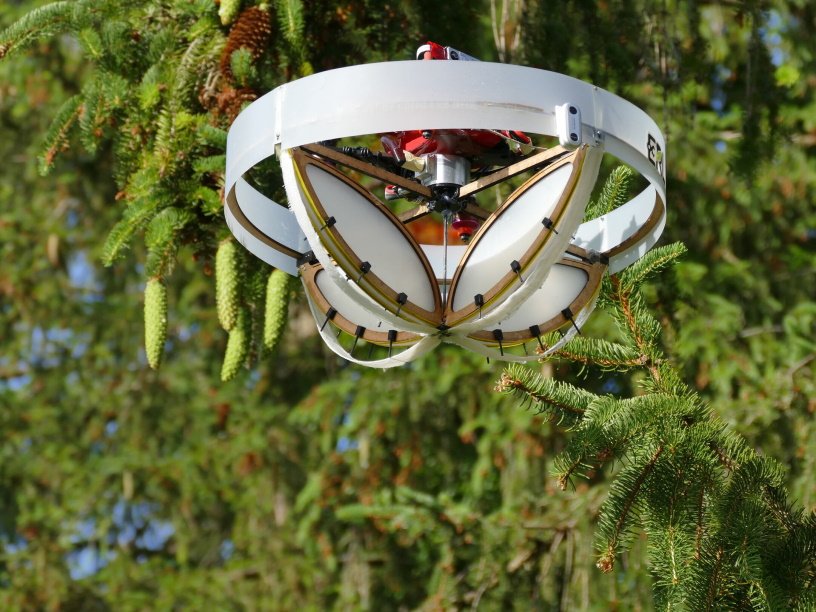
It is not difficult to get samples from water or soil - it is more difficult to access other habitats, such as the canopy of the forest. As a result, in poorly studied areas, many species remain unaccounted for. To solve this problem, a team from the Higher Technical School of Zurich, the Swiss Federal Institute for Studies of Forest, Snow and Landscape and Spygen created a special drone that can autonomously collect DNA samples from trees branches.
The drone is equipped with adhesive stripes. When it sits on a branch, the material from the branch sticks to the strips. Then researchers can extract DNA in the laboratory, analyze it and compare it with databases.
To teach the aircraft autonomously approaching the branch and staying on it stably for a long time to take samples, has become a serious task for robotics. “Landing on the branches requires complicated control,” says Stefano Mintchev, professor of environmental robotics. Initially, the drone does not know how flexible the branch, so the researchers equipped it with a device that allows you to measure this characteristic and take it into account when maneuvering in flight.
Researchers tested a new device on seven types of trees. In the samples, they found DNA of 21 groups of organisms, including birds, mammals and insects. Now researchers want to improve their drone even more to prepare it for competitions, the purpose of which is to detect as many different types as possible on 100 hectares of tropical forests of Singapore in 24 hours.
In order to check the effectiveness of the drone in conditions similar to those in which he will be at the competition, Stefano Minchev and his team are currently working in the Pavilion of the Zurich Zoo “Tropical Forest of Masoala” (named after the National Park in Madagascar). “Here we have an advantage in the fact that we know what types are present, this will help us to better evaluate how carefully we collect all the traces of DNA with the help of our technology, or we missed something,” says Minchev.
During home tests in Switzerland, the drone collected material from seven trees in three days, in Singapore he will have to collect samples from ten times larger number of trees in just a day. At the same time, the collection of samples in the natural tropical forest sets the developers with even more complex tasks. Frequent rains wash off the DNA from the surfaces, and the wind and clouds interfere with the work of the drone. “Therefore, it is very curious to see whether our method of sampling in extreme conditions of tropics will justify ourselves,” says Minchev.
The study is published in the journal Science Robotics.