
Translated material
BL@Dish
In the opposition
 BL@Dish
September 21, 2011 Julia Latynina
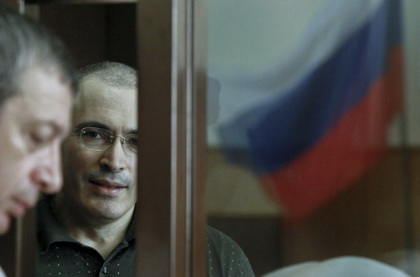
The Strasbourg court made BL@Dsk and political decision. I can’t name the decision on the “Yukos case” in any way.
The Strasbourg Court ruled that in the case there was a number of procedural violations - in the same way he regularly finds these procedural violations in the cases of any soldered criminals like Andrei Buldakov or Alexander County - but there is no political subtext and the Russian authorities did not bankrupt Yukos to take their property from the shareholders.
That is, apparently, Yukos’s oil is now exported not by Timchenko, but by some Pupkin or Mumkin, who has no attitude towards Putin's smallest.
The fearless satisfaction of the Chechen claims gave rise to a dogma about the infallibility of Strasbourg in the Russian liberal consciousness. Actually Strasbourg:
a) considers it formally, and not on the merits, and monitors not for the essence of the matter, but for procedural violations;
b) the concept of “human rights” does not always coincide with common sense.
A typical example of the decision of Strasbourg is the decision on the complaint of John Hurst, the British-killer who hacked his housewife with an ax. This English Raskolnikov sent a complaint to the British law of 1870 to the ECHR, prohibiting criminals to vote. In 2005, the ECHR decided that the law should be canceled-as a contradicting the European Charter for Human Rights.
Another typical Strasbourg is a decision on the claim of Magnus Gefgen. This German student of a legal farm abducted with the aim of ransom and immediately killed 11-year-old Jacob von Metzler. When he was arrested, the local police chief threatened him with torture that Gephgen give out the whereabouts of the boy: the police hoped that Jacob was still alive. Hefgen argued that the threat of torture violated his human rights, and the Strasbourg court partially satisfied the lawsuit of Gefgen.
In these cases, when it comes to abstract rights of criminals (whether Gephen, Buldakov or Hurst), when it is possible to collapse with all human rights disinterested countries such as Great Britain or Germany (or Russia in Chechnya) for non -compliance by them of human rights - here Strasbourg is fundamental.
But when the owner of the Kremlin, the important partner of Europe, without five minutes the laureate of the Quadriga Prize, is suddenly suspected of ruining the company and putting it to the prison of its owner only in order to transfer this company to his roots - there is a completely different cliff. Here you are not stripping in the new Aldes.
In fact, back in June it was clear that Strasbourg would decide. If you remember, it was then that Senator Torshin introduced a bill - not to recognize the decisions of the Strasbourg Court if they contradict the Constitution of the Russian Federation. And almost immediately the project disappeared. Like a hand. In fact, it was precisely these days that the decision was made in Strasbourg, and among the judges who made it, the Russian judge Bushev, who merged the information, and in September the decision was simply announced.
I'm afraid that the bill Torshin was one of the elements of pressure on Strasbourg. Let's assume that he was the only one. Let’s say that the judges of such incorruptible, deprived of corruption of countries, such as Azerbaijan (judge Hanlar Khadzhiev), Greece (judge Christos Rosakis) and Croatia (Judge Nina Lajich) are not available for nothing more low than political considerations.
The ECHR decided that the tax optimization schemes that Yukos used were never legal in Russia. We agree. No matter how you call what Yukos did, “optimization”, “minimization”, but in fact it is evasion.
But the ECHR also did not find evidence that such techniques were "generally accepted in Russian business." Yes? Then I advise the ECHR to call the Minister of Finance Alexei Kudrin as a witness. In his letter, written in early 2002, it is described in detail about the similar work of Lukoil and the Moscow Oil Refinery through Baikonur. I also advise the ECHR to look at the conclusion of the Accounts Chamber (December 2003), in which a similar scheme used by Sibneft is not only described, but also recognized as completely “legal”.
The ECHR decided that "Yukos did not have enough time to get acquainted with the case," and that, bankrupt Yukos, "the Russian authorities could not find a fair balance between the legal requirements and the measures they chosen." This is the very violation of the rights that the ECHR awards both to hefgen and the dicks.
But the ECHR did not find evidence of “which would allow the real court to conclude that Russia abused these requirements in order to destroy Yukos and obtain control over its assets.”
Oh well? And the fact that Yuganskneftegaz was sold to the Baikalfinancandgran -Group of Baikalfinance Group, registered in the glass in Tver, is this an accident? And the fact that Baikalfinancandegroup paid $ 9.3 billion for Yuganskneftegaz, despite the fact that, even according to the Dresdner Kleinwort Wasserstein and JP Morgan, the cost of Yuganskneftegaz was from $ 18 to 25 billion? And the fact that the money for the purchase of an unknown “Baikalfinance group” received a de facto from the budget? And then, finally, that Putin in February 2006 personally admitted that Baikalfinance Group was a front -line company, established so that future acquirers of Yuganskneftegaz could evade claims to buy stolen ones? “ Cutting owners had to think about how they ... would answer in courts to claims that could be filed by him ,” Putin said then . What is this, if not “abuse of requirements in order to obtain control over assets”?
Such a decision could not be made either in the United States or in the UK, that is, in those countries where there is a precedent law, and the case understands on the merits. Such a decision is possible only in the countries of continental law that have turned into countries of the Pharisee human rights protection.
As international bureaucracy develops, international organizations more and more claim to the same status that the Pope had in the Middle Ages, and at the same time they begin to resemble the Basmanny court - of course, with the strictest observance of all human rights.
Photo by RIA Novosti