
Translated material
Andrey Kofod
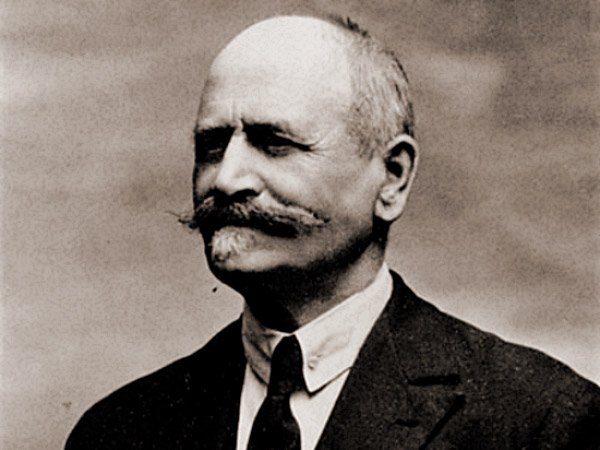
On October 16, 1855, the landowner Andrei Kofod, the ideologist of the Stolypin agrarian reform, was born.
Personal business
Andrey Andreevich Kofod (Karl Andreas, 1855-1948) was born in Skannereborg (Denmark) in a large family of a pharmacist. The boy did not want to follow in the footsteps of his father, because since childhood he had a tendency to agriculture. He studied at school without much interest and was often listed as lagging behind, although he always passed the exams for “excellent”. After school, he studied agriculture on his father’s estate for a year and a half, then he entered the Royal Veterinary and Agricultural Academy in Copenhagen, which he graduated in 1875. For two years he worked as an assistant manager, performing, in his own words, "incredibly primitive work on the estate." After the completion of practical courses for conducting dairy farms, Karl stayed for some time manager and the will of chance in the summer of 1878 left for Russia.
In 1880-1886 he was the manager of the estate in Titovo in the Kaluga province. In 1887-1889 he served as an appraiser in the company of mutual land loan, since 1889 - in the noble land bank and its branches in Samara.
Over time, Kofod acquired a reputation as an indispensable specialist in difficult occasions. In 1892 he accepted Russian citizenship. In the same year, envious people achieved his transfer to “Tmutarakan” - the Transcaucasian branch of the noble land bank in Tiflis, where he worked for nine years.
In 1901, the Kofod was appointed to Mogilev, where, finally, “found something that was still missing to start the campaign for the deployment ... - Russian villages that have deployed on their own initiative of the peasants.” The Belarusian peasants became interested in the way of the single field economy used by Latvians, and themselves developed a new, original procedure for dividing land (land trading, where the land was a means of payment, and the land surveyor was an auctionist) and “expanded”, that is, “released” from the community. According to the observations of Kofod, almost all the first deployments were impeccably in geodetic and agronomic terms, since they were taken after careful discussions, while subsequent expansions left much to be desired, because they were largely a trend in fashion. However, this experience of self -development remained unknown due to a misunderstanding of its significance (social and economic) administrative apparatus of Russia.
Based on the materials collected in the Belarusian provinces, the Kofod wrote and published a number of articles on the land issue that he summarized in the monograph "Peasant farms on the ground land." These works largely predetermined the methodology and practical program of activity created during the Stolypin agrarian reform of the year of land management commissions.
On April 1, 1904, at a meeting of the Imperial Geographical Society, the college secretary Andrei Kofod reported the results of his research research. His conclusions were kindly met and published. Thanks to the assistance of the Minister of Finance S. Yu. Witte Kofod, he was able to engage exclusively with his research - he was exempted from official duties while preserving the salary. Since November 1905, he was appointed correcting the position of officials of special assignments with the chief controlled land management and agriculture (approved in this position in 1907). In the same year, remaining nominally appraiser of the Mogilev branch of the noble bank, on behalf of the Zemsky department of the Ministry of the Interior, he went on a foreign business trip to study the land deployment system. During this trip, Kofod visited Holland, Belgium, Luxembourg, Austria, France and Prussia to get acquainted in practice with the course and results of the expansion. According to its results, he published the review “The fight against the vestibule in Russia and abroad” (1906) and “Land management in the legislation of Western Europe and Finland” (1912).
Upon returning in October 1906, the Kofod met with P. A. Stolypin. As a result, he entered one of the groups created to explain the causes, course and tasks of government reforms in the field of land issue to the population and the administration of Russian provinces. As an official of special assignments, he took an active part in the preparation, propaganda and conduct of the Stolypin agrarian reform.
According to the deep conviction of the Kofod, expansion could only be carried out gradually, since it required the dissolution of the community, this pillar of the peasantry in Russia. Even after the abolition of serfdom in 1861, the community was still considered as a specific Russian way of protecting the rural population from industrialization.
Since February 1908, the jacket as an auditor of land management headed the instructor part of the land management committee. In 1912 he was appointed a member of this committee. In this capacity, he personally equipped the staff of instructors, traveled a lot around the country, controlling the course of land management in the regions. In 1914, in the work of the Russian Land Management, he described the course of agrarian reform and summed up its results, and also translated and issued O. A. Auhagen criticism “Criticism of Russian Land Reform”.
With the outbreak of World War I, Andrei Kofod in the fall of 1914 was sent to the Galicia occupied by the Russian troops to study the state of agriculture. After the creation of the Ministry of Agriculture of Russia, he was a member of the Council under the Minister.
After the renunciation of Nicholas II, in 1917 he moved to the service in diplomatic and international humanitarian organizations. Since September 1917, he served in the Moscow branch of the Embassy of Denmark; He was engaged in the help of the Austro-Hungarian prisoner of war in the Danish Red Cross. To this end, in 1918 he went on a short-term business trip to Siberia, where he stuck for two years: he served several months in the Tobolsk hard labor prison on charges of espionage, and after his release he acted as a Danish minister-resident in Omsk.
In the summer of 1920 he returned to Moscow and, having received Danish citizenship, left Russia to his homeland. Since 1921 - Attache on agriculture at the Embassies of Denmark in the limitrophic Baltic states. From 1924 to 1931 - attache for agriculture of the Danish Embassy in the USSR. In the spring of 1931, he was withdrawn at the insistence of the Soviet authorities.
In 1932 he traveled to Yugoslavia twice, where he spent a total of 3 months, having traveled the whole country with the Danish envoy. According to the results of this trip, I released a book about the detection translated into Serbian. In 1933-1935 he was engaged in the study of land relations and the history of deployment in Western Europe, after which he released the appropriate monograph in the Danish language. In the summer of 1936 and 1937 he traveled to Romania and Bessarabia, where he also got acquainted with the agrarian situation. The work of Kofod was also interested in the Ministry of Agriculture of Germany, which issued its works called “Berichte über Landwirtschaft: Einzelhof Oder Dorf” (“Khutor or Village”).
In November 1939, he published in the two largest Danish publications an article, in which he positively evaluated the USSR’s exit to the previous borders of the Russian Empire after the adoption of the Baltic states in the Union.
Andrei Kofod died on February 7, 1948 at the age of 92 in Copenhagen (Denmark).
What is famous
 Andrey Kofod.
The agrarian and land surveyor Dane Andrei Kofod lived in a total of 50 years in Russia. He was the author of the idea of resettlement of peasants from the community to the farm with the information of all the peasant lands in a single allotment. She became one of the main goals of the Stolypin agrarian reform.
When the jacket appeared in post -reform Russia, agriculture developed here extremely slowly, entangled in various "feudal remnants." He was one of the first to pay attention to the facts of the voluntary exit of the peasants from the community to the farm and appreciated the national significance of these facts. The book of Kofod “Peasant farms on the grounding land” determined the methodology and practical program of the activities of land management commissions created in the spring of 1906, and he actually acted as an ideologist of the Stolypin agrarian reform.
The commands of the Kofod compiled a methodology for studying the practice of expanding Russian villages and pedantically carried it to life: removed copies from the sentences (decisions) of rural gatherings and open -standing plans, analyzed the reasons for unsuccessful delay attempts, evaluated the influence of detection on the economy and lifestyle of peasants (the change of three -perennial crop rotation, increasing the dairy productivity of livestock; reducing drunkenness and reduction of drunkenness; reduction of drunkenness; fight). Kofod even identified supporters (for example, the Zemsky department of the Ministry of the Interior) and opponents of the detection (rich peasants, petty peasantry, Orthodox priests, police, rustic women) and based on these studies developed a tactic of the fight against resistance. These were the tour of the peasants at the public expense to the places of successful deployments without the participation of officials (which was especially important). Excursions were in great demand.
Being an auditor of land management, the Kofod actually led the technical side of the detection in the field: he personally controlled the process, making many trips in the province and introducing foreign delegations to the state of affairs. No one knew how to explain the goals of reform from the Earth so intelligibly. In the summer of 1907, on behalf of Prince Vasilchikov, Kofod wrote in a simple and intelligible tongue the brochure “Khutor's resettlement” intended for the peasants. She “was swallowed by Russia” with a huge circulation of 500 thousand copies at that time.
Over the six years of land reform (from 1907 to 1913), more than a million farms and bran farms were formed in Russia, which amounted to almost the eighth of all Russian householders in Russia. The results of the reform surpassed all conceivable and unthinkable expectations: the yield in the country from 1906 to 1915 increased by 14 %, and in some provinces-by 20-25 %.
What you need to know about
The memoirs of Andrei Kofod “50 years in Russia (1878–1920)” in the Russian translation were first published in 1997 by the Moscow publishing house “Human Rights”.
The main attention in the book is focused on the position of peasants, agrarian reform and the problem of land management in Russia. However, thanks to literary talent and observation, the author managed to present a bright picture of life in Russia at the beginning of the 20th century, including the events of wars and revolutions. The uniqueness of the memoirs of the Kofod is that they are written by a person brought up in European traditions and at the same time knowing from his own experience the features of the Russian bureaucratic system and the life of the Russian village.
In 2003, volume of documentary materials, correspondence and memoirs “Stolypinsky reform and landowner A. A. Kofod” (compiled by A.V. Guthers) was published.
Direct speech
About the dangers through the lamps (from the pamphlets "Khutor's resettlement" ): “Throughout the world where the peasants settled villages, Domozhozheyev distributed field lands among themselves over the pour. The reason, through the lady of the land, of course, the one that Domozhozheyev wanted to observe complete justice in the distribution of the Earth. To do this, they divided it with such a calculation that each owner would receive the lands near and far, good and bad in the same ratio. At the same time, they forgot only that with such shares it happens not equally good, but equally bad.
Each peasant on his shoulders experienced what the skips from distant stripes and delivery there are also manure, how much time it disappears in the rumors from the strip to the strip and how much grass is trampled in vain with the annual division of mowing. How great is the useless loss of time and labor, which is inextricably linked with through a lady land use - this is evident from those huge overtives that peasants have to do in vain to cultivate them over the lamps. The owner of ten acres in a common village, over the lady, has to make from 2000 to 3000 a mile annually in the same crossings and move from the yard to the strip and one lane to another ... But the worst thing is that the peasant is deprived of the opportunity to constantly monitor his field when the lands are scattered by stripes all over the allotment.
The unprofitable sides over the losers began to be found stronger as the population grew and suitable for the development of land sorted out. Each crop failure began to cause hunger strikes, which were more sensitive, the less land for every person had. ”
3 facts about Andrei Kofode
- Already in Russia, the jacket has mastered the Russian language (“not at all easy for the Western European”) and later wrote all his books on agriculture in Russian.
- Over the years spent in the Transcaucasia, Kofod recognized this area and its population well. His descriptions of life, national traditions, customs and religious beliefs of Armenians, Georgians, Tatars, Circassians and other peoples in the late 1970s were published in Georgian as a historically valuable source.
- Andrei Kofod was one of the first in Russia awarded a sign of distinction for land management works. Other awards: the Order of St. Anna of the II degree (1911), the Order of the Holy Prince Vladimir IV degree (1916), memorable medals, the cross of the Order of Danebro (Denmark).
Materials about Andrei Kofode:
Twice Dane Andrey Andreevich Kofod
Biography of Andrei Kofoda on the site people.su
The history of land law. V.I. Petrov
Article about Andrei Kofode on Wikipedia