
Translated material
A very timely book
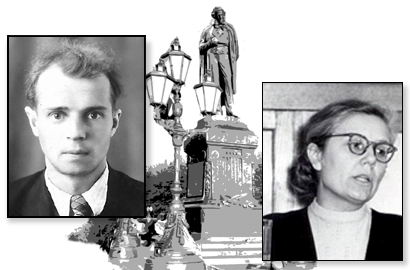
Exactly forty years ago, on the fifth of December 1965, in Moscow on the monument to the poet, a “ragpoint” was held on the monument to the monument. The slogan "Demand the publicity of the trial of Sinyavsky and Daniel!" - Namely, the arrest of writers was a direct reason for protest - at first glance a little strange. Why "publicity", not "liberation"? The initiator of this venture, a mathematician, a poet and former political prisoner Alexander Sergeyevich Yesenin-Wolpin, said that publicity leads to freedom, and the opposite is not necessarily true. Respect for the procedure, for law was natural for a person with logical thinking: means are no less important than the goal.
Natural for the day of the "Stalin" constitution, the same on December 5, was another slogan "Respect the Constitution (Basic Law) of the USSR!" However, Yesenin-Volpin was ready to defend him. The book provides such a dialogue: "Alik, do you want the Bolsheviks to follow their own laws?" - "Yes, this is what I achieve." - "Alik, but if they begin to follow the laws, then they will cease to be the Bolsheviks!" - “TS-s! Of course, this is so, but they don’t know about it yet! ”
Mostly students, students and graduate students of the university, according to various evidence, from fifty to two hundred people came to the square. 22 people were detained, but released on the same day. Then, however, the study and “sewage” along the Komsomol line, exceptions from universities, followed. That was the first unofficial manifestation in the capital after 1927.
A rally on Pushkinskaya is often called "the day of the birth of a human rights movement in the USSR." At least that is how it is entitled
prefaceTo the book “December 5, 1965 in the memoirs of the participants of the events, materials of Samizdat, publications of the foreign press and in the documents of party and Komsomol organizations and notes of the State Security Committee in the CPSU Central Committee” (Memorial - the Memorial - the Publishing House of Starks, 2005), the presentation of which took place today in the Memorial society. Retelling the book is in vain work, too many clutches of the times and fate in these documents and evidence.
But here are a couple of plots.
There was then the third slogan on the square: “Freedom of V.K. Bukovsky and others, placed in psychiatric hospitals in connection with this rally of publicity!” Even before its obvious phase, the domestic human rights movement was accompanied by the attention of the authorities: psychiatric hospitals, camps, then everywhere ... Bukovsky did: a rally - three years of general regime camps - the publication of the truth about “punitive psychiatry” - a camp of strict regime and Vladimir prison - “exchanged a hooligan for Luis Corvalan ...” by Soviet standards, a fall into the abyss.
However, in the same historical circumstances, on the same material, someone managed to “rise”. For repressions - albeit “soft” - a device, people were needed against the participants in the “rally of publicity”. Eduard Molchanov, who was excluded from the Komsomol on December 15, was remembered by one of the members of the university (what a word is forgotten!): “... Absolutely boring ... with a cunning eastern pleasing, which generalized what was completely out of what was happening,” the rest, “except for a single thought of Misha Polopanov, felt clearly awkward.” On February 23, 1966, at the end of the study campaign, both distinguished zeal were marked by recommendations for joining the CPSU. Both “reached the degrees of famous”: Polopanov in 1997-2001 was the deputy director of the Institute of Legislation under the Government of Russia, and the second ... He, so inadvertently characterized, you know well. This is Ruslan Imranovich Khasbulatov, born in 1942. The same age as Bukovsky, by the way.
All Soviet human rights defenders can be considered to some extent by the students of Yesenin-Volpin. Fifteen years ago, it might seem that this "school" won. True, along the path of everyone who was not transplanted, they were squeezed into exile, but the “idea, having mastered the masses, became material force.” It seemed that the goal did not justify the means. That law and procedure is actually important. That "the Bolsheviks began to follow the laws and ceased to be the Bolsheviks." Moreover, several “students” even came to power - so, not high, deputies and directors of departments ...
But then - fifteen years ago ...
Alexander Sergeevich is mentioned in the book almost through the page. The hero of the next paragraph is found once.
On April 20, 1966, at a meeting on ideological and political work among students, the secretary of the University Committee of the Komsomol Pospelov reported on the work done: “... we gathered the entire asset of 400 people, and our entire hall was scored to capacity. We invited us to speak with us. Chechin is a member of the Supreme Court, which led this Danielyan case [sic!] - Sinyavsky. She talked with the guys for two hours. Maybe she asked her wild questions, all sorts of asked, but she perfectly coped with this matter. It is perfectly owns a speech. And I must say that the effect was the one we wanted. The wave that could begin, it was removed. There was a normal reaction, and the correct idea was given ... "
Nadezhda Aleksandrovna Chechin from 1962 to 1977 (three deadlines!) Was a converter of the Supreme Court of the RSFSR, in this capacity was also conducted by the Daniel-Sinyavsky case. But this was not her main work. Since 1948, she taught at the Law Faculty of Leningrad University-an assistant, senior teacher, since 1954, from 1966 (the very one!)-a professor, from 1952 to 1989 he headed the Department of Civil Procedure. She is distinguished by “an exclusively conscientious attitude towards its duties” - this is what is written in an article dedicated to the half -century anniversary of her teaching. “Many thousands of highly qualified lawyers have been trained by N.A. Chechina. " We know one of them well - this is Vladimir Putin. Many of his team also went through this school.
So the history of Russia in recent years can be interpreted as a clash of two understandings of law, as a polemic of the "School of Nadezhda Aleksandrovna" with the "Shkoli of Alexander Sergeyevich". However, the discussion is not over yet ...
Young faces look at us from the pages of the book ... Forty years have passed - much has changed. But something returns. Standing "At the closed door of the open court." Some reincarnation of the Komsomol-what are the recovery of Voronezh students for failure to appear at the congress of the next "Yugene". Each person again has to choose fate for himself. So, turning the last page, I say: "A very timely book." By the way, someone has already said that-do not remember who?
The author thanks Dmitry Zubarev for valuable advice.