
Translated material
The third term is Merkel
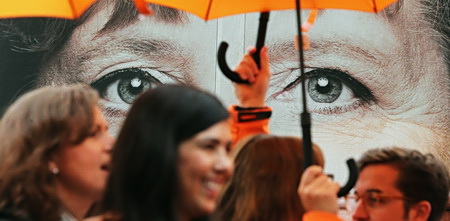
Tomorrow in Germany will be held parliamentary elections. There are almost no doubts that the united CDS/CSS block, which is headed by the Chancellor of Angela Merkel, will win. At the same time, the third term (if it takes place) - it will be the first when the Tatcher’s Teutonic Tatcher will be untied. During its first term, Merkel was a “lame duck”, related within the framework of the “large coalition” by many agreements with the post-Shrederian social democrats, the entire second term left the leader of the CDU to combat the global economic crisis.
The storm in the eurozone, the landfill recession in Greece, the rapid impoverishment of the countries of southern Europe brought Merkel in addition to a headache and recognition as an unconditional leader of the EU. However, focus on allied affairs led to the fact that Merkel thoroughly abandoned “household chores”. This, as well as multi -billion dollar subsidies to needing countries, extracted from the pocket of the German taxpayer, have done their job. As a result, since 2010, the HDS lost 8 of the 13 elections in the Landtagi federal lands, and 4 “matches” brought in a draw, retaining power only as part of a coalition with direct competitors from the SDPG.
At one time, the Schroeder government brought to itself a vote of no confidence only after one (!) Lost regional campaign-after the defeat in the “small elections in the Bundestag” in 2005 in the most densely populated German land, North Rhine-Westphalia, where 17.8 out of 80 million citizens of Germany lives. The Merkel government did not dump and eight (!) Similar defeats. In the same Dusseldorf in 2012, the HDS was crushing with the lowest result in history - 26%. Also, under Merkel, power was surrendered in Baden-Württemberg, where Christian democrats were at the helm of 58 years. In Bremen, the “Chancellor Party” generally takes third place, letting the “green” forward. Whatever defeat is an update of a historical record. Only in the elections in Bavaria, which took place last Sunday, the “nursing” party of the CSS was able to regain the absolute majority, having received 47.7% of the vote, which will allow them to form a single -party government. However, it is worth recalling that the CSS has been in power in Bavaria for more than 50 years, while not allowing colleagues from the CDU to the Catholic Republic, but not claiming to go beyond the region. The victory of the CSS can become a strong cruttle for Merkel in the federal elections on September 22 - it is not the first time to the conservatives, losing the electorate in "mainland" Germany, to storm the Bundestag on Bavarian Baurian bayonets.
Today, Germany lives in a strange paradox and managerial schizophrenia. Having the highest personal rating in German history - the peak of 68% was reached last summer, today the chancellor supports 63% - Angel Merkel does not control his own country. Thanks to total defeat in the regional elections, Frau Merkel has already lost the second parliament - Bundesrat. In the Federal Council of the CDU, he was forced to go to the opposition, as he was trumply supplanted by the “red-green” coalition, which is ruled today in most “principalities”. Even in the event of a convincing victory on September 22, Merkel will have to coexist with the opposition “upper house” for several years. Overcoming the Bundesrat Veto will lead to bureaucratic and reputational costs each time, and it will be necessary for many years of stubborn struggle to conquer all the land lost. So the third term Merkel will be overshadowed by eternal managerial wires, preventing him from concentrating the full power in his hands.

The second paradox of the upcoming elections is that Christian democrats may not be able to form the majority government, even having won a firm victory on Sunday (already, judging by the surveys, 39-41% of voters are ready to vote for the CDU/CSS). Reason: Merkel simply has no one to unite with. As always happens in difficult moments of history, allies brought down. Colleagues in the Black-Yelnoy Coalition-a free democratic party-are now balancing on the verge of passing to the Bundestag. For the last electoral cycle, the liberals-centrists lost 10% of the vote, and during many regional campaigns even lost the Pirate party and neo-Nazis from the PMC. The story that we observed in the elections in Baden-Württemberg and in Lower Saxony may well be repeated. In both lands, the party Merkel won a confident victory, but because of her political loneliness, she was forced to give power to the Social Democrats and the Green.
In the event of a defeat of the younger partners, Merkel, according to many experts in order to maintain power, will have to go to the creation of a “big coalition” with the Party of Peer Steinbryuk (SDPG). The fact is that Social Democrats (26%) and Green (10%) lacks votes to create an alternative red-green coalition. There is an option to attract the third player, the ultra -lane party Die Linke (9%), but most likely the SDPG will not go to a similar step. Feeling themselves by the power of the “decisive voice”, the “left” will again engage in “class blackmail”, which will give the coalition a strong instability. It was because of this that in the regional elections, when the SDPG had a chance to take power with the “left-wing”, they always preferred a large coalition with the CDU. Less effectively, but hundreds of times calmer.
As a result, the main pain point and the main intrigue of the elections will be the result of the younger colleagues Merkel in the opposition - SVDP. If the “yellow” take place in the Bundestag, we are before the repetition of the option of 2009-2013, but if they do not pass, Germany returns to the practice of the “red-black” coalition with the “lame chancellor” at the head, as it was already in 2005-2009. And this means that the entire package of reforms planned by Merkel will be frozen for a maximum of 4 years, and at least until the first government crisis and early elections. In such a case, Germany is waiting for either a “swamp” or a “fever”. It is not worth saying that if this happens in the head country of the European Union, this does not portend anything good for all united Europe.
Already now, the German economy began to slip a little. For the first quarter of 2013, the growth of the German economy was only 0.1%, with a growth forecast of 0.3%. Having slipped about two years ago, the phase of full employment, now unemployment in the country is 6.8%, which is against the rest of the European Union (12%), however, a very low indicator. Plus, the German budget seems to be reduced with a surplus that for crisis Europe is generally a miracle. However, in Germany there are many long -playing problems that Merkel will have to solve during its third term. This is a pension reform, the final transition from the “generation agreement” system, when their sons and grandchildren pay a pension to private pension insurance, to increase its share. This is a tightening of migration policy, which, in general, as it comes to power in many European countries of the right -wing parties, is the trend of the season. (“The integration of migrants is expensive. It would be cheaper to immediately give this money to pensioners.” A. Merkel). This is a fair social state, the program of “new redistribution”, the achievement of a thin balance, when the economic system does not produce dependent groups of citizens, does not pursue the rich and does not lead to an increase in taxes, which, in turn, is called by Peer Steinbryuk. This is the general system of budget discipline and reduction in expenses, which has already brought half of Europe to anti -German demonstrations.
It is clear that if Merkel will have to share power with the Social Democrats in the framework of the Great Coalition, you will have to forget about all these reforms. And this means that both Germany and the European Union, barely leaving the crisis, will immediately plunge into stagnation, and this can end either with a direct coming to the power of clowns, as in Italy, or to a sharp increase in the popularity of ultralery and ultra -right parties or such forces as an “alternative to Germany”, which generally call for dismantling the existing system. It is worth noting that a few months after the formation of the Alternative has already reached a bar of 4% and quite really claims to place in parliament.
So far, Merkel’s authority is enough to restrain such moods. But if the third term of the chancellor takes place in endless inter -party skirmishes and approvals, then Angel Merkel is completely at risk of finishing as Margaret Thatcher, who in 1987 triumphantly won the elections for the third term, but did not fulfill it to the end, being overthrown by its same party citizens.
Photo by EPA / ITAR-TASS and Olga Pashkova / Hedgehog / Dusseldorf