
Translated material
Geneva disciplier
Former Federal prosecutor of Switzerland Karl del Ponte is no longer engaged in high -profile Russian affairs. Today they are led by a man named Bernard Bertoss
In March last year, when the federal prosecutor of Switzerland Karl del Ponte came to Russia, many were surprised to learn that the quiet Alpine Republic is famous not only for its hours, cheese and chocolate, but also with high -profile exposures of international crime. The beginning of the investigation of the most scandalous Russian affairs of the last time: “Mabetex”, Aeroflot with Andava and the Feasts and the Feast, as well as Sergey Mikhailov, known in authoritative circles under the name Mikhas, is associated with the name del Ponte. Actively collaborating with the former Russian Prosecutor General Yuri Skuratov, Iron Karl for some time involuntarily became almost the current person of Russian politics.
For exactly one year now, Karl del Ponte has not been engaged in Russia - in August 1999, she was appointed chief prosecutor of the International Tribunal in the former Yugoslavia. However, the case of "Iron Carla" lives. Today it is continued by the Prosecutor General of Canton Geneva Bernard Bertoss. Not as eminent as his compatriot, but no less experienced and decisive.
In the books made by books and through the smoky office, located in the inner wing of the Geneva Palace of Justice, the threads of the investigation of almost all of the affairs that shook the Russian bomond converge in the last year. Under the leadership of Bertossi, the investigation of the Mabetex case continues, there are a search for those who participated in the decoration of $ 4.8 billion allocated by Russia by the International Monetary Fund for stabilization of the ruble, the fraud of Russian "authorized exporters of oil" is monitored, many other dubious operations of characters close to the top of not only Russian, but also Ukrainian, are investigated. Kazakhstan. “Our country will not tolerate it to be turned into a storage of dirty money,” says Bertoss, whom the Genevites twice elected the Prosecutor General of their canton.
Judge for justice
He is 59 years old, and he loves walking in the mountains with his three children and riding a bicycle. He is fond of football: he does not miss a single match of the Favorite team "Servett". He loves the French bards of Braus and Brassens. Visitors meets with an open smile. As a convinced socialist, does not recognize political taboos. And continuously smokes the cigarettes "Goloaz" from black tobacco. 
(Photo: AP )
This is what Bernard Bertoss looks like - a man who, without looking around, rushes into battle with corrupt officials, large mafiosi and dictators from around the world.
The idea of confrontation with world evil carried him back in his youth. In October 1966, young justice workers from Switzerland, Italy, France, Spain and Belgium gathered in Geneva, who made an effective mechanism for international cooperation between law enforcement agencies to combat organized crime. Among the others, in addition to Bertossa, such heroes of our days as the Spanish judge Baltasar Garzon, who took Pinochec, and the Belgian prosecutor Van Reimbeke, who lead the case of the French oil concern Elf (it is the famous case of France by France, Taiwanu, who was involved in the former Minister of Foreign Affairs Rolan, signed up. Dumas; see "Results" # 34 for 1998).
Young lawyers anxiously noted that Europe “black” and “gray” capital, tax paradises and offshore companies is developing rapidly, challenging the respectable institutions of liberal democracies. The document, which became known as the "Geneva call", contained a demand to adopt a number of international conventions that would allow to reveal banking secrets, establish relations directly between the investigating authorities, and provide administrative mutual assistance in the tax area.
"Geneva call" was an important milestone in the construction of the legal system of Europe. Since then, the Convention on the fight against money laundering, on the legal mutual assistance of the investigating authorities, has entered into force, an international agreement on criminal liability for the bribe of foreign officials has been reached. To a large extent, this initiative contributed to the adoption in 1990 in Switzerland of the Banking Convention on the establishment of the personality of customers, which put an end to the practice of opening anonymous accounts. And then, two years ago, a law on the fight against laundering illegal income.
Dictators hunting
Bertoss grew up on the working outskirts. The family hardly made ends meet. Hence, perhaps his painful perception of social injustice, which in his youth, while studying in Paris, led him to the left -handed democratic movement of students. When the movement broke up, one of its participants joined the Communist Party, someone became a trade union figure or left for the organization of the extreme left. Bernard Burtoss preferred the socialist party, but forever retained the tendency to left -handed extremes.
Among his friends were the Chileans, some of whom died at the hands of the Pinochet's junta. “I was very disappointed when the socialist government Allende fell. Because I had high hopes for this experience,” Bertoss later recalled. Perhaps that is why he took as something deeply personal attempt by his friend Baltasar Garzon to force Pinochet to appear before the court. Recall that in the summer of 1998, the Spanish judge wrote out an arrest warrant and handed it to Interpol. 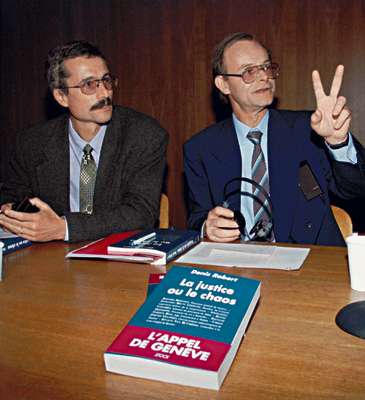
One of the most famous prosecutors of Europe, Bertoss, is closely communicating with his colleagues. With Belgian van Reimbeke (photo: AP )
The Geneva prosecutor also submitted a request to issue a Pinochet to attract a student to the court during the years of the dictatorship of a student who had a double, Swiss and Chilean citizenship. Explaining the reasons for this act, he said: "I can’t bear it when he leaves justice to walk out at large those who committed the grave crimes, no matter what reservations they hide behind."
Bertoss did not accept the argument that the immunity of Pinochet allegedly stems from the fact that at the time of the commission of crimes he was the head of state, that is, a person inviolable. If you follow this logic, he believes Bertoss, then "Ribbentrop can be judged, but Hitler has immunity."
When the British court in one of the stages declared Pinochet to be inappropriate, Bertoss gave free rein to emotions. He fell upon the British, splashing out his old hostility towards the state, which gave rise to a whole bunch of offshore zones on the islands in the La-Channel and the Caribbean: “The UK has become a real robber brothel: criminals, terrorists and other evil are hidden on the other side of the La-Channel. Bertoss.
Today, Bertoss can triumph: Pinochet has lost immunity and will appear in front of the Chilean court. “The immunity and impunity should not be confused,” Bertoss believes. “All the systems of providing immunity were conceived to facilitate diplomatic relations, the current conventions provide for immunity exclusively for diplomats.”
Indeed, the problem of immunity for political figures, in particular the heads of states, does not appear in legal documents, and it is decided on the basis of the right based on custom. "I believe, although this is a controversial point of view that the head of state, who left the post, is no longer enjoying immunity," Bertoss told the author of these lines.
Without trembling, he gave orders to arrest the accounts of the late Filipino dictator Ferdinand Markos, expelled from Haiti Jean-Claude Duvalier, who died the ruler of Zair Mobutu Seko and President Nigeria Sani Abachi.
New style of the prosecutor
The whole career of Bernard Bertossy took place in the Geneva Palace of Justice. At first, he chaired the police court, who dismantled the administrative offenses, in the House of Lease and the Commission of claims in the field of construction. However, this was clearly not his element: he was eager for battle with financial scammers and mafia combinators.
And such a chance was introduced in the spring of 1990. The chief prosecutor of Canton went to the federal court, and the Genevites for the first time in history received the right to elect the prosecutor general. They opted for Bertoss, known for their modesty, allergies to the "lamb in a piece of paper" and commitment to high ideals of justice.
From civil cases, Bertoss had to urgently re -qualify for criminal law. And this did not bother him at all. The investigations in the Geneva prosecutor’s office went faster and became more effective. Meanwhile, the new style of the Geneva wrestlers with crime caused fierce disputes. Socialist deputy Jean Tsigler warmly supported Bertossa's undertakings: "Previously, the prosecutor for the most part was instructed to turn a blind eye to fraud. Bertoss became the first knight in this position." But almost immediately other opinions sounded. Lawyer Alec Reimon, who later defended the Russian celebrity - Sergei Mikhailov, said: "People are breaking, charging them, often putting them in prison. For all financier, who is doing well, they suspect laundering affairs."
Such a different voice arose not by chance. The beginning of the 90s was the era of a fracture in the thinking of the Swiss. It's time to part with a beautiful legend that a good bank is a bank that "does not ask unnecessary questions." It became known that for many years, both bloody and dirty money passed through the accounts of Swiss banks, and no one interfered with this. In 1990, anonymous accounts were canceled. Now, when opening a bank account, it was necessary to present a certificate of personality.
The new law, who entered into force on April 1, 1998, was designed to put an end to laundering of money, ordered banks to work closely with law enforcement agencies. Bertoss explained to the correspondent of "results": "Having received a request from law enforcement agencies, the bank does not have the right to refer to a bank secret and is obliged to provide data." In addition, the law obliged banks on its own initiative, without waiting for a signal, knocking on suspicious customers.
Innovations in the banking sector predetermined the style of work of the new general prosecutor. “Perhaps now the Swiss banker may be in prison for the first time in prison,” Bertoss joked. At the same time, he emphasized that all efforts to combat money laundering do not give little to if the control of this kind is not introduced in such paradise corners for financial frauds as the Principality of Liechtenstein: "Although we can access any account in the Swiss bank, Liechtenstein never opened his accounts."
Bertossu is often reproached for the fact that he is fond of the struggle against organized crime or loud political affairs to the detriment of the local turnover - stories about thieves, taxes and violators of traffic rules. He always has an answer to this: even if the crime was committed in Ukraine, in Nigeria or Argentina, the money was washed in Switzerland. And, therefore, this is a Swiss offense. The argument in favor of Bertossa is that only 70 million francs were confiscated and transferred to the state only in cases of laundering money since 1996.
However, in some way his opponents are right. Bertossu, it seems, really attract international scandals. The more resonance, the more effective the struggle for justice, the prosecutor believes. One of these cases was Bertossa’s conflict with the representative office of China at the UN branch in Geneva. This happened just on the eve of the visit to Switzerland of the chairman of the PRC Jiang Zemin. On March 18, 1999, four Swiss - members of the Tibet Independence Movement, climbed over the fence into the mission, chained themselves to a lamppost and deployed a Tibetan flag. After 20 minutes, the violators were detained, but the mission gave an official protest.
The case got to the prosecutor’s office and eventually ended up on the table with Bertossa, who imposed a resolution: "Leave without consequences." In the explanation, he wrote: "It does not seem reasonable to punish these democrats for peacefully occupied several square meters of the territory of the People's Republic of China for several minutes, while the leaders of the same republic forced the entire territory of the previously independent state of Tibet for many decades."
And when the central authorities tried to press Bertossu, referring to the need to follow the letter of international law, he answered in a sharp tone that the decision in this case is its prerogative.
“This is funny: Mr. Bertoss confuses politics and justice,” the Chinese representative of Feng Wei said then. However, Bertoss readily accepts the reproach of politics: “Of course, I am engaged in politics, like anyone who holds a power position. But I am not a personal point of view. The values that I protect - justice, equality - these are collective achievements of democracy. They simply applying them in practice are the matter of the authorities. Meanwhile, justice has not decisively defended these values.”
On the verge of justice
What does Bernard Bertossy have in common with Carla del Ponte? In fairness, it should be noted that the Geneva prosecutor never experienced great personal sympathies for the "iron carla". And outwardly they are complete antipodes. Ms. del Ponte does not go anywhere without bodyguards and drives exclusively on an armored car, fearing the revenge of the mafia. On the contrary, Bertoss, whom all Geneva knows in person, calmly walks the streets, rides a bicycle or public transport. Prefers to do without bodyguards and a service car. He believes that nothing will happen to him.
At the same time, no matter how much Bertoss said that he is not a supporter of the Del Ponte methods, the fact remains: both prosecutors in the struggle against organized crime do not hesitate to use any means. Deputy Bertossi Laurent Casper-Antequerm, who investigated the case of the owner of the company "Noga" Nessima Gaon, who was suspected of attempts by its false bankruptcy (this story is not directly related to the current scandal), resorted to the services of the provocateur and repeatedly arranged "leaks" in the seal, just as in the case of Mabetex, Del Ponte used the loud Applications Felipe Turover and "drained" information in newspapers.
They say that Bertoss masterfully knows how to use different tricks, acting on the verge of violation of the law. He squeezes out of the law everything that is possible for the sake of justice, which, as he believes, "will never be satisfied, while there is an inequality between privileged, like us, and victims that make up three quarters of humanity."
It seems that it was Karl del Ponte who instilled in Bertoss's love of spectacles and sensations. The arrests of accounts are increasingly accompanied by high -profile statements, a television interview, and the prosecutors, headed by their boss, are thrown by the words “criminal”, “bribe taker”, “corruption” without waiting for the verdict of the court. This allowed the investigator of the Prosecutor General of the Russian Federation to Ruslan Tamaev with irony to address Bertoss's question: "Where did your vaunted presumption of innocence go?!"
However, no matter how sophisticated the prosecutor acted, often playing on the verge of a foul, he is not guaranteed from defeats. Bertoss still cannot come to terms with the fact that Sergei Mikhailov managed to avoid punishment. And besides, sue 530 thousand dollars of "lost profit" for a two -year stay in prison. However, when they remind him that the one in Geneva was called "the godfather named Mikhas" was recognized as juried innocent, the prosecutor does not agree. “Mikhailov was not recognized as innocent,” he says. “He was justified on the basis of the principle that doubt is interpreted in favor of the defendant, and even then not completely, and only freed from punishment. This is not the same thing.” 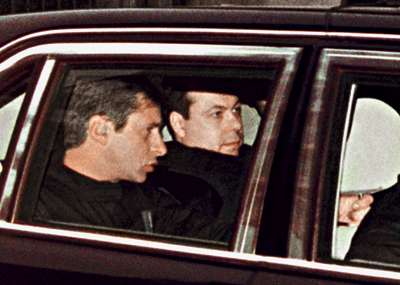
When the Bertossa team was defeated by Sergey Mikhailov (in the car, on the right), the Geneva prosecutor accused the Russian prosecutor of unwillingness to cooperate (photo: AP )
Mikhailov’s case is far from the only failure of the Bertossa team. At one time, the case of the former acting ended in a major failure Premiere of Ukraine Efim Zvyagilsky. His accounts were blocked, he himself was imprisoned for the duration of the preliminary investigation, but Bertoss was not able to bring the case to court. In connection with the case of Mikhailov Bertoss, accuses the Prosecutor General of the Russian Federation of unwillingness to cooperate. He addresses the same reproaches in history with Zvyagilsky.
"Such a prosecutor's office cannot be trusted"
Bertoss does not get tired of repeating that it is extremely difficult to track the process of laundering money. “Money goes to the Bagams, from there to the islands of Gernsy and Jershi in La-Channel, then to Monte Carlo and again to Gernsy ... the ways of this money, which are rarely transferred to any person, but almost always-some offshore companies. In all these matters, international cooperation becomes a prerequisite for success. If it is not, it cannot be finished to the end. And often it happens,”-it happens, ”-it happens,”-it happens. With bitterness it states Bertoss.
Perhaps Burtoss is especially skeptical of cooperation with Russian colleagues. "Российскую прокуратуру нельзя считать независимой от власти, - сказал он в недавнем интервью. - Всем известно, что внутри идет борьба интересов, схватка между кланами. Такой прокуратуре доверять нельзя".
Когда прокурора донимают вопросами о счетах Бориса Ельцина, он отвечает, что вряд ли их когда-нибудь обнаружат. "Счета открывают подчиненные, а не кремлевские руководители, - говорил он мне. - Это такая же история, как и с Гельмутом Колем: мы, видимо, никогда не найдем зарубежных счетов, выписанных непосредственно на имена первых лиц... Есть, правда, возможность обнаружить оффшорные компании, связанные с российскими руководителями, но рассчитывать на это трудно. Русские - это не африканские диктаторы: они действуют гораздо изощреннее".
"Но разве ничего не изменилось в России после ухода Ельцина?" - спросил на днях Бертоссу корреспондент "Коррьере делла сера". "Прежде чем разъезжать по заграницам, Путину следовало бы навести чистоту у себя в Москве", - резко ответил тот. Он считает, что "если Россия хочет выйти из средневековья, ей не обойтись без соблюдения правил правового государства".
При этом, говоря о России как убежденный социалист, он болезненно реагирует на любое проявление социальной несправедливости: "В стране люди умирают от голода, а кучка богачей вовсю транжирит общее богатство. Я каждый день вижу здесь, в Женеве, этих "новых русских", разъезжающих на огромных дорогих машинах. Они живут припеваючи, совсем не так, как средний русский гражданин, занимающийся лишь той деятельностью, которую принято считать законной. Богатство этих людей несопоставимо с нищетой большинства русского народа".
Женевский прокурор усвоил роль ментора. Ему нравится вещать, эпатировать или бросать вызов, особенно если это сильные мира сего. Возможно, это расплата за трудное детство, за тяжелый путь наверх. В швейцарском обществе таким, как он, редко удается подняться столь высоко.