
Translated material
Finnish optimism
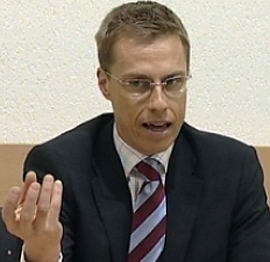 Foreign Ministers of France and Finland brought to Moscow a plan to resolve the conflict in Georgia, signed by Georgian President Mikhail Saakashvili. The Finnish Minister Aleksander Stubb, simultaneously presiding in the OSCE, held negotiations on August 12 in Moscow with Russian colleague Sergei Lavrov, after which he gave a press conference at which he said that he was optimistic, which intensified compared to the preceding day. He saw Russia's readiness for negotiations. Negotiations will be long and difficult, but now the situation seems to him, albeit difficult, "but not as much as they try to imagine it."
Naturally, journalists could not help asking Stubba what to do with the fact that Russia has repeatedly declared its unwillingness to talk with Saakashvili. To this, Stubb replied that negotiations would be conducted in international mediation. About the statement of Deputy Prime Minister Sergei Ivanov, who stated that Russia was interested only in direct negotiations with Georgia, the Finnish minister responded in the sense that one cannot sit on two chairs: one cannot at the same time want direct negotiations with the country and not want to talk with its leader.
Stubb emphasized that the plan prepared by him and his French colleague Bernard Kushner is not the final version of the contract. He recalled that French President Nicolas Sarkozy with his plan of settlement, which most likely includes elements of the Kushner-Stubba plan, arrived in Moscow.
The minister said that during the conflict many sharp statements were made from different angles that do not quite reflect the real state of things, but now, in his opinion, hostility in rhetoric is gradually coming to naught, which brings the parties closer to the cessation of fire. “There will probably be still minor clashes, but the front offenses and the seizures of the territory will stop,” said Stubb. - We can start the process, in stages, performing the following points: a complete ceasefire, providing humanitarian aid, negotiations on the withdrawal of troops and discussing the presence of international observers. The OSCE is primarily concerned with the creation of conditions for the provision of humanitarian assistance - we are discussing problems with transportation, with humanitarian corridors. The second task of the organization is to monitor the process of peaceful settlement. ”
Stubb noted that one of the most controversial points of the plan is to withdraw the troops to the positions that they occupied before the conflict, because "some will say that the conflict broke out in 1991, and others - that on August 7."
As you know, one of the requirements of Russia, which Georgia has still refused to accept, concerned the signing of an agreement on the non -use of force with Southern Ossetia. Stubb said that it is difficult to talk about Georgia’s readiness to do this, but the possibility of signing such an agreement, most likely, under a multilateral agreement with the participation of the European Union and the OSCE, should be discussed during negotiations, especially since Saakashvili’s signature is already under a plan that includes a ceasefire.
Stubb recalled that the OSCE has been present in South Ossetia since 1992 and that Russian President Dmitry Medvedev has insisted on the presence of the organization in the region in the future, but emphasized that it was too early to talk about how the peacekeeping mission in South Ossetia would look and who would become part of it.
Lavrov on August 12 spoke out against the presence of Georgian peacekeepers in South Ossetia. Stubb admitted that he did not discuss this issue with Lavrov, and said that his discussion should be postponed before the start of peace negotiations.
Stubb admitted that now it should already be said not only about the conflict in South Ossetia, but about the situation as a whole, including a conflict in Abkhazia, therefore, both fronts should affect peaceful negotiations.