
Translated material
Igor Spassky
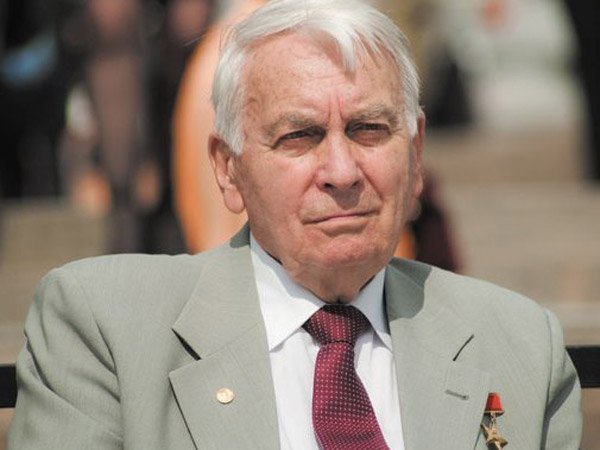
On August 2, 1926, Igor Spassky was born, general designer of submarines, ex-head of the Central Design Bureau "Rubin".
Personal business
Igor Dmitrievich Spassky (94) was born in the Noginsk near Moscow in a military family. “I was a very shy boy as a child - horror,” he recalled later. - He was shy to go to the store. Father, a military personnel, said to me: “So you can’t work out of you. You need to be for military service. ” And just before the war in Moscow, the Naval Special School opened, and I was determined there after the eighth grade. ”
After school, he entered the Higher Naval Engineering School. F. E. Dzerzhinsky. Having graduated from it in 1949, for some time he served on the Frunze cruiser of the Black Sea Fleet, then he was sent to the KB to create submarines. “I went to the faculty, which is preparing the surface. There was some kind of childish savagery: they say that for the homeland you need to die under the sun, not under water. But in life the whole thing is. When I served on the cruiser after my studies, I was sent to the design bureau in Leningrad. I come, and the chief engineer says to me: "You will design submarines." - “What are the submarines? I am a layman! " But there is nothing to do. I got into this matter, I began to generate something-they looked at me, nominated. I quickly walked on the steps: the chief engineer became twelve years old, ”said Spassky.
Since 1953 he worked in the Central Design Bureau-18 (now the Central Design Bureau of Marine equipment "Rubin"). He participated in the design of atomic underwater missile carriers of the first and second generations. In 1956 he became deputy chief engineer, in 1968-the chief engineer, in 1974-the head of the Leningrad design and installation bureau Rubin (since 1983 the head of the bureau became called the general designer).
He also published a number of scientific papers on the theory of construction and submarines. In 1973 he became a candidate, in 1978-a doctor of technical sciences, in 1984-was elected professor and corresponding member of the USSR Academy of Sciences, in 1987-a full member of the USSR Academy of Sciences.
With the beginning of perestroika and the subsequent collapse of the USSR, the state order on the new Premier League decreased sharply. Rubin, under the leadership of Spassky, began to simultaneously engage in civilian projects, among which the development and construction of platforms for oil production near the island of Sakhalin, in the Sea of Okhotsk and near the coast of South Korea.
Another important project was the floating cosmodrome "Marine Start", created from the converted oil platform. Spassky also managed small projects that brought KB money, for example, by the modernization of city trams. In 2006, he described the sphere of activity of the Central Design Bureau: “Now, in addition to submarines, we are forced to do, God knows what: both platforms for the Arctic areas and high -speed trains. But this is still a technique. And I had to work in a completely non-core area: we created an excellent business center on Nevsky, recently made the Planet Neptune shopping and entertainment complex. This is also very interesting, although difficult. ”
In 2007, he moved away from the Office of Rubin, remaining to the Central Design Bureau by the scientific director.
Igor Spassky is married to the indigenous Petersburger Lyudmila Petrovna. The couple has a son and daughter.
What is famous
The famous designer of Soviet and Russian atomic and diesel submarines. According to his projects, 187 submarines (91 diesel-electrical and 96 nuclear submarines) were built, which made up the core of the domestic underwater fleet. This, in particular:
- Atomic underwater cruisers of strategic purpose of projects 667BDR Kalmar, 941 Shark, 667BDRM Delphin,
- Atomic underwater missile cruisers of projects 949 Granit and 949A Antey.
Under the leadership of the inventor, a whole family of low-noise and highly effective diesel-electrical submarines was created, which are in demand in the world market.
Led by Spasski, the highly specialized Rubin Central Design Bureau became the head organization of the United Shipbuilding Corporation for the design of platforms for the development of oil and gas fields on the continental shelf.
What you need to know about
 Igor Spassky
The Rubin Central Design Bureau developed the Kursk Premier League, which sank due to a torpedo explosion on August 12, 2000. Most of the crew died during the explosion, the surviving sailors tried to escape in the tail of the ship, but by the time the rescuers reached the compartment, the sailors were already dead.
During the rescue operation, the General Designer Spassky was a consultant, some journalists accused him of ineffective crew salvation.
According to the Rubin Central Design Bureau, part of the submarine was raised to the surface. The cabin of the Kursk Premier League turned into a monument to the dead submariners in Murmansk.
“The wounds are still fresh,” said Spassky in 2011. - Remembering the days that painfully hit our people, by sailors, by the creators of the ship, with deep respect, you begin to relate to the international community, which in such a difficult period has found the optimal solution to the gigantic task - to pull out a unique submarine from the abyss, one of the best in Russia ...
This operation opened our eyes to new technologies. It is necessary to master the shelf and create a technique that organically fits into the conduct of emergency rescue operations at sea, combining reliability and economic optimality ...
After the accident at the Komsomolets, we “wound up” things so much! Along the entire submarine, a “tube” is stretched. In each compartment, a branch with a personal hose and a valve has been made from it: if something - a person has the opportunity to connect and breathe. On Kursk there was such a blow that people could not use this system. <...> But the most terrible accidents happen unexpectedly, although we analyze up to hundreds of classical emergency situations that they can be. However, military equipment is still made on the verge of permissible and reasonable. ”
Direct speech:
About the start of work: “I came to the Rubin Bureau in 1950 and found those people who designed submarines at the beginning of the century. Four. These were brilliant designers. Each drawing is a work of art, even send to the Tretyakov Gallery or to the Russian Museum. Today we no longer know how to draw this way: computers, graphopo builders do this work for us ... How many books, documents had to be shoveled to master, realize new equipment! The post-war period was complicated by the fact that the scientific and technical revolution was simultaneously: nuclear energy, ballistic missiles, the rapid development of electronics, as well as metallolation. These components have determined the face and characteristics of our submarines. ”
About new times: “We live at a time when the excessive outline and criticism of our defense forces will cause only a negative effect. Because they have the form to which our society led. The origins of the reasons for what happens quite often not only in the fleet, but with all other military equipment, in the early 90s ... When Putin’s policy began after Yeltsin, I crossed himself ... ”.
About the future submarines: “There are no stagnation techniques. There you either move forward, or go to the shoulder blades. We improve boats every year. I expect that an increase in quality will be in this decade [2010–2020]. Because the volume of engineering knowledge has accumulated, which allows us to make our ships even more perfect. ”
About the future of the fleet: “The peculiarity of Russia, that there are many seas-oceans around, and all this must be protected. Therefore, there will be submarines, and frigates, and several large surface ships ... The navy is eternal. Many conflicts are resolved faster when a ship comes in support of the diplomats under the proud Andreevsky flag. ”
4 facts about Igor Spassky:
- The first governor of St. Petersburg Anatoly Sobchak jokingly called Spassky the “hero of the capitalist labor,” thereby emphasizing the success of Rubin in the new economic conditions.
- Igor Spassky has been an honorary citizen of St. Petersburg since 2002.
- Laureate of the Lenin Prize (1965), USSR State Prize (1983), State Prize of the Russian Federation (2007), Hero of Socialist Labor (1978). He was also awarded two Orders of Lenin, Orders of the October Revolution, the Red Banner of Labor, “For Merit to the Fatherland” of the II degree, the Order of the Badge of Honor, was awarded the awards of the Russian Orthodox Church.
- Author and co -author of books: “Five colors of time”, “Kursk”. After August 12, 2000 ”,“ Sailors and creators of the Russian fleet ”,“ History of domestic shipbuilding ”in 5 volumes, the scientific and historical reference book“ Submarines of Russia ”.
Materials about Igor Spassky:
Biography of the designer on Wikipedia
Biographical certificate RIA Novosti
Help on the site "Personality of St. Petersburg"