
Translated material
Project "Abkhazia"
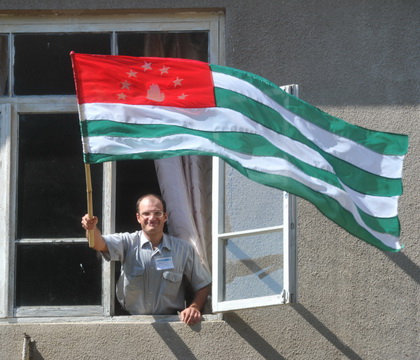
The cleanliness of the elections is sometimes quite applied factor, and if somewhere in the elections it is not customary to argue with the results of the eczit regions, then in Abkhazia they believe observers. Here they do not understand conversations about the possibilities of observers on the site, when counting votes and generally on the entire path of their followed by the most official announcement. In a word, the results of the presidential elections in Abkhazia were actually known a couple of hours after the closing of polling stations. And the more they rejoiced at the headquarters of Alexander Ankvab, the less it turned out to hide the disappointment at the headquarters of Sergei Shamba. It turns out that they really believed in victory, but, as the close supporters of the former prime minister were later admitted, two hours after the end of the elections they were ready to congratulate the winner.
But a few days before the denouement, Sergei Shamba made such an intrigue as if he had set out to prove: without his participation, the elections would turn into a fresh formality. And this was true: Raul Hajimba, the eternal Alter Ego of the Abkhaz authorities, sparkled at the finish and also exclusively thanks to Shambbe. This is later, when it ends, at the headquarters of the chambers will be recognized in their inexperience, which pushed them to the invitation of Moscow political technologists. “They slipped it to us a bait from Kitovani, and we will blow it off and swallowed it ...”
But the story with Kitovan should be played simply for the purity of the genre, because it is a sign, and by no means only for the elections. Of course, you need to have a very outlandish idea of history in order to pull out on the screen of a man who did everything so that the war with Georgia is remembered as defense from a gangster invasion. First, the story of Kitnan in Moskovskaya Pravda about the merits of an ankvab before Georgia, about how Shevardnadze had already appointed him to lead the conquered Abkhazia. Then, based on this performance, a movie was shot, which was shown on a large screen in the center of Sukhumi.
That, contrary to the expectations of the PR headers who went to the Abkhaz, was literally perceived: Tengiz Kitovani - again, after 18 years, in the center of Sukhumi.
Shamba did not recover from this blow. He still continued to try to get out of this situation. Saying that he was unacceptable to this provocation, he immediately recovered that, they say, even if he were involved in her, he did not see anything reprehensible in this. And in fact, he insisted, why not check who was doing what was doing at home for the homeland?
Without a chamb, this topic, perhaps, would not have acquired such an expressive sound. But her underlying rumble was still heard, because the main Abkhaz contradiction was arranged so. There is no wars for 18 years, one might say, a whole generation, and this generation even graduated from school. Everything that happens has nothing to do with the war. You can arrange piercing and extensive excursions on the heroic struggle for freedom. The ruins for every taste: combat, looter, burned, simply dilapidated - at the same time, most of them, even those who are irreversibly overgrown with weeds, have his own master who has been expecting clarity with the real estate market for years. Today, only a citizen of Abkhazia can buy it, which, on the one hand, is understandable, since the abolition of this ban will make Abkhazia a resort part of the Russian real estate market, and on the other hand, Russians are already buying real estate according to the most uncomplicated schemes. Although, of course, where there are schemes, there are crooks, not without it. And so you have to live.
But these ruins are only a very expressive image. In Abkhazia they live as they should live in the provinces by the sea, cozy, in which everyone knows each other. New houses are being built next to the ruins, and the question of why in parallel reality the story that stopped 18 years ago continues, hangs the air. And the story of election preferences begins with the fact that all three are “our guys, and what a pity that you can vote only for one.” And this, too, on the one hand, however, at least it is said to be sincere, but sociologists smile in crushingly, because they have nothing to ask about and no one in Abkhazia. Because neither eczitla nor election surveys are impossible here. (True, Shamba slyly reported something about the sociological reports of his unprecedented popularity. But his staff, in response to a request to reduce with these sociologists, taking his eyes away, answered that they would hardly want to say: “You give your phone-if they want, they would call you ...” They didn’t call.) They don’t talk about their addictions not out of fear. In order not to offend anyone, so that it does not work out not in the same way and not in a kind. In addition, the year 2004 taught how such mental openness could end. Therefore, the saving way to get away from the question is "they are all of ours." And if so, then there is only one step to the origins of this logic: they all fought for us, they are all heroes, and we do not divide them, although, alas, we have to. And therefore, something exotic again sounds from the headquarters of the chambers: let all the candidates swear on the ancient sanctuary that they did not betray their people. And it again becomes the topic of the day.
And everything seems to be a little suspected of the truth: the only meaning of the firm memory of the war is that there is no better way to get away from unpleasant issues that are posed with all historical directness. Including August 2008. And the war, which was not in Abkhazia this time, and recognition.
Seven years ago, in the 2004 elections, one era was replaced by another, some people with weapons almost clashed with others. They argued who was better - Raul Hajimba, who was destined to be the last representative of Vladislav Ardzinba, or the late President of Bagapsh, who, incidentally, was then considered a replacement of Ankvabu detached from the elections. But in fact, everything was easier: Abkhazia had already experienced a war in itself, there was no longer the strength to be afraid, hate and endure in gratitude for the silence what has long been called the vertical of power in Russia. And the victory of Bagapsha, quite democratic, as it turned out, was powerless to cancel the genre in which they found a life -loving people who do not care - “United Russia” or the same “One Abkhazia”.
And already without any allusions on the topic "If only there was no war." After all, this era in 2004 ended for everyone. Everything is honest and without unnecessary heroics.
But then 2008 happened. Oleg Domenia, director of the Center for Strategic Research under the President of Abkhazia, is a philosopher, and he formulates with philosophical directness: “Russian recognition has become a challenge for us, for which we were not ready. The question that we have no answer yet. We are so accustomed to being a state that we must fight for the recognition that when we were recognized, we now do not find a new meaning. ” Domenia calls this a crisis of identity and generally all previous value attitudes. Abkhaz intellectuals talk about the need for a new project. There is no project. There is not even a draft. And the elections are extraordinary. To which, like by 2008, no one, including favorites, was ready.
People close to the chambers recall their past plans: to calmly wait for the end of the Bagapsha period, which inevitably had to begin friction with an ankvab, as a result of which the Shabel became the only successor. The Abkhaz opposition, which is the representative of Raul Hajimba, was also made to wait, but to his own: when Bagapsh finally confused in the traps that she placed with the Kremlin. The Kremlin, say, says: AIBGA, divided by the Russian-Abkhaz border of the village in 30 families-ours. And the opposition replies: see how Bagapsh gives our lands, which are already few. Or like this: see what Bagapsh will do with our real estate! But Bagapsh did nothing-he, tied hand and foot, as if he had personified the question with his whole appearance: who in his situation could afford at least some maneuver?
Probably, the secret of the stunning success of the questionnaire was that it was him who was recognized by the authorities, and Abkhazia is no less a country of loyalists always voting for power than all its post -Soviet neighbors. Both Shamba and Khadimba, who put on criticism of this power, were probably doomed from the very beginning. But for an ankvab in this situation, one could not help the same image that he cultivated for many years: he is a rock. He is a continuation of the bagapsha, only frowned and adamant. He knows what Bagapsh did not really work out and that neither Shamb or Hadjimba could definitely say: say no. To everyone - both their own and a stranger. Both the West and Russia. And the bribe taker, and mediocrity ...
This is the image. Ankvab, expelled from Abkhazia in the former era by its leader, Vladislav Ardzinbo, who was also a rock, obliged to rise above everyone else, began with such a negative rating that would make any ambitious man think. And the point is not that it was Tengiz Kitovani in the center of Sukhumi today - and more worthy people would hardly have managed to leave even a scratch on the image of an ankvab today, trying to doubt his past. The past ended in the generation back.
But nothing else that could be mistaken for a new and real project, so far is also not visible. In addition to an ankvab, which promises order. The need to look for answers is again saved.
Photos of RIA Novosti