
Translated material
Alexander Lukashenko is looking for new Eurasia
Alexander Lukashenko knows the price of peace with Russia even better than Ukraine, and he would have something to tell in Kyiv a colleague Petro Poroshenko, the debutant of the genre. If, of course, he wanted it. But Alexander Lukashenko does not need to share this experience. And not the fact that Poroshenko would be interesting.
Alexander Lukashenko is the only one of all post -Soviet colleagues who himself decides whether time has come to quarrel with Moscow again, and only Moscow has to adapt to it. As a rule, unsuccessful. In the Yeltsinskoye, Moscow guessed about the true ambitions of Lukashenko, who extended from Brest to Vladivostok, and was forced to engage in open controversy with him. From the current government, nerves surrendered only once, during the 2010 oil war, when she expressed Lukashenko everything that accumulated for years, but nothing good came out of this. All the benefits of Belarus were quickly returned, and Moscow, which received a visual lesson on the difference in the union and symbiosis, has learned it. Now her style is the restraint of the older brother, who is higher than to swear with the younger, even if the younger is looking for a reason and does not stand on ceremony in expressions.
In a word, the more clearly the Moscow is evaded from the fight, the more decisive Minsk is, as if groping for all new boundaries of the permitted. And Moscow holds itself in his hands again. For the reluctance to solidarize on the Crimean issue with Moscow, like five years ago with South Ossetia, only elegiac resentment. For a demonstrative visit to Kyiv - only the same demonstrative unwillingness to meet in Moscow that, against the backdrop of a desire to meet with Nazarbayev, who was just as flying to Kyiv, should look undoubted, although not too impressive punishment.
Maybe it looks. But certainly it is not at all.
Old focus in the new circus
This is all the same unwillingness to bring controversy from Lukashenko to a public level. There, where he is stronger. Just because it does not hide anything.
After all, the political goods that the Eurasian partners took to the large Kyiv fair have been fundamentally different. Nazarbayev went to the presentation of his strategic neutrality, which is today at a high price. Lukashenko never pretended to be a strategist. To live until the evening, then until the next, then until the weekend, then before the election. He solves current problems, and to solve them, you sometimes just need to stay from Russia, the further the more passionately it creates problems for itself.
Nothing strategic and long -term. The usual tactical wish is not to go to the bottom with those who are harder. The ruble will return to the place - Lukashenko will return. Problems will resolve - there will be a brotherhood again. Until the next problems. And everything is intense, without any slyness.
And everyone believes. Even Nuland. For the umpteenth time. Why not believe?
But regularly repeating momentary is doomed to become a system, no matter what Lukashenko thought about this.
At first glance, the current Demarshi Lukashenko does not stand out with anything special against the backdrop of the former experience. The reaction is common and predictable. In order to guess how to make money on Russian quirks, you do not have to be Alexander Lukashenko, and if you have become for them, you simply must drive through Russia allegedly in transit what it prohibits and cultivate salmon in all its manifestations. And to shut off such neighboring undertakings, which the neighbor seemed to be satisfied with Lukashenko elegically clarify the world: did you call me a sick person in Europe?
This happened several times every few years, but now the situation is special: the Russian reversal is for a long time. This is not a few months, as in 2008, when, it seemed, everyone only thought how rather to make peace and return to previous comfort.
Alexander Lukashenko, as it turned out, habitually played the old number as the history of his presidency - but in a completely different world. And what to do with it does not know, it seems, even he.
One on one
The debugged program risks hanging. The scandal technology has developed its temporary rhythm over the years. Fair political indignation and Belarusian national pride should be clearly coordinated with credit needs and a budget process. Like the schedule of the release of the next political prisoners - with the rhythms of negotiations with the IMF and, of course, with the Kremlin: Minsk always solves a multi -criteria problem.
And now nothing is clear with the rhythm. And with a loan, by the way, too. And with the needs and with the budget, because the 30 percent purchase tax tax will save tomorrow, but not in a week, but who said that it will end earlier? And even if the next tranche of the loan Minsk will receive from Moscow, will he close a hole, the size of which no one knows yet?
And even the participation in the EURARASEC, which Lukashenko successfully traded for loans, even for oil and duties, even for a share in potassium fertilizers, loses its effectiveness in the rate of falling of the ruble. In general, the market that he used to go to Moscow, as is customary in Moscow, is rapidly being rebuilt.
It is necessary to trade with something else. And with someone else. In addition, the entrusted population continues to habitually watch Russian news. And therefore, the Maidan reacted with such anxiety that, as sociologists assure the position of Moscow, reacted with a much greater understanding than Lukashenko himself. On the one hand, of course, hatred of any Maidan is the property of the ruler of that well -known variety to which, along with other colleagues of our Shirit, Lukashenko belongs. But, on the other hand, if tomorrow the war is a new trading, informational and indeed some - how will the Belarusians behave? Therefore, the time has come to aggravate values.
Lukashenko has been playing brightly on the field of defenders of Belarusian statehood, from which the Belarusian opposition has gone. But this year, Belarus suddenly widely celebrated the 400th anniversary of the Battle of Orsha, in which the troops of the Grand Duchy of Lithuania, with which only the opposition had previously identified Belarus, defeated the Russian army. Previously, Lukashenko did not welcome attention to such dates. And now even Zenon Poznyak, a long -standing and expelled inspirer of the Popular Front, could envy the freedom of the national leader who warns Russia from the temptation to mistakenly accept Belarus for Novorossiya.
And also not for the first time. But also in a completely different world.
Somehow, the Belarusian government will not be able to westernize and liberalize in reality, even if Lukashenko declares a state program. He can release a couple of political prisoners, but he will not succeed in looking more friendly to the west than in 2010. And how quickly Lukashenko changes the vector of historical development, everyone remembers the adventure of the opposition on the day of elections, which suited that friendliness of the election, exactly four years ago. This Ilham Aliyev can afford and quarrel with the West, and to show undisguised arrogance to Eurasianism, and plant one opposition after another. But he has a resource that will save it even in difficult times for all oil -producing groups. Lukashenko had his own resource, but now he should be to complain after Putin: yes, excuse me, he did not diversify.
It is impossible to leave the east, especially since there is nowhere. And it makes sense to remain only to the extent that you can still pull the time in order to live at least a little in the old way, and Lukashenko has nothing to hide here. And at the same time nothing threatens nothing, nothing prevents to live up to the evening, and even before the elections, and even after them. And the scandal with Moscow, no matter how Lukashenko appeals, will settle down long before he becomes a little clear how to live on. Lukashenko, in general, also had nothing to discuss with Putin in one -on -one format.
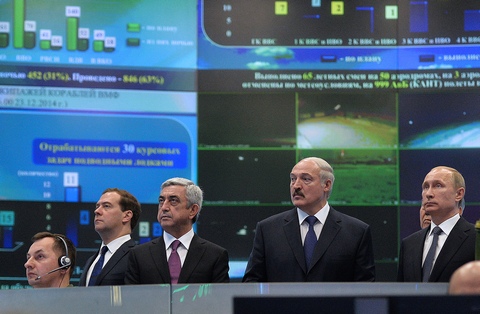
In the photo: Russia. Moscow. December 23. Russian President Vladimir Putin, President of Belarus, Alexander Lukashenko, Armenian President Serzh Sargsyan and Prime Minister of the Russian Federation Dmitry Medvedev (from right to left) during a visit to the National Center for the Defense Management of the Russian Federation. Alexey Druzhinin/Press Service of the President of the Russian Federation/TASS