
Translated material
On boarding!
Party "Children of Marx and Microsoft"
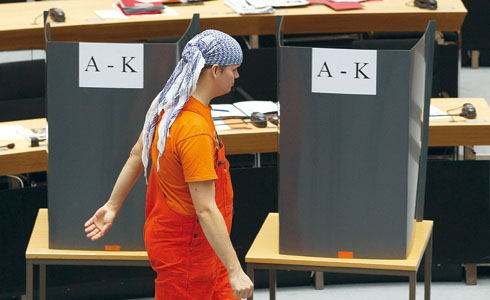
Gervald Klaus-Brunner shocked with his appearance of stiff colleagues on the Berlin parliament on boarding! In Germany, a sensation: a Pirate Party of Germany, not known a couple of years ago, is rapidly gaining points. In September 2011, Pirates took 9% in the Berlin parliament, they have about the same rating, according to polls, on the eve of the May land elections in the Northern Rhine-Westphalia. What is the province there: now more than 7% of the Germans would vote for the “pirates”, which would allow the party to go to the Bundestag. There is such a party in Russia - it has already been under three similar names just filed an application for registration with the Ministry of Justice of the Russian Federation. The phenomenon of those who have already been dubbed by the “children of Marx and Microsoft,” the 40-year-old Gervas Klaus-Brunner studied on the first working day in the parliament in bright orange t-shirt and overalls and tied on the head of arafat. This immediately caused the protest of the Jewish community, which demanded to remove the "Palestinian scarf, as a symbol of terrorism and anti -Semitism." A few days later, the Pirate showed up in the same arafat, but with the star of David on his neck, saying that he would take off his handkerchief as soon as the Israelis and Palestinians would come to a compromise.
The 20-year-old “Pirate” deputy Suzanne Count immediately after the election issued his friend life at the headquarters of the assistant, which in Germany is considered “unethical”. Comrades in the party criticized such a "family", and Suzanne abandoned the venture.
The 26-year-old graduate-mathematician Simon Weiss posted on the Internet a photograph in which he leaned over a path of white powder similar to cocaine, draws him through a paper tube. Nearby stands a solon. "What did you think?" - Simon jokingly commented on his act. He, like many of his one -partyists, advocates the introduction of Rauschkunde in the Berlin schools (“knowledge of intoxication”, playing the word Naturkunde - “natural science”). The joke was considered extremely unsuccessful.
Pirates publicly abandoned service cars with a driver and go to meetings on a bicycle. Having barely entered the new hall of meetings of the faction, they repainted it in orange.
Five years ago, this could not be imagined even on the stage of the Berlin cabaret, where they like to make fun of political marginals.
"
They require restriction of the powers of special services, refusing to collect and storage by public structures of personal data of citizens, secrets of electronic correspondence. In fact, they declare themselves as a clear alternative to total state control
"
The wind in sails in 2006 gathered together young Berlin techies, programmers, and information technology specialists and decided to protest against censorship on the Internet. So, in fact, “pirates” arose (Piratenpartei Deutschland), which took the name from Swedish like -minded people. With their color, they chose orange. Their coat of arms is a stylized sail inflated by the wind. Now they are also members of the World Pirate International - Pirate Parties International.
For the first time, the Pirate Party of Germany entered into a political struggle in January 2008 in the Parliament (Landtag) elections of the Federal Land Hesse. Then she scored about 7 thousand votes. In 2009, the Pirates participated in the elections to the European Parliament, gaining about 230 thousand votes (0.9%). Further - more: in the Bundestg elections on September 27, 2009, they already received 847,870 votes (2%), distinguishing themselves among the so -called "other" parties. Finally, September 2011 is a success in Berlin.
It seemed for a long time that they were more likely playing politics. Critics mockingly christened them with "digital bohemia." Pirates came to their meetings with a drawn mustache and dressed in carnival costumes of corsars. They demanded suffrage for foreigners and minors, free download of music and films, completely canceling censorship on the Internet, free travel and metro, legalization of mild drugs. Despite all this or thanks to this, almost 130 thousand people spoke out for the “Orange”. And in the age group from 18 to 30 years, the party generally received the most votes. She triumphed in all parts of the city - both in the West and in the East. In some areas, they received more than a quarter of the vote.
So why do hundreds of thousands of voters vote for the "pirates"? Or people are so eager to save on licensed products that they are ready to vote for anyone?
Attraction
The Pirate Party of Germany (abbreviated as Pirates) was founded on September 10, 2006 in Berlin on the model of the Swedish Piratpartiet as a party of post -industrial (information) society. Goals - promoting the free dissemination of knowledge and free culture, reform of laws on copyright, the struggle to maintain civil rights and freedoms on the Internet (in particular, counteracting electronic surveillance and censorship). In addition to membership fees in the amount of € 36 per year, Pirates accept donations from individuals. They refuse to accept money from large companies from large companies. |
The "pirates" have a completely different way to conquer the voter. Here is what the New Times Karmelito Bauer said, the leader of her youth wing: “On the Internet we communicate much more and more frankly than in real life. The fact that I would not say to someone in the eye, I will easily write on the forum. So faster and more honest. And in politics, everything is the same. Truths of democracy instilled in us the Internet - when the opinion of one is more valuable than the silence of thousands. ” And this is almost a political attitude. At one time, one of the most striking figures of the pirate party, former Kiev woman Marina Weisband said: “My Fatherland is the Internet,” referring to a new communication space. “We have in the first place the respect of the views of an individual,” continues Carmelito Bauer. “When politicians do not plant the right decisions, but listen to what the bottoms say.”
Among the Pirates themselves there are no lower classes or tops. Where others have party discipline and vertical power at the congresses, these have a riot of opinion. It is good or bad, but this is a way of political struggle.
Populists and realists “German“ pirates ”are not populists,” President Schleswig-Holstein Torsten Gerdts explains in a conversation with The New Times, hinting at the northern neighbors from Sweden and Denmark-and the Internet for them is only a means to proclaim ideas. ”
The deputy of the Berlin land parliament from the Pirate Party Christopher Lauer agrees with this opinion: "We do not reduce our activities to the virtual space." And Bastian Tsapf from Marburg at the December Congress of Pirates at Offenbach directly stated: “None of the Pirates will say that he was going to engage in politics only in the World Wide Web. We are talking about the rights of citizens in real life, about the freedoms of each individual citizen. We will fight for them. ”
The famous political scientist Oscar Netermeier called the "pirates" "digital revolutionaries of the information society." They require free access to those scientific research that are financed by the state, restrictions on the powers of special services, the abolition of biometric passports, immediate refusal to collect and storage by state structures of personal data of citizens, preserving the secrets of electronic correspondence, and real combating corruption. In fact, the "pirates" declare themselves as a clear alternative to the total state control of the state. And many people like it.
However, some requirements are still clearly populist. For example, “unconditional basic income” is a guaranteed cost of living provided to every citizen without any conditions. Or a radical revision of copyright laws. In this case, in the first case, they cannot explain: where to get the money? In the second - how to guarantee worthy wages to the authors if copies of their works are distributed for free?
The party’s program was created following the example of Wikipedia-everyone can add something to it or fix something, controversial moments are discussed by everyone on the party’s website; There, a compromise solution is developed, which is recorded in the program - until the next sentence or change made by the next visitor.
All meetings of the leadership and factions are now held in open mode: either by direct broadcast on the Internet, or through the publication of complete protocols of these meetings. In the 80s of the last century, it was precisely such transparency that “green” protruded. However, they soon returned to the traditional methods of political work: they did not want their internal squabbles to immediately become public.
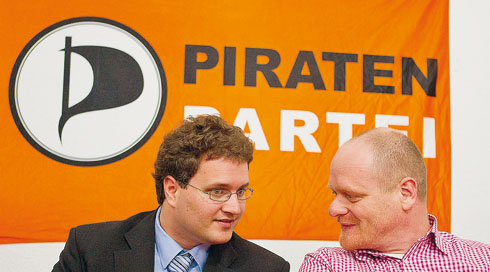
Sebastian Nerz (left) and his deputy party Bernd Schlömer feels under the pirate flag a very confident course on the Bundestag at the congress in Offenbach, where 18 thousand party members and sympathizers from all over Germany gathered (there were no delegates), the Pirates directly declared their federal ambitions. The co-chair of the Pirates of All Germany 29-year-old Sebastian Nerz proclaimed: "We are not a one-day party, we came to politics for a long time." He is also sure that the ideas of the "pirates" attract a classic liberal voter. And refers to some free democrats, who sometimes call the Pirate Party "a new hope of German voters with liberal views."
The commentator of German television Michael Strepel, however, believes that the “pirates” gave an alternative to those who did not want to vote for anyone before. The main reason why voters have already cast their votes for them or will still give them is fatigue from the slurred policy of established parties. In Germany, this is primarily the CDS and SDPG (it is enough to recall at least the recent throwing of the CDU on the issue of nuclear energy). As German political scientists joked before the 2009 parliamentary elections, if Christian democrats and social democrats changed programs, hardly anyone noticed it. However, experienced analysts, for example, the election expert and telecumentist Yorg Schönenborn, believe that even on the wake of a protest vote to take a five percent border to the Bundestag (almost 2.5 million people) “pirates” will not be easy. In his opinion, for most voters such topics as work, pension, income, internal security are much more important than freedom to download music. But just on these main issues, the Pirates has too few programmatic ideas.
For them, however, youth. Former apolitical power. The same Nerz already predicts the contours of the future coalition: red-green-orange (red are social democrats).
Hostages of success
The Pirate Parties International - PPI is the main organization of the international movement of "pirate" parties. It was founded in 2006, registered in Belgium in October 2009 as a non -governmental organization. The first was the Swedish Piratpartiet Party, founded on January 1, 2006, PPI supports and coordinates the creation of national parties created in 33 countries. In 2009, in the elections to the European Parliament, the Pirate Party of Sweden received 7.13% of the vote and one place in the European Parliament (two places after ratification of the Lisbon Agreement). |
A hundred days after the elections in Berlin, the already mentioned deputy Christopher Lauer wondered: “What, in fact, are doing in parliament?” The Pirates themselves recognize their low competence in socio-economic issues. So, the head of the faction in the Chamber of Deputies Andreas Baum, a specialist in the field of Internet technologies, to the question of what the budget debt of the capital (€ 62 billion-The New Times) could only answer: "I do not know many millions, accurate numbers." Another deputy Fabio Rainhard spent a year and a half at unemployment benefits and now with difficulty finding himself at work. He knows little about Eurosrisis, and even more so about the ways of leaving it.
“Pirates” have become hostages of their own success, ”explains The New Times, political scientist Nils Diderich. “They have not yet found themselves on the political map of Berlin.” He is echoed by the hero Negebauer from the Berlin Free University: “The protest voting is very shaky. And to conquer the voter, real professionals are needed, we need a team. ”
Some members of the leadership of the Pirate Party began to understand the severity of the burden that they had taken over and left politics. One of the leaders of the “pirates” at the federal level Marina Weisband returned to her dissertation. Her ally of the leadership of Jens Zaypenbush left. Herhard Anger left the post of head of the Berlin organization.
Now the "pirates" in the party in the country in the country is over 20 thousand members. Due to the lack of any restrictions on taking them, more and more. How will they start their success? At least one thing is clear: the political landscape of Germany will never be what it was a year ago.
The main points of the program of the Pirate Party of Germany, adopted at the congress in Offenbach:
* The abolition of the church tax is complete freedom of the Internet, subject to copyright and the inviolability of private life, the absolute transparency and accountability of the state apparatus legalization of drugs without dividing by mild and difficult introduction of the basic income for all citizens as an alternative to unemployment benefits