
Translated material
"Snobism is not an engine of progress"
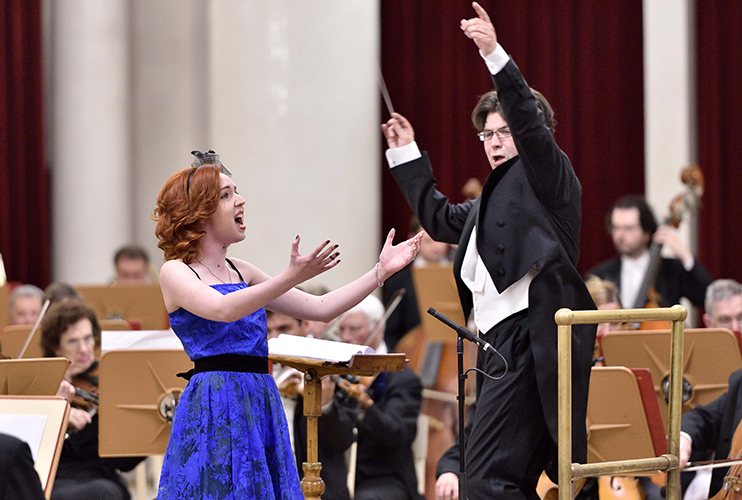
Irina Nikitina is the president of the Musical Olympus Foundation, which has been bringing the most status musicians to Russia for many years: this is Andrash Shiff, Anna-Sofu Mutter, Yo-Yo MA, Vienna Philharmonic with Christian Tilemane. Another area of activity of the Musical Olympus is the promotion of young laureates of international competitions both in Russia and at the best world venues. The festival of the same name, annually collecting from all over the world of newly-made winners, was held in St. Petersburg for the 20th time, after which Ekaterina Biryukova met with the president of the fund.
- Since we meet during the Tchaikovsky contest, the first question is whether his laureates participate in your winners festival?
- Participated. Not every time. But participated. Tchaikovsky is a competition that stands apart ... He has a difficult story ... For example, we had a cellist Istvan Vardai, whom we loved very much. He took third place on Tchaikovsky, it seems, three contests ago. And he seemed to me the most interesting there. During this time, he had already won the ARD contest in Munich, now he has received a very prestigious leaf award in Budapest, and in general he has a very large concert activity. Last year, we sang AO of Lee, the Chinese baritone, having won the “Operation” to Placido Domingo, he is now participating in the Tchaikovsky competition. He is a fantastic singer and the kind, amazing soul man. We already managed to show him in Carnegie Hall and once again on the newly completed Musical Olympus. He sings at the San Francisco Theater. As I understand it, he was invited to come, the prize is very large, he is very confident in his abilities. I will be very surprised if he receives something not the first.
- The current competition is distinguished by an abundance of formed, rather famous musicians. I even heard some participants with solo concerts at BZK. Why do you think they need a competition?
- People who can continue to move their careers are sitting in the jury. Director of Carnegie Hall-in the jury of the cellists. Director of the Lucerne Festival - in the jury of the violinist. Director of the festival in Verbier - to the jury of the pianists. These are serious doors. And I think that, probably, many came to the competition for this. Then - not the last moment in this life - large bonuses. It’s hard for musicians to earn. Especially now.
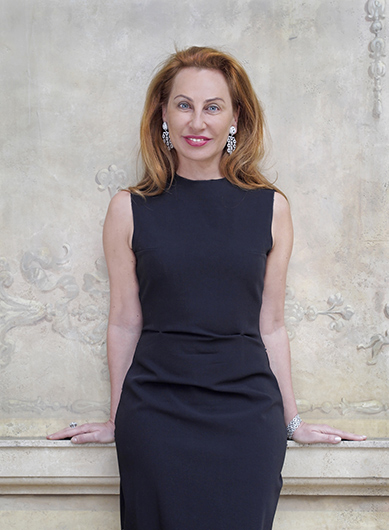 © Vladimir Lipovskaya Irina Nikitina
- What has changed in your festival over these 20 years?
- Of course, initially the festival was not easy. A whole festival of unfamiliar names! I can say to myself. Here I come to Vienna, or to Berlin, or somewhere else. A good hall, a good orchestra, but at the poster I see four unfamiliar names. Well, Kat, honestly, I won’t go! But in 20 years, I think we absolutely overcame this fear of the public. The audience is ready for debuts and trusts the Libra of the Musical Olympus. They know that they go to people who are on the runway in their lives. Getting a bonus at the competition is not the end, but the beginning. This is a huge springboard, huge expectations. And humanly, it is necessary to immediately give them good concerts in good halls with good orchestras. It is very important to show that they are waiting.
We have developed a certain backbone of the public, which goes to each concert. We still have such an idea - a prize of spectator sympathy. And for some, this directly became vital - to walk, to leave everyone, to put their crosses. The festival also has a constant Western audience, which specially comes to it. For 100 people. There are clubs of friends in New York, in Switzerland, now we will organize one in Russia.
For me, our festival is such an information television tape: what happened in the competitive world in a year. Daisin Kasimoto or Sayak Shoji, for example, played one competition, next year they won again somewhere else, then the third. Istvan Vardai also brought some new victories every year. And we showed some from three to four times. But this is a rare case.
Why are I interested in contests? Of course, the competitive system has pros and cons. But the fact is that concert life requires great endurance. Mental, psychological, physical. I am sitting at a concert in Tokyo, and it doesn’t matter to me when and what time the artist from New York arrived. It is important for me that I came to this artist and he has something to tell me. And if a person breaks through this competitive meat grinder, then he is most likely ready for such work. This is one of the plus sides of the competitive system.
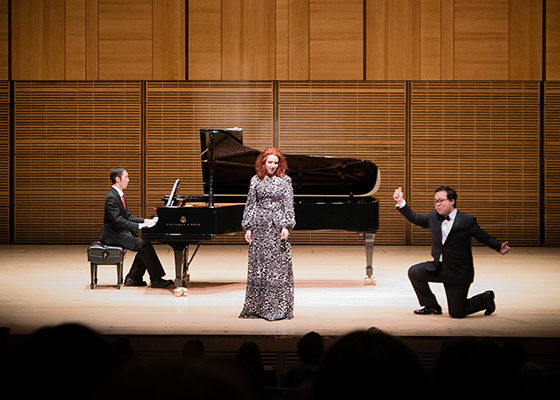 "Musical Olympus-2015"
- an inadvertible question. A large number of oriental names at competitions - for you a problem or not?
- You know, when they ask me, for the west or out of the east, I answer: I am for the music. A huge, of course, is the army of Asian musicians. Moreover, if about 20 years ago this is ... not that it was firing, but it was surprised, now it is no longer surprising at all. Korean, Chinese singers - Katya, how they relate to diction, pronunciation! How it is polished by any language! I remember we invited the Korean girl Song Young Ceo, by the way, she won the last Tchaikovsky competition. And she writes to me that she really wants to make a “Tatyana’s letter”. I have a slight horror and distrust. Korean sings Tatyana's letter with the Maryinsky Theater orchestra! I am writing-maybe something else can be? But she asked so that my heart trembled. In short, a girl came out, and even in such a dress, you know, before in the party committees such plush curtains of dark red color hung, I pressed into a chair. And this lasted exactly until she sang the first two words. The purest Russian language! Each word is felt! I still can't forget it.
- That is, what are your forecasts? Classical European music will be saved in the East?
- Classical music will be saved where they will be more engaged in children. There is a clear failure in the European school, they are not engaged in children. Any school for gifted children causes great social criticism. How do we distinguish someone?! I can say that in Switzerland this is completely nearby. In Germany, a little easier. This is not democracy, but pseudo -democracy. You can’t. Children should receive education early. Because the fact that the child will not receive in childhood, he will almost no longer catch up. I mean the technique, the same discipline.
And Asians - yes, very disciplined and efficient. And as soon as they come to Europe - I observe this phenomenon all the time - they retain their best, but also let into them a new one. They perceive everything very quickly. I already have no feeling that was 20-30 years ago that they play someone else's music. They have a motivation - to survive and break out, which Europeans do not have. And they are not snobs at all. Snobism of aesthetes is probably good. But snobbery is not an engine of progress.
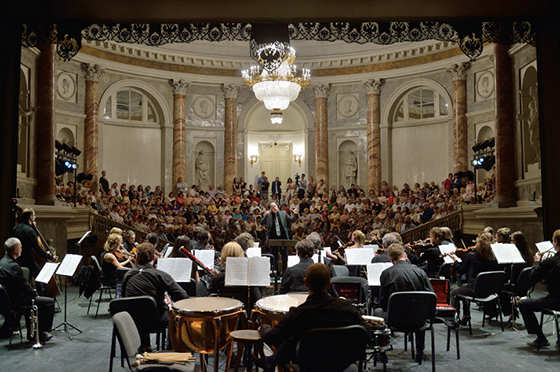 "Musical Olympus-2015" at the Hermitage Theater
- The main event of the last Moscow season was the arrival of the Viennese Philharmonic Orchestra with Christian Tileman, organized by the Musical Olympus, behind the remote control with Beethoven's full symphonic cycle. I still can’t believe what it was. Since then, the situation has changed a lot - crisis, sanctions, a cautious attitude towards Russia. Would such a project be possible this year?
- First of all, I must say that this project is really happiness for me. I wanted to bring the crowns so that they show something worthwhile, which could not sound for a long time. Oddly enough, the cycle of all Beethoven's symphonies, if it sounded with us, is fragmented. And so that in a few days a flurry of Beethoven music - of course, this is a very strong impression. We became very friends with Tileman. This is one of the most difficult characters among the current conductors. Unpretuous, categorical, uncompromising. He is very interesting to me as an absolute honesty musician. There are few of them. He is very self -sufficient. I think this prevented him from taking the place of the boss of the Berlin Philharmonic. But I was not upset for him. Because he has an amazing orchestra - Dresden Staatskapella. I just listened to them at the Easter Festival in Salzburg. Sound excellent!
The Moscow tour was very difficult to organizationally when we met, everyone was very tense, and parted as deeply loving and understanding each other. So this week turned upside down. Tileman and I spent a lot of time together, walked around the museums, funny dined on the day when all the restaurants did not accept the cards, because the master bank closed, remember?
After a trip to Russia, he wanted to try the Russian repertoire - which he never did at all. And now at the Easter Festival in Salzburg, the sixth Tchaikovsky and Shostakovich’s concert with Nikolai Tsnider conducted. You can imagine what a metamorphosis happened to him!
-Yes, he is a persistent adherent of the Austro-German classics.
- I can imagine how the sixth Tchaikovsky would have passed here! Probably, she would just divide the listeners into two camps. Tough. He has beenproit it as we cannot imagine at all. He completely destroyed the usual idea of Tchaikovsky. At a press conference, he immediately stated that Tchaikovsky was not at all such a sentimental composer as he was used to representing him. Indeed, nowhere was there that the soul was torn to parts. This filling, expansion, extension, as in the accordion, was not there. On the contrary, he dried everything, built everything, by the end of the final there was a feeling of some centrifuge, it seemed that he was almost accelerating. It was as if the superholphist took from some first field and fell into this last hole through all the fields. You do not understand how it is possible, but it still breaks you.
We are negotiating with him. Now we are working on the opportunity to bring the Dresden Staatskapell. We have not been with this orchestra for a very long time. They are in excellent shape. I think we will succeed.
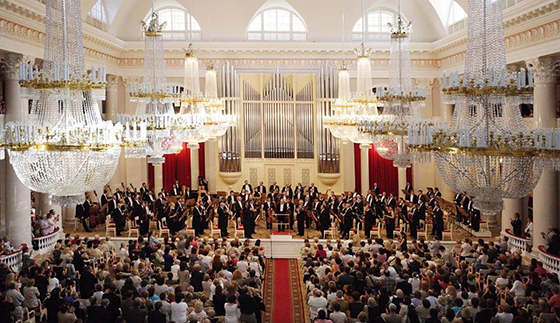 "Musical Olympus-2015" in the Great Hall of the St. Petersburg Philharmonic
- How do Western artists react to invitations from Russia now?
- Absolutely normal. We only had with Evelyn Glenni exactly a year ago the situation was such a situation with which I, frankly, collided for the first time in my life. During the festival, we have a master class. And, in addition, the artists participate in social programs: one group goes to the orphanage, the other to the crosses, the third - to the hospice for the elderly. When we just started to organize it, I thought that they would smell it. And then I heard how the amazing French violinist Salen Paidassi, who won at the Margarita Long and Jacques Tibo, played in front of six children who were already completely in the crib. She played better than at a concert!
So, this year we had the master classes of Zakhara Bron and Evelyn Glenny, with whom we have been friends for a long time, the first to once brought her to Russia. And when we entered into an agreement with her a year ago, then a point about force majeure suddenly crawled out, which said that if the British Ministry of Foreign Affairs considers that it is dangerous to visit Russia at this moment, then we still have to pay her a fee. Well, of course, I boiled, it is unthinkable! In general, usually force majeure is natural disasters. Flood, fire. And then her manager was frightened, maybe in a year we will have war, tanks, Maidan. I wrote to them that music is outside politics.
- Do you really think so?
- I believe that music, of course, can be tried to make a political lever, and we know a lot of examples of this ...
- ... the whole XX century.
- Yes. But. You can, for example, say "we are for peace", but we can "we are against war." I believe that it is better to be “for” than “against”. Against - this, let's say, is inconsistent.