
Translated material
The results of the year. Kondovo, but successful
Around Russia
 The results of the year. Kondovo, but successful
January 1, 2013 Sergey Karaganov
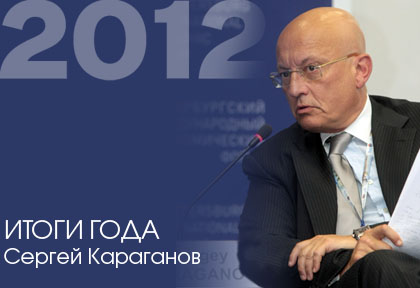
The correspondent of the “daily magazine” talked about Russian foreign policy with the famous international expert Sergei Karaganov .
Sergei Alexandrovich, what, in your opinion, were the main trends in Russian foreign policy in the past year?
In 2012, Russian foreign policy developed in the spirit of the trend of recent years. That is, Moscow behaved in the international arena, simply speaking, rather, rather Kondovo, but very successfully. And if we talk in political science terms, very traditionalist, in the spirit of the XVIII-XIX centuries. In fairness, I note that our partners are conducting the same policy, however, driven into the framework of a few large decency (however, from these decency, if you look at their actions in the Middle East). In this situation, Russia acts quite skillfully, believing that the rest of the world is rolling to vulgar geopolitics. Is it constructive? No. Is it right? Don't know. However, in the prevailing coordinate system, Russian politics was more advantageous and much more successful than that of any other large country, except perhaps China. Yes, and he began to get into conflicts.
What was this manifested in relations with the West?
Obviously, the foreign policy of Russia began to more and more annoying part of the Western partners, firstly, with stiffness, and secondly, deliberately demonstrative neglect of their opinions and interests. In the West, relations with Russia in the past year was characterized by the collapse of illusions caused by the four -year rule Dmitry Medvedev. For many, it was very convenient. He allowed them to be painlessly pretending that Russia is not what it really is. That it is modernized. Although, in fact, perhaps the fastest demodernization in Russia since the revolutionary crisis of the early 1990s has occurred in the last four years. This, however, is not exclusively associated with the actions and decisions of Dmitry Medvedev. We all were pleased to do nothing. And smoke about modernization. However, with his departure, it became impossible to lie to himself and others, and dissatisfaction with Russian foreign policy came to the surface.
The domestic policy, meanwhile, developed in a certain way: point repressions against the opposition and partial political liberalization. Against the above background, these point repressions created a situation when it became considered that it was indecent to cooperate with Russia (although they cooperate with might and main). In addition, there is a hope that Russia can be pressed. The Magnitsky Law, of course, should have been developed not in the US Congress, but in the Russian parliament. But he is a reflection of deeper trends in relations between Russia and the West. This does not mean that we do not need to do anything in connection with cases similar to the stories of Sergei Magnitsky. The investigation conducted by the Human Rights Council under the President leaves little doubts about what was there. But despite the outrage of this story, the “Magnitsky Law”, unfortunately, is not concern for human rights, but a political signal against Russia. As well as experience to undermine the Obamovskaya “reboot”. The answer to it is exactly the same political signal on the principle of "and you went." This reminds me not of the struggle for some principles, but the competition of two boys who spit further. It is a pity that we again rolled down to the times of my unkind, but cheerful youth.
True, the ban on the adoption by the Americans of Russian children, including Patients who refuse Russia-in fact (but not de jure) a proposal to exchange a refusal to pursue possible criminals to refuse to give sick children-causes a severe feeling. The ruling elite has lost moral feeling. Despite the partial economic and political revival, we are spiritually still sick country.
In Russia, few seriously accept the criticism of the West-firstly, because we are now not dependent, and secondly, because, unfortunately, the West has suffered several moral, economic and political defeats. And it may lose the aura of the moral leader and the winner who needs to be equal. This is sad for Russia. In it, from time immemorial they wanted to live "like in Europe." The moral leader is lost.
How effective is the Russian position in the most acute conflict of 2012 - Syrian?
Russian policy regarding Syria was simply virtuoso. We did not fit into the conflict, did not join any of the parties. We did not “throw” the person perceived by our client. Although he was, rather, like all local relatively enlightened dictators, a client of the West. But, on the other hand, no one can say that we supported Assad. We led such a policy that, against the background of others, looked most reasonable. It is no coincidence that she enjoys the support of most of the non -Western world and finds understanding even in Israel. Another thing is that in the West, whose politics in the Middle East is a desperate frenzy, they would like to “throw Assad with Russian hands after Gaddafi to show that the West is still strong. Let me remind you that for attempts to overtake the Assad are not only and not so much indignant by corruption and the authoritarian mass regime as the most conservative and reactionary Sunni regimes of the Persian Gulf, which overthrow one after another corrupt, but secular regimes in the Middle East, plunging into a new round of degradation. Russia, I repeat, did not fit into the conflict, but that of the partners who climb will once again remember the constantly forgotten truth - "who climbed into the Middle East, he lost." This happened with the Soviet Union in Afghanistan, with the USA and NATO in the same Afghanistan and Iraq. Even in Libya, the victory turned out to be in many ways Pirrova - there is a collapse of the country and the complete degradation of the social order, and as a result, anti -Western forces will come to power. Iraq falls apart.
Another acute problem is the disputes around the US missile defense ...
The plot around the American pro is very curious. It occupies a disproportionately large place in the Russian public consciousness and in current politics. Europrop, a system, which, of course, can pose any threat to Russia in a foreseeable future. It is easy to make sure that even the statements of our military are carefully read: they talk about the third and fourth phases of Europro in the style of "when cancer on the mountain whistles." It seems to me that the discussion of the PRO is imposed by Russia simply so that there is no need to negotiate nuclear weapons. We are not going to reduce them, but, on the contrary, we rely more and more rely on them in a situation of deep reforming the armed forces.
Will this, as you say, turn into a discussion with a new arms race?
Of course, there will be no race. Another thing is that in the context of an almost complete absence of a serious discussion around military construction, the danger is growing that the purchases of weapons in Russia will get out of control. Of course, it will not reach the extravagance of the Soviet era - there it was about the sums, ten times large. The whole country was a military camp. Nevertheless, it’s a shame if such errors are made. But these are the problems of our political system. Even in late Soviet times, there were more discussions in defense policy.
I don’t think that the change of Minister of Defense, who was appointed to the position to do exactly what he did (I'm not talking about possible violations) will lead to any significant change in the course to radical reforming the armed forces. The course will be continued, which means that we will create armed forces ready for low and average intensity conflicts in all directions. That is, the actually armed forces will go away and are already leaving, one might say, a centuries -old traditional orientation towards the confrontation with the West. To contain the West and any other strong opponents, we will have nuclear weapons. However, the West does not need to be restrained - he already has no strength for any serious actions. In the vast majority of European countries, the armed forces and the costs of weapons are reduced so powerfully and confident that their military potential is already approaching the symbolic level. Apparently, there are no such large disagreements with the United States that could lead to real political conflicts. Although anything can happen behind the horizon. In any case, I have repeatedly had to notice that the armed forces in the current world, which is becoming more unpredictable, are needed, and it is quite obvious that their role begins to grow quietly again. But Russia is located and in the coming years will be in a unique position for itself: for the first time in more than a thousand -year history, no one really threatens it. This is a very unusual situation, we see with what difficulty the Russian ruling elite, and the Russian population is mastered in this reality. We are used to the fact that someone threatens us all the time, and are ready to self-organize only in response to an external threat, but we have to self-organize without it. And you need to self -organize. We need to fight together for new Russia. And do not continue to divide the rent, envious of those who steal her pieces, receive her pieces and front, eat her crumbs and keep silent. We are in a ringing ideological and moral void and inaction. And the world is developing. And in it we - both the country and society - rapidly losing competitiveness.
This is the main problem of Russian foreign policy. But the questions are not to the Foreign Ministry - to you and me.