
Translated material
Hayabus
The Japanese delivered soil from an asteroid to Earth - they look for samples of water and traces of organics in it
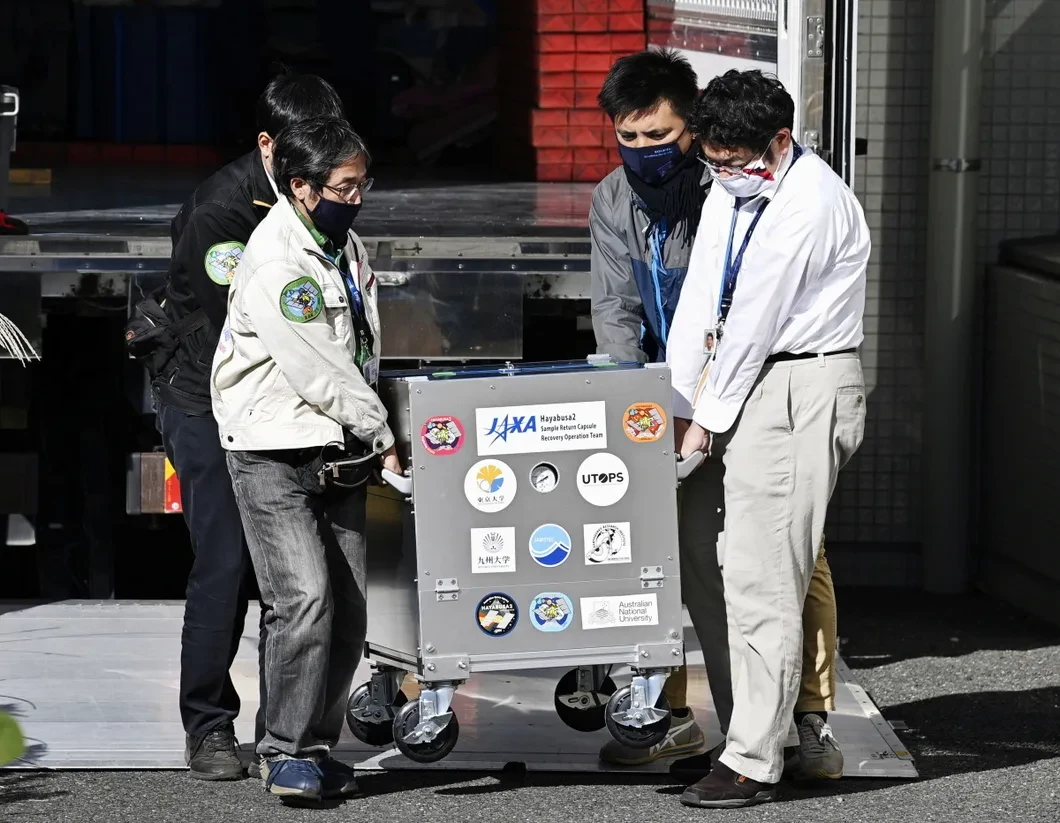
At the Tokyo Handa Airport at dawn on December 8, a small business jet arrived from Australia, from which an impressive metal box was unloaded with considerable precautions. Under the protection of the police, he was placed in a special car and a few hours later he was taken to the headquarters of the Japanese Aerospace Research Agency (Jax), where researchers with homemade posters enthusiastically met the cargo.
“We are waiting for you, the treasures of the dragon!”, “Thank you, Falcon!” - It was hastily written on them with crooked hieroglyphs.
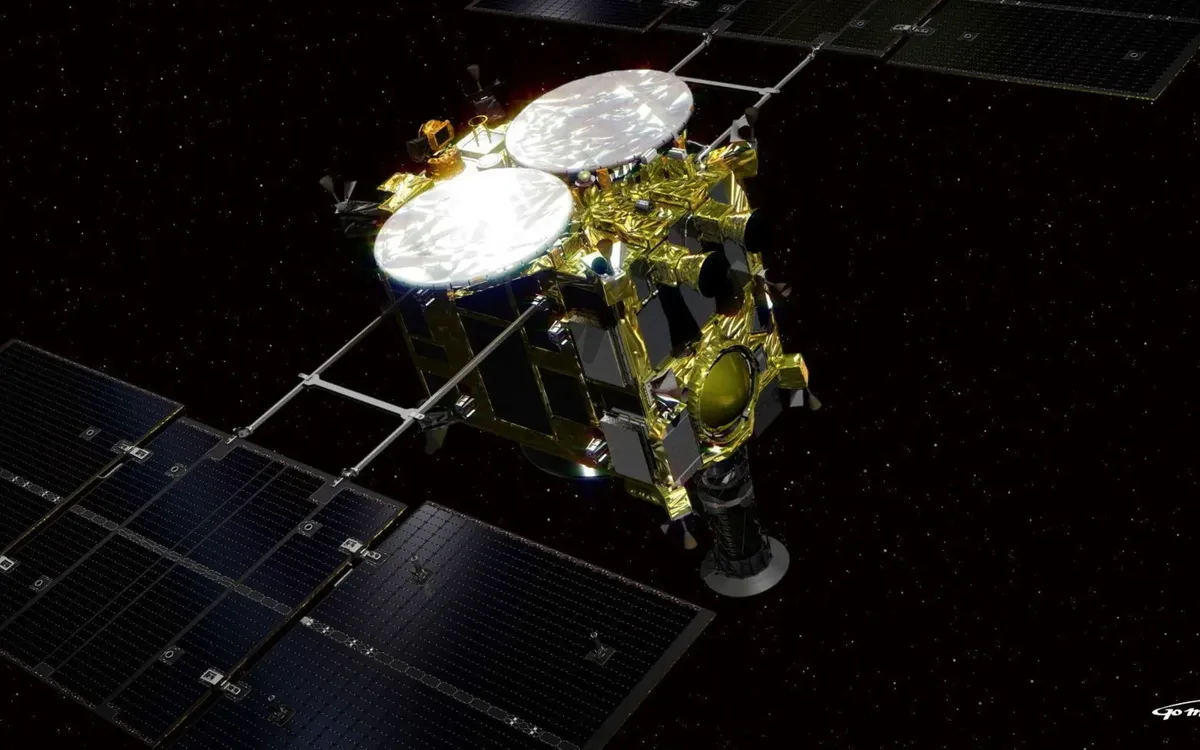
Thus ended the first stage of the dizzying operation, which demanded six years of hard work and an incredible space travel with a length of 5.2 billion kilometers. The “intermediate” point was placed in this story on the night of December 5 to 6, when a heavy capsule with a diameter of 40 centimeters landed in a closed military training ground in the desert in the South of Australia. In it were the Hayabus-2 (Sokol-2), which was collected by the Japanese space probe samples from a distant asteroid, the study of which, as they hope in Tokyo, can shed light, including the secrets of life on Earth.
In the footsteps of a fabulous fisherman
The operation began in December 2014, when a heavy launch vehicle launched from the Japanese cosmodrome on the island of Tangasim, which sent Sokola-2. The goal is a small cosmic body located at a distance of 300 million kilometers from the ground. This asteroid with a diameter of only 900 meters in Tokyo was named “Ryugu” (“Dragon Palace”) in honor of the popular Japanese fairy tale about the journey of a young fisherman who landed to the mysterious lord of the depths, but managed to return home. And he brought with him a casket with a gift from the underwater residence. Thus, the organizers of the expedition hinted that the Japanese apparatus could get something valuable during their space epic.
Hayabus-2 arrived in the summer of 2018 and temporarily turned into an artificial asteroid satellite to carefully study its surface and choose a place for landing. The situation turned out to be much more complicated than it saw from the ground: Ryugu was densely covered with uneven sharp stones, the site had to be sought for a long time. For this
For the first time in the history of astronautics, small self -propelled robots were dropped on asteroid, which transmitted detailed information about its relief.
Finally, in February 2019, Sokol-2 landed and collected soil samples from the Ryugu surface. He repeated the success of his predecessor, the first “Falcon”, which in 2005 managed to take samples from the surface of another asteroid and delivered them to Earth in 2010. Scientists then first received soil samples from the celestial body in addition to the moon.
From the gun to the "Palace of the Dragon"
But the Falcon-2 faced an even more difficult task: to get samples from the deeper layers of asteroid, which, according to scientists, were generally in an untouched state from the time of the formation of our solar system about 4.6 billion years ago.
It was an operation in the dashing style of Jules Verne: “Sokol-2” separated the gun from itself, which approached the asteroid and shot at it with a copper projectile weighing 2.5 kg.
He created a crater on the surface like those that arise from a meteorite strike. I had to solve many more puzzles, but in July 2019 the device made a second landing and took the soil samples from the bowels of Ryugu.
At the same time, the Hayabus-2 computer solved many tasks itself, since the radio signal from the Earth at a distance of 300 million kilometers has been going on for too long. But everything passed, as they say now in Tokyo, "by 10 thousand percent successfully."
Having made a return trip, Sokol-2 from a height of 220 thousand km from the ground separated the cassette with precious samples of extraterrestrial soil on December 5, 2020. The flight of this tiny object, stretched for 12 hours, was accurately oriented to the site at the Vumer military training ground in Australia, where, by the way, in the 50-60s of the last century, Britain conducted a series of nuclear tests.
To the new asteroid
The capsule flashed through the atmosphere of our planet, withstanding heating over three thousand degrees. At an altitude of 10 thousand meters, she opened the parachute and turned on the radio beacon. According to his signals, the Japanese search mission aimed at a helicopter accompanied by a drone to the landing area easily found the capsule. The search engines immediately handed the photographs of the cassette to the Central Administrative District, which lay peacefully on the reddish land of the desert, clinging to a parachute behind a low bush.
Now the capsule was delivered to the Jax headquarters: it will be opened in a special room in a full vacuum so as not to influence the samples and catch gaseous discharge. The study of the rocks itself will begin only after six months of various preparatory work: Japanese scientists are most interested in the presence of organic compounds and traces of water in the soil of the asteroid. They believe that life in the universe could spread the wreckage of small celestial bodies such as Ryugu. The study of the Sokola-2 production, as experts hope, will help to verify such assumptions.
By the way, scientists intend to completely isolate the possible organic substances from the asteroid from the earth's atmosphere - after all, in a fairy tale, the fisherman fell into trouble when he violated his promise and frivolously discovered the magic box received in the dragon palace.
Well, the probe itself went on a new journey: it is in excellent technical form and so far has spent no more than half of his fuel. Now the device must make the path to the new tiny asteroid with the registration name 1998ky26, which, like Ryugu, is located between the orbits of the Earth and Mars. To this celestial body, only 10 meters of Sokol-2 should fly up in July 2031 with diameter. What will the space monastery will do after that, has not yet been decided, but they will no longer return to Earth.