
Translated material
Is burning Siberia the norm?
In July 2019, there were twice as much fires than usual.
Fires in Siberia excited Russian society and world media: the smoke from fires threatens the Arctic, and the US president offered assistance in extinguishing them. In Russia, a discussion flared up whether it is necessary to extinguish fires, or they are the norm for the forests.
TJ looked how often the eastern part of the country burns.
An annual problem
The Siberian Federal District is in second place in Russia in the area of forests after the Far Eastern Federal District and on the first forest in the territory (hereinafter, the data before the transfer of Buryatia and the Trans -Baikal Territory to the Far Eastern Federal District). But usually Siberia is called not only the federal district, but the entire territory beyond the Urals. It is characterized by an uneven distribution of settlements - people live mainly in the south. Over the past week of July 2019, the most fires were observed north of Lake Baikal, Irkutsk and Krasnoyarsk.
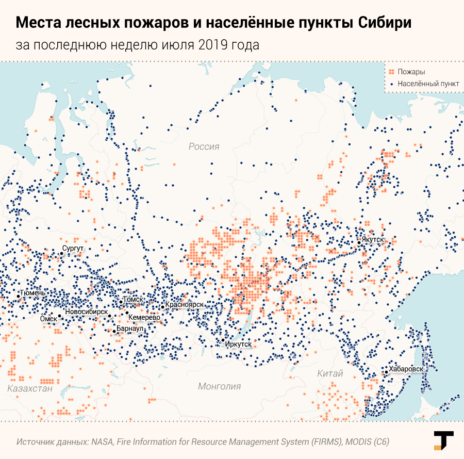
In the first seven months of 2019, the largest fire area was recorded in Yakutia, the Krasnoyarsk Territory and the Irkutsk Region. In all three regions, this indicator is higher than a year earlier. In the Irkutsk region, it grew four times.
In total, since the beginning of 2019, the Square of Forest Fires was 6.3 million hectares in the FFF and the Far Eastern Federal District - according to preliminary data, this is almost twice as much as the fire for the whole of 2018 in the country. According to satellites, the number of fires of fires in July 2019 exceeded the average annual values of the 21st century.
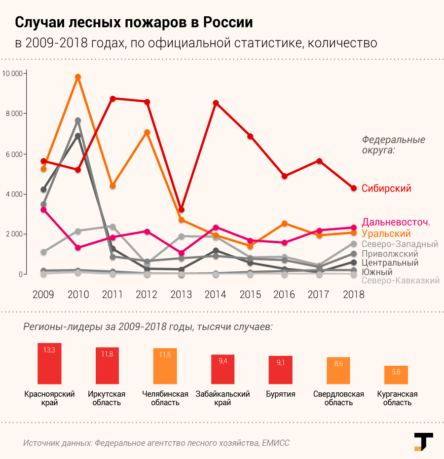
In the number of cases of forest fires, the Krasnoyarsk Territory and the Irkutsk region are traditionally ahead. Over the past 10 years, only once the Siberian Federal District did not take first place - in 2010. Then the densely populated European part of Russia burned more.
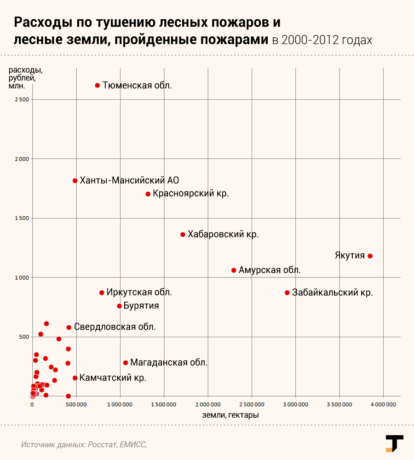
Yakutia takes the championship by hectares. At the beginning of the 21st century, in this republic, the fire absorbed the largest area of the forest, but in terms of expenses to extinguish Yakutia, there was not all ahead. This is understandable by the small density of the population.
Among the causes of fires in 2019 are called dry weather and the human factor. Prime Minister Dmitry Medvedev instructed to figure out whether the forest set fire to hide the illegal cutting down. Ecologists are the alarm that fires are destroying the forest. Since the beginning of the 21st century, its number in Siberia has significantly decreased. According to Greenpis, the Square of Wild Forests in Russia declined by more than 18 million hectares. In Siberia, the forest in 80% of cases dies due to fires. At the same time, 1% and less from the entire forest of the country die from the fire annually.
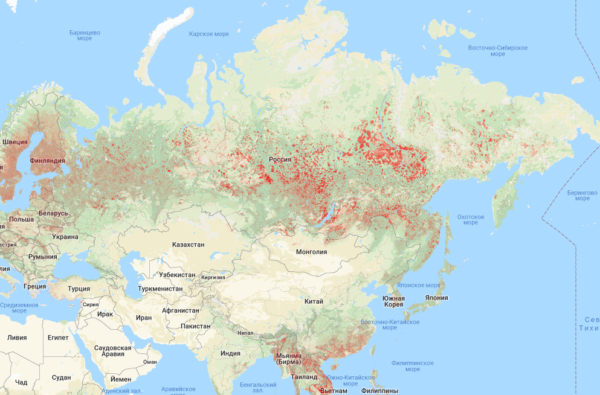
The Rosstat data say that from 2000 to 2012, 477 million cubic meters of forest burned in Russia, and since 1992 - 722 million. Most burned in the Khabarovsk Territory. In 1998 alone, 125 million cubic meters (about 2 million hectares) were killed in it. The damage then caused to the health of the residents of the region, the UN estimated at $ 31 million.
As in the past, one of the main dangers is represented by smoke that covered about 600 settlements of Russia - not only for residents of neighboring cities, but also for the Arctic and America. Fires are also associated with the approach of global warming.
You can not extinguish
The fact of a fire does not mean that it must be stewed. By law, local authorities, within the framework of a special commission, can evaluate how threatening the fire to settlements and the forest fund. There are control zones where fires do not extinguish. Usually these are hard -to -reach territories without the population. Now about 90% of fires are taking place in these zones. If the fire is far from people, and more money will be spent on its elimination than the loss of wood will damage the economy, then the extinguishing may be stopped or not to start.
One of the main reproaches in the current situation is associated with this rule. The authorities are suspected of unwillingness to extinguish the fire when it was not so large -scale, and the delimitation of too large control zones. In general, in Russia, about 70% of forest fires are liquidated annually within a day after detection. In the regions where the fiery element is now raging, the forest, on the contrary, is left to burn out.
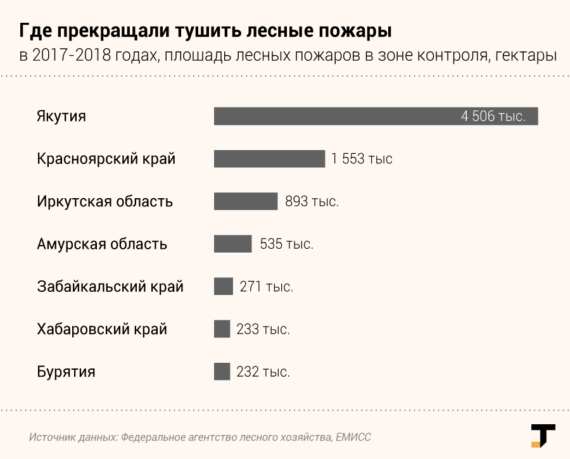
The phrases about the lack of money and economic disadvantage are also related to this rule. Formally, local authorities and the Ministry of Emergencies are right: there really is no money to extinguish all fires. Based on the official assessment, it was calculated that the extinguishing of all Siberian fires for July would cost 1.8 trillion rubles - this is 10% of the Russian budget.
In connection with social significance and interest abroad, Siberian fires also became a political problem. The federal authorities paid great attention to them, the Ministry of Defense joined the extinguishing. The State Duma offers to revise the law on forest fires and control zones. Abundant rains should help the fight against cataclysm, but they are not predicted in the next week.
#prashed #shocking