
Translated material
Pressed or not?
In the Kremlin
 Pressed or not?
June 3, 2011 Alexey Sidorenko
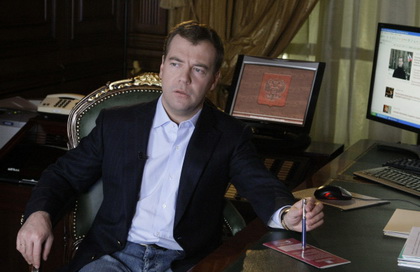
The instructions of Dmitry Medvedev published today by the Ministry of Communications, made after a meeting with bloggers in April this year , cause enthusiasm. 5 out of 6 instructions are unambiguously progressive for the Russian segment of the World Wide Web and will be useful to Russia and its citizens. In particular, it is worth noting instructions regarding free licenses and providing access to audiovisual materials.
The problem with the instructions is that they are extremely extensive and only outlines areas without giving any solutions. "Prepare sentences." "Conduct a discussion." Etc. In fact, all responsibility for these decisions lies with the Ministry of Communications, and the instructions themselves hardly talk about any political decisions, rather outline the areas of activity of the ministry. So there are all reasons with increased attention to how (and in whose interests) these instructions will be fulfilled.
Order No. 3, binding by Minister Schegolev until the first of August, is like this: “To prepare proposals for amendments to the legislation of the Russian Federation on the media establishing the limits of liability of the media distributed on the Internet for the placement of readers and expressions of third parties that violate the legislation of the Russian Federation, including the combination of extremist activity.”
This decision was perceived by some as a new collision with freedom of speech on the network. This is not entirely true. If we consider this issue wide, then, rather, this is the next maneuver on the principle of "pick everything up - to give part." An example is electoral legislation. (First introduced dragon demands on parties, and then gave cosmetic links.)
In general, where did this order No. 3 come from? And here we are returning to the question of the liability of portals for comments.
The very question of the liability of the editorial offices for the comments of third parties (and in general the entire “extremist” discourse), from the point of view of the Universal Declaration of Human Rights (and even the Russian Constitution), is absurd, because Freedom of speech is freedom of speech with all the ensuing consequences. Yes, of course, in such complex countries as Russia, one has to go to some compromises, but by “Russian complexity” - as an argument, especially in the field of civil rights - they are unambiguously abused.
Another absurd aspect of the question of responsibility for comments on third parties is the very formulation of the question. Even “boy logic” (a primitive, but common set of natural legal norms in Russia, backwardness and harm to the society of which is a separate topic) implies “that the kid is responsible for words”. Notice, not a fence on which the kid demonstrated his vocabulary, but the author. From a rational point of view, no one except the author of the commentary can be responsible for his comments.
A year ago, the Plenum of the Supreme Court issued (it is surprising that the Russian courts still make decisions in the interests of citizens) is precisely such a decision (quotes on feed ):
“And Nternet-Smi will not be responsible for the comments of readers and should not subject these comments to censorship before publication .”
[...]
“ If the supervisor considers that any comment is violating the law, it can apply to the Internet media with a request to delete or edit this comment. Responsibility for the media can only occur if the comment remains unchanged and the media cannot prove that claims to it are unfounded. As previously reported, only Roskomnadzor will be monitored by compliance with the law on Internet media forums . ”
Those. In indirect form, the responsibility for the network media remained, it just turned out to be veiled by the “Rules of one Day”, according to which network editions are obliged to change or delete a comment within one day after receiving a message from Roskomnadzor. Later, the procedure for sending appeals to the Internet media was published on the website of Roskomnadzor. Read more about this story here .
Now back to April 2011. The question of deeply vicious practice “Rules of one day” at a meeting with Medvedev was raised by Mikhail Kotov (“Gazeta.ru”) and Demyan Kudryavtsev (Kommersant Publishing House). Mikhail Kotov turned to the president:
“We have some problem, which is that now modern network media cannot be presented without commenting readers. For our part, we approach this case quite responsibly and try to prevent the statements that violate our legislation. On the other hand, not always and not everyone likes what we can have a comment on. Or, for example, we take, say, from the Living Journal: Oleg Kashin spoke about ... In general, you probably know this story. And this comment appeared with us. We cannot but inform our reader that this loud story received some continuation. Law enforcement practice shows that we act here as co -consumers. ”
Medvedev replied to this:
"It's clear. Colleagues, it seems to me that this can certainly be corrected. [...] I still think that this is, in principle, a real problem, which is quite possible to make a decision. One could think, Igor Olegovich. Anyway, you will probably prepare some instructions with the administration. I am ready, this is already such a subtle sphere, to talk with our colleagues, so that they may look at practice. ”
By the way, as it turned out during this meeting, the decision of the Plenum of the Armed Forces was agreed with the ministries (only the Ministry of Culture and the Ministry of Communications were named, but, obviously, it was not without those ministries that were simply not accepted about in Russia), which in itself clearly illustrates the declarative “independence” of the judicial system.
Order No. 3 and appeared as a result of April promises of Medvedev to bloggers. At least, judging by the tone of conversations with bloggers, it clearly does not lead to a “increase in the degree of responsibility”, but rather, on the contrary, it will correct the initially unnatural and non -liberal practice.
The reason for concern, however, remains that the order No. 3 was given to the Ministry of Communications, and it was the Ministry of Communications and was the structure that raised the issue of the responsibility of the network media for readers' comments.
The formulation of the order itself leaves enough space for various interpretations. Medvedev is trying to keep his promises, shifting real decisions to his subordinates. One can hope that Minister Schegolev will help Medvedev in fulfilling these promises, but there is no confidence in this.
Photos of RIA Novosti