
Translated material
European damper
What awaits Gazprom in the Old World
European damper. At a recent meeting in Kirishas, Prime Minister Vladimir Putin struck the head of Gazprom Alexei Miller for disrupting export supplies of gas to Europe during the peak loads of January-Marot. In the most frosts, nine countries did not receive Russian gas: a decrease in supplies reached 30%. What awaits Gazprom in the Old World - the newspaper, the deputy chairman of the Board of Gazprom, found out the export failures of the last months with two reasons: the weather (the winter was too long and cold) and the machinations of Ukraine, which arbitrarily taken gas from the pipe intended for Europeans, found out. In turn, Naftogaz Ukraine claims that since the beginning of 2012 he has not taken a single cubic meter of gas from transit volumes.
The logic of the collision Executive Director of East European Gas Analysis Mikhail Korchekin agrees that the problem is not in Ukraine, but in Gazprom itself. According to him, 157 million cubic meters of gas per day that Ukraine selected in January-February is normal for the winter. Ukraine took about the same volume a year and two ago, and two ago, which did not prevent Gazprom from fulfilling its contract obligations in Europe.
And at a meeting in Kirishah, the Minister of Energy Sergey Shmatko spoke very critically about Gazprom, who is considered a protege of Deputy Prime Minister Igor Sechin: he scolded the monopoly for not developing the Russian gas storage system and tearing the gas pipeline repair schedule. In order to avoid the repetition of international gas scandals, the head of the Ministry of Energy demanded that his department have the right to more rigid control over the activities of the gas monopoly and proposed to tie Gazprom's top managers bonuses not to the average annual gas production and deliveries, but to peak. In Gazprom itself, the fact of harsh critics denies, arguing that "the discussion of the problems of the industry was of a working nature."
"
If a gas pipeline passes through Europe, it should be open for different suppliers of “blue fuel”. Gazprom wants only Russian gas to
"
Sticks in the pipes of the problem of Gazprom - not only in Ukraine, with much more serious he is faced in Europe. In mid -March, it became known that the European Commission obliged two gas pipelines that connect the Northern Stream to the European gas transmission system through the territory of Germany, to reserve half the capacities for supplies from other gas companies. As a result, through the "northern stream"
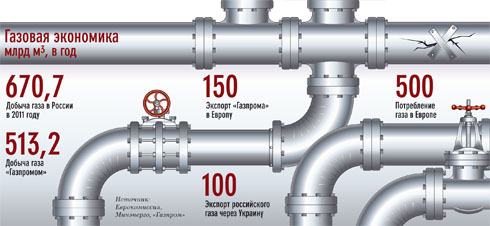
* * Its construction cost $ 8.8 billion, payback, according to Gazprom, - 15 years. Gazprom will be able to pump only half (27.5 billion cubic meters) of the volume that could. Through Ukraine (bypassing the Nord Stream laid), almost four times more are exported - about 100 billion cubic meters per year.
The European Commission limits the possibilities of Gazprom not because some other European companies apply for this pipeline: at the moment there are no applicants and it is not clear where they could come from. But these are the requirements of the so -called “third EU Energy Packet” (a set of six legislative acts adopted in 2009 and regulating relations in the energy sector of the Old World): if a gas pipeline passes through the continent, it should be open for different suppliers of “blue fuel”. Gazprom wants only Russian gas through his pipes.
At the same time, Gazprom did not believe that the restrictions on the “third package” could spread to it. But now they begin to directly affect the profitability of Gazprom investment projects, proudly not taking into account the nuances of European energy policy. So far, all the efforts of the Russian monopolist are aimed at loading only one thread of the Nord Stream, while this year the second is expected to launch. Where to get gas for her, to whom to supply and how to look at law -abiding Europe - these questions are still unanswered.
The fact is that if suddenly Europe really needs more Russian gas, Gazprom is able to deliver it there without the participation of the widely advertised Nord Stream and Southern Stream, says Mikhail Krutikhin’s partner. The current capacities of Russian gas pipelines already working for Europe (without both “flows”) amount to 196 billion cubic meters per year, and real deliveries are about 150 billion cubic meters. Arithmetic is simple: Russia is calmly and with a large margin is capable of delivering gas to Europe without spending billions of dollars on new gas pipelines.
“The only meaning of the construction of“ flows ”is purely political,” Krutikhin believes, “to kneel Ukraine as a transitor of our gas to Europe.”
Meanwhile, the European Commission regarding Gazprom is very consistent. Last fall, Gazprom and its large partners, such as E.on Ruhrgaz, RWE, OMV, conducted searches in the European “daughters”: EU controls suspected these structures of gas conspiracy about gas prices. Gazprom still faces a fine of 10% of the turnover for violation of the antimonopoly laws of the EU. If the violation of the provisions of the third energy packet is proved, Gazprom may lose their ownership or management to gas pipelines in Germany, Great Britain, Poland and Baltic. And the new pipes, including sections of the South Stream (its construction should begin at the end of 2012) in Bulgaria, Hungary and Slovenia, the monopoly will be able to control only from the sanction of the European Commission.
Meanwhile, Europe is launched by a large -scale project that even more limits the supply of Russian gas: the Italian ENI lobbyes the creation of an intra -European gas pipeline system, which will allow you to pump “blue fuel” from the western part of the continent (Scandinavia, the Netherlands), where it is in excess, to the eastern (Bulgaria, Slovakia, Slovenia). As the head of ENI Paolo Scaroni recently stated, if Europe took up this project earlier, the decrease in Gazprom supplies would not have frozen Europe in January-February. Such a project, of course, is necessary, although the combination of torn European gas pipelines is not cheap. It is curious that ENI, with the presentation of the former prime minister of Italy and Putin Putin Silvio Berlusconi, participates in the Gazprom project “South Stream” (a pipe along the bottom of the Black Sea), which, however, does not prevent the company with the apennin to reduce European dependence on Russian gas
* Read more - The New Times No. 10 of March 19, 2012.
The game for a decrease in March became known that the Russian monopolist reduced the contract price for gas for European companies by an average of 10% in 2012. The deputy chairman of Gazprom, Alexander Medvedev, said that "this was done at the request of European buyers." The Russian gas monopolist made concessions during negotiations with large European companies: French GDF Suez, German Wingas, Slovak SPP and Turkish Botas.
According to Gazprom, during 2011 the volumes of its gas supplies to Europe grew: compared with 2010, they increased from 138 billion cubic meters to 150 billion. At the same time, the total gas consumption in the region decreased by 8%.
After the March adjustment of the prices of Russian gas, it became known that in 2012 Gazprom plans to send 154 billion cubic meters of gas to Europe at an average price of $ 415 per thousand cubic meters. The average annual price last year amounted to $ 384 per thousand cubic meters, but oil prices are now, as you know, at the peak, and the cost of Gazprom's export is tied to them.
So European consumers Russian gas costs a solid penny. Say, now a spare one
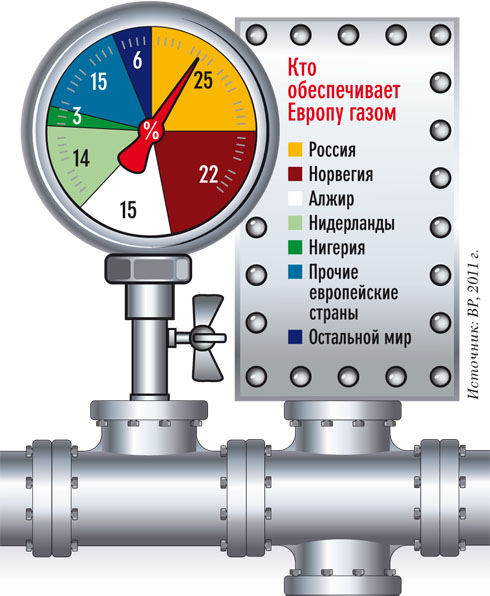
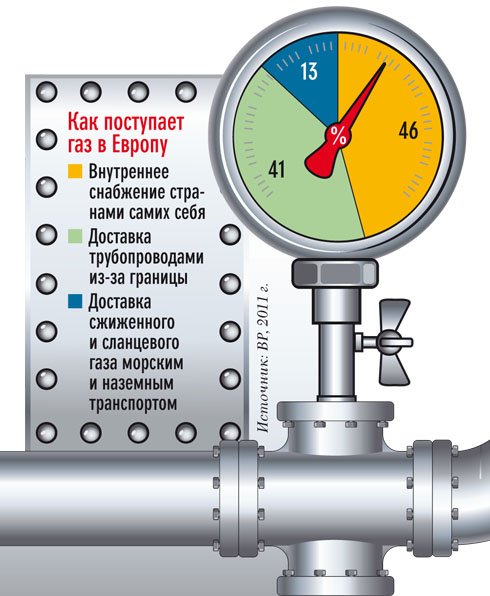
* The expense market for gas is designed for daily supply of small volumes. The price of gas in the Belgian Zebrugg - $ 290 per thousand cubic meters. It is no coincidence that the share of Gazprom in the total volume of gas supplies to Europe over the past three years has decreased from 27% to incomplete 25%. Recently, in the EU, in order to reduce dependence on Russian gas, they have been developing their own shale gas production projects, as well as fuel imports from other countries using liquefied natural gas technology (LNG).
Gazeta threatens Gazprom not only in Europe. According to the forecast of the International Energy Agency, the production of shale gas in the United States will greatly grow in the coming years (by 2015 - up to 268 billion cubic meters, or 37% of the total volume of gas consumed in the country). He seriously thinks about the development of shale deposits and China. Now there is no commercial production of shale gas in the Middle Kingdom at all, but by 2015, according to the plan for the national committee for development and reforms, it should reach 6.5 billion cubic meters per year, and by 2020 - 60–100 billion cubic meters. Own booty should reduce China's need for Russian gas, for which expensive pipelines have been built for Gazprom.
"
By building energy relations with Europe, in the upper echelons of the Russian authorities no longer bet on Gazprom. Probably, private gas companies will be more actively connected to the process
"
To take away and divide, meanwhile, the main Gazprom project - Shtokmanovskoye field
* It is considered one of the largest in the world, explored gas reserves - 3.7 trillion cubic meters. - Until now, is in a limited state. The government could not decide for a long time what tax and administrative benefits can be provided to it. And the shareholders of the joint venture, developing Shtokman (this, except for Gazprom, Statoil and Total), postpone the decision on investments until they receive guarantees from officials. On March 29, it became known that the shareholders reserved the opportunity to get out of the project after the design stage if the benefits are insufficient.
The problems of the monopoly are also related to the fact that Vladimir Putin has many friends who have interests in the gas industry. As a result, promising deposits have to be given to “Novateka” (it is controlled by Gennady Timchenko) and “ITER”. And the other day it became known that the “daughter” of the Gazprom Drilling monopoly was sold to the structures of Arkady Rotenberg at a price of 4 billion rubles - four times lower than the property contribution of Gazprom to the company for 2005-2010. This “daughter” performs 70% of exploration for Gazprom, the contract with it was signed three years in advance. It is no coincidence that there are once again rumors in the market that Gazprom will begin to be divided by removing gas pipelines from the monopoly, and giving out the extraction by independent gas producers.
It seems that, by building energy relations with Europe, in the upper echelons of the Russian authorities no longer bet on Gazprom, says Valery Nesterov, an analyst with the Threename Dialogue. Probably, private gas companies will be more actively connected to the process. Russian consumers will only benefit from this: the possible loss of part of the European market will force Gazprom to intensify their activities within the country - in particular, to quickly complete the Gasification program of the Russian regions, which is still calculated until 2020.