
Translated material
Giants | Colta.ru
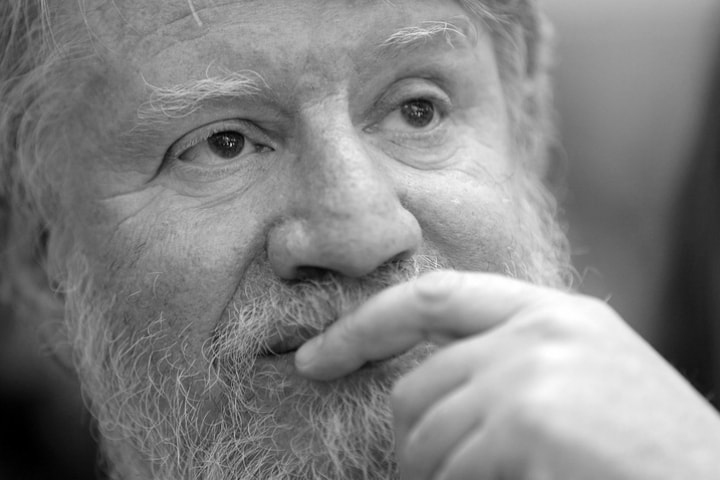
Today, April 7, the writer Vladimir Sharov would have turned 69 years old. The translator of his Romanov into French and his friend Paul Lecture recalls him.
In the literature, I prefer gnomes of giants. I am not saying that gnomes should not be taken into account; When there are many of them, they can even save the princess. But the advantage of giants lies in their ability to immediately take you far, and sometimes lend you your seven -mile boots.
However, not all giants are the same, you need to be able to distinguish real giants from imaginary. This is very easy: in the society of a real giant, you yourself quickly begin to feel like a giant.
Once I met a giant, and his name was Vladimir Alexandrovich Sharov.
This happened more than 25 years ago, in August 1994. At that time , the first stage of my life ended, and I all hesitated before moving to a new step, and decided to spend one month in Russia - in a country known for its heroes: Pushkin, Tolstoy, Shklovsky, Platonic ones.
One of my publishers, the famous Vladimir Dimitrievich, the founder of the L''GE D'Hamme publishing house, just opened a branch in Moscow with the name “Our House”, witting words with a similar sound. He gave me the address and name of the leader of the branch, a certain Tatyana Chugunova.
I had a difficult period in my life, and then the journey passed as in a dream. I settled in a house at a charming married couple: a translator from the French Olga Greenberg and the famous Japanist Viktor Sanovich. They both lived in the country with her seven -year -old son, but from time to time Olga came to Moscow, and we had long conversations, interspersing them with culinary experiments. It seems to me that she was glad to talk in French . We got along well. I went by train to them to the cottage - it was a real village in the middle of the forest a stone's throw from Abramtsev, in which little has changed since the 19th century.
I no longer remember what a happy incident brought me to such legendary personalities as the publisher and magnificent translator Mark Freudkin, who at that time worked on a collection of Brassens songs, and Marietta Chudakov, whose apartment seemed solely thanks to the walls of books folded in piles.
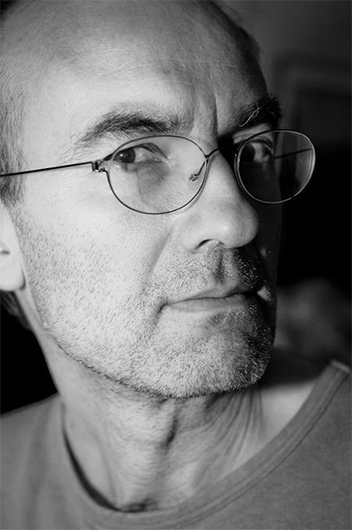 © Natanael Santana Reis Paul Leken
Now, looking back, I think that these meetings were only preparation for the main event.
I don’t remember exactly where Tatyana made an appointment for me. Most likely, it was in the premises of the "our house" on Tverskaya. However, who else could introduce me to Vladimir? Maybe Dimitrievich himself advised me to meet him. He must have been going to publish it in French and, perhaps, planned me as a translator.
The more I think about it, the more it seems to me that this first meeting occurred on the street. Someone told me: "You will see, he looks like a real Russian writer." But who said this? Tatiana? Dimitrievich? These words puzzled me, since I did not really understand what it means "to look like a real Russian writer." For example, my favorite Pushkin. Did he look like a real Russian writer? And Senkovsky? Shklovsky? Green? Olesha? Parsnip? I must admit that the great Russian writers have a curious habit of being Jews, Poles and even Ethiopians, if we talk about the first of them.
However, having seen Volodya for the first time, I realized what was meant: he really had a beard, like Dostoevsky’s, and a slanting fathom in his shoulders, like a Tolstoy (I mean not a lion, but Alexei Konstantinovich, who tied the poker with a knot and drove a nail into the wall without a hammer). But most of all, I was amazed not to catch the eye of “Russianness”, but by an ironic look, which is too quickly matured by a child. He was one of those people to whom you instantly experience confidence that you are ready to see at your table daily, about whom you immediately say: "This is my brother."
Among other things, this brother had an extraordinary voice, thick and deep, like a whisper that gradually grows, gains little power, turning into a confident, loud speech, repenting of unusual and at the same time truthful stories. At first it was difficult for me to understand it, and later it always took a little time to get used to and configure the ear to its special sound.
I do not remember very well what happened next. He invited me to visit his apartment in the Airport metro area. From there I returned to Olga and Victor with two numbers of the New World magazine, where his last novel “before and during” was published; They told me that this novel was caused by a real scandal on the pages of the magazine itself - a scandal, the cause of which I did not quite understand.
I set about reading the novel that same evening, and now I have a strange feeling, as if I had read it in one breath before the next day, although I understand that this is impossible. In addition, I clearly remember that at first everything in this book repelled me. Firstly , it was written in a single text, without breaking into chapters and paragraphs, the lines followed one after another, creating a feeling of suffocation. Secondly , a religious spirit was felt in the book, and religion was always unbearable to me, since it seems to me that religions were invented only to give people a convenient excuse to kill each other (in my opinion, this is the meaning of the history of Cain and Abel). Thirdly , the story from the very beginning seemed to refuse to go forward, wandered in the retreats, went astray, multiplied with new plots, reminding the Delta of the river. In general, it did not look like anything - I never met or read anything like it, except to recall "Don Quixote" or "manuscript found in Saragos." Precisely because it did not look like anything, I could not stop. I was carried away by the course of this river, and I no longer had any desire to get ashore.
Later, the expert of the National Center for the Book, where I applied to the scholarship to translate another novel by Vladimir - “Old Girl”, wrote in his review that the author of the text does not recognize the generally accepted rules of the composition. I think that the expert was absolutely right, but for this reason the book deserved to be supported, translated, published, distributed. From Volodya, it was necessary to follow the general rules, but the cathedrals were not built.
As I read, I saw how all these stories echo, they explain one another, forming the foundation on which the main storyline is gradually lifted - saturated, full, imbued with crazy reality.
Having finished reading “before and during”, I was not sure that I understood what I had read, and did not know what to think about it, but still I really wanted to once translate this book. In my head, her music was already in French. (But alas, I didn’t translate this novel, my friend made the translation, the magnificent Veronika Patt: when the time came to translate, I was busy.)
It seems that I was visiting Volodya when he explained to me what the scandal caused by his book was. This was mainly due to the image of the philosopher Fedorov. I must say that even after his explanation, I did not fully understand the essence of the conflict. I don’t remember what exactly we talked about, but most likely, it was about another book that I would like to translate first, namely, about the novel “Rehearsal”, published two or three years before in the journal Neva; I also remember, we talked about his disagreements with Dimitrievich’s publishing house about copyrights for publication abroad.
When I left, we met on the stairs of the poet Leo Ozerov, and this was another miracle that happened to me during the trip.
Returning to France, at the first opportunity I spoke with Dimitrievich about “rehearsals”, but he was only angry. “Vladimir Sharov ...” he grumbled, rushing rushing. - This man wants him to be paid as Nabokov, but Nabokov was waiting for many years before becoming Nabokov! ”
I didn’t understand very well what Nabokov has to do with it - perhaps the case is in the same names? Nevertheless, there was a great respect for the author in the editor's voice, although it was not even necessary to hope for the slightest concession on his part.
Meanwhile, “rehearsals” struck me. As Viktor Shklovsky said, the style can be determined from the second phrase. I was delighted with the style of the book. At first I read indecisively, because I did not understand where the author was driving. It seemed to me that the plot unfolds too slowly, although in fact the story developed gradually, the sound at first in a quiet whisper, then more louder and more powerful, gaining width and depth. As in the novel “before and during”, the main character comes from France, moreover, from the French province, from the distant Brittany, like myself. The hero, who appeared literally from the edge of the earth, became a brilliant author’s find, giving the book independence from himself. “Rehearsals” in the book naturally become “repetitions”, and the novel, as it were, begins to live his life, tell his own story; It is not just about the theater troupe from the Russian province, but about all of humanity, which always begins at first, without tired of returning to the same crime.
In general, it was a book that knew how to speak, and I adored her voice.
I met Michel Parfenov from Solin ; He also heard about the novel and his author and invited me to translate this book. I admit, I did not hesitate for a second, instead of fighting L''Ahe d'Homme , trying to convince them to the author and the translator with dignity, lay down the weapon and signed the contract with the Acte Sud-Solin .
I really liked to translate “rehearsals” and other novels - “Old Girl”, “Be like children”. During our conversations, Volodya told me how he writes: standing in front of a typewriter or wrapping circles around the room until the phrase completely folded in his head to transfer it to paper. These specific details helped me a lot, and I translated this way. And even used this method in his further work. I liked to translate these long phrases, look for a true word, discover a rare and at the same time familiar expression, give a voice to these books. And they began to sound very French , even a little in British .
At the time when I worked on “rehearsals”, my disposal was a small workplace in L'Esprit des péninsules ; Unfortunately, this publishing house is no longer; It was founded by my friend Eric Nollo, and he appointed me the head of the Russian section. The publishing house was Eric himself, the manager and his assistant Sandrin. They published extraordinary books. I translated most of the novel in the room of L'Esprit - in a mesonin without windows in one hangar near the square of the republic. Since I had the habit of translating aloud (constantly muttered something under my breath), Eric and Sandrin asked me to explain to them from time to time what made me laugh or outraged. Then I read whole excerpts to them: so in a military camp the soldiers sometimes read other people's love letters.
But Volodya came to Paris on the occasion of the book salon. We crossed the whole city from south to north. All the way we talked about this, but most of all - about our fathers. At the grate of the Tuilery Garden, Volodya told me the story of his father: during the war at night, he got lost in the minefield. My father also encountered war, but later: it was a war in Indochina, which he came to as a result of disagreements with his own father. And it was necessary to happen that then I again encountered my father’s figure in Volodya’s book; This figure demanded Slu, resurrected memories, destroyed and rebuilt history.
But I found an episode with a mine field in another novel, and it was then that I realized that all that he writes about, all these crazy and absurd characters who live on the pages of his books, the stories of love and hatred, crimes and good deeds - all this is absolutely pure truth.
I again met with Vladimir Dimitrievich some time after the publication of Rehearsals. Of course, he was unhappy, but it seems that he did not hold on to me angry for my betrayal. He asked how I was doing and whether I was satisfied with my work. I replied that I was happy, that I finally transfer living authors. He then looked at me sternly and said: "The great writers are all alive, I do not know a single dead." And for this only phrase, I think, a lot will say goodbye to him.